We’re exploring seven pneumatic air compressors worth keeping handy, from compact portable units to oil-free designs that cut maintenance. We’ll weigh high CFM at 90–120 PSI, sturdy aluminum manifolds, and leak-proof fittings, plus on-the-go options like 3–5 gallon tanks and IP-rated protections. With interchangeable hoses, extended nozzles, and reliable safety shutoffs, there’s a setup for every project—and we’ll show you which features matter most as you choose your next tool. Stay with us as we break it down.
Key Takeaways
- Durable aluminum air manifolds and leak-proof connections enable versatile, reliable distribution for multiple pneumatic tools.
- Portable tanks and onboard systems deliver high PSI and duty cycles for automotive, suspension, and field use.
- Flexible hoses and fittings (BSPT/PT/NPT) ensure secure, adaptable connections across various setups.
- Extendable blow guns provide reach and precision for hard-to-access cleaning and debris removal tasks.
- System pressure guidance and build quality considerations help maintain performance and longevity in different environments.
PATIKIL 5-Way Aluminum Air Manifold Splitter Block
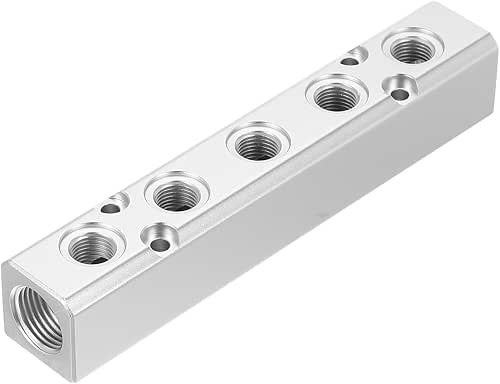

The PATIKIL 5-Way Aluminum Air Manifold Splitter Block stands out for its durable aluminum build and true 5-way, 7-port design, making it ideal when you need to distribute compressed air from a single source to multiple tools. We value its solid, thick aluminum construction, which resists deformation and wear, plus strong corrosion resistance. With leak-proof, sealed connections, installation stays straightforward and maintenance is minimal. We appreciate the 1/4″ BSPT ports and 1/2″ supply, enabling flexible setups for pumps, compressors, cylinders, and vacuum engines. Verify size before ordering, and enjoy a simple, reliable inline manifold solution.
Best For: This inline 5-way aluminum air manifold is ideal for professionals and hobbyists who need to distribute compressed air from a single source to multiple tools or actuators with a durable, corrosion-resistant block.
Pros:
- Durable aluminum construction resists deformation and wear
- True 5-way, 7-port design with leak-proof, sealed connections
- Flexible 1/4″ BSPT ports and 1/2″ supply for versatile setups
Cons:
- Verify port sizes before ordering to ensure compatibility
- 30-day returns may be subject to conditions
- Only supports up to 1 MPa (145 psi) and 0–60°C, limiting extreme environments
3 Gallon Air Tank with 200 PSI Compressor

This 3-gallon aluminum tank with a 200 PSI compressor stands out for quick on-site air supply, ideal for suspension setups or air horns where space is tight. We’re back with a compact, rugged onboard kit: CNRAQR’s 3-gallon tank, 12-volt compressor, and NPT 1/4 connections. It delivers up to 200 PSI, 1.76 CFM at zero PSI, and supports 100% duty at 100 PSI with 250 PSI intermittent. Built with anodized aluminum, IP67 protection, and thermal overload, it’s safe and durable. Includes fuse, filter valve, and extras for simple installation, making it a reliable, portable air source for cars, trucks, trains, and horns.
Best For: automotive enthusiasts and professionals needing a compact, high-flow onboard air source for suspension, air horns, or small- to mid-size air systems where space is limited.
Pros:
- Compact 3-gallon aluminum tank with a 12V 200 PSI compressor for on-site reliability.
- High flow: 1.76 CFM @ 0 PSI and support for 100% duty at 100 PSI with 250 PSI intermittent.
- Durable, IP67-rated protection with thermal overload safeguard and anodized aluminum construction.
Cons:
- May be overkill for small DIY projects that don’t require high-pressure capability.
- 23-amp draw could demand a robust electrical setup and wiring considerations.
- Includes only basic accessories; additional fittings or hoses might be needed for full integration into existing systems.
Rubber Air Hose 30ft, 300 PSI, BSP Brass Fittings
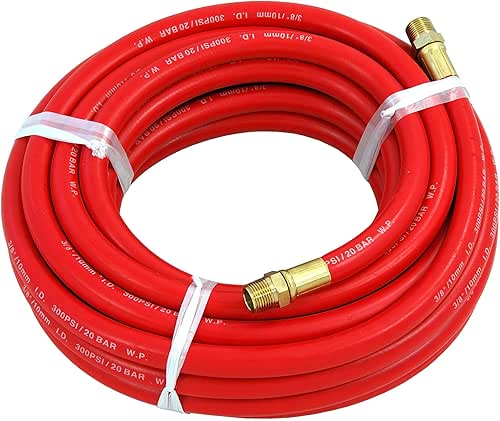
Looking for a flexible, durable hose that keeps up with any air tool? We’re talking about the Neilsen CT0002-3/8in x 30ft Rubber Air Hose. This 30-foot, red rubber hose handles up to 300 PSI with BSP brass fittings for secure, leak-free connections. Its 0.38-inch outside diameter and 0.375-inch wall thickness balance pliability with strength, making it easy to maneuver around shops, garages, and job sites. Designed for general compressor tasks, it bursts at 900 PSI, well above normal use. Includes one hose; 30-day Amazon returns apply. With a 4.4/5 rating from 41 reviews, it’s a solid choice.
Best For: This hose is best for DIYers and tinkerers needing a durable, flexible 30-foot air hose for garage, workshop, or job-site tasks with reliable 300 PSI operation.
Pros:
- High burst pressure (900 PSI) provides a generous safety margin for typical air tools.
- Flexible rubber construction and 0.38-inch outer diameter offer good maneuverability in tight spaces.
- BSP brass fittings ensure secure, leak-free connections and durable wear.
Cons:
- 30 ft length may be cumbersome in very small spaces or require longer-than-desired reach for some tasks.
- Rubber hoses can kink or wear over time with heavy use or coiling; may require careful handling.
- Only one hose included per unit; additional hoses or accessories would need separate purchase.
Tuxing 4500Psi PCP Air Compressor with Power
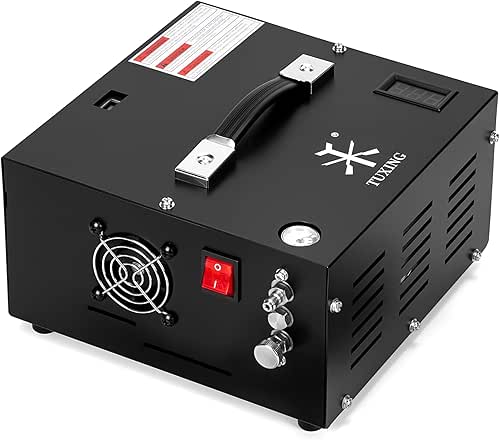
If you need portable, high-pressure charging on the go, the Tuxing 4500Psi PCP Air Compressor stands out with dual power options. We value oil-free, water-free operation for PCP rifles, pistols, paintball, and HPA tanks. This compact unit delivers up to 4500psi (30MPa) with a 250W brushless motor, filling 0→300bar in about 20 minutes and 200→300bar in ~8 minutes. It runs on 12V car power or 110/220V AC, with included separators and a repair kit. Weighing 7 kg, it’s portable, easy to set up, and compatible with standard outlets and car batteries for field or range use. Warranty and support accompany the package.
Best For: Portable PCP enthusiasts who need on-the-go high-pressure charging from either a vehicle or home power source.
Pros:
- Oil-free, water-free operation simplifies maintenance and reduces contamination risk.
- Dual power options (12V car or 110/220V AC) enhance field and home versatility.
- Lightweight (7 kg) and compact with included separators and repair kit for quick setup.
Cons:
- Charging 0→300 bar takes about 20 minutes, which may be slower for high-volume fills.
- Maximum capacity is recommended for cylinders ≤ 1L, limiting larger tanks.
- 0.5 m hose length may require closer proximity to power source or accessories.
PATIKIL 2-Way Air Manifold, 5-Port 1/4″ Aluminum
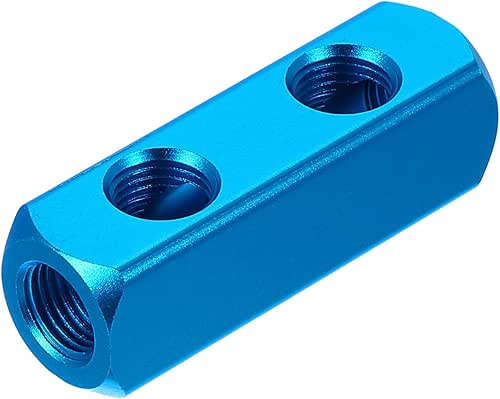
The PATIKIL 2-Way Air Manifold is ideal for keeping a compact, leak-proof air distribution setup on hand, thanks to its solid aluminum build and 1/4″ PT ports. We’ll use it to split a single supply into multiple, tight, reliable outputs, ideal for small shops or portable rigs. This 5-port block handles up to 145 PSI with durable corrosion and wear resistance, maintaining solid seals through use. Installation is straightforward, with PT 1/4 connections matching typical hoses and fittings. At 6.5 x 2 cm and light, it’s easy to position, monitor, and maintain for consistent airflow across devices.
Best For: Individuals or small workshops needing a compact, leak-proof 5-port air distribution block for 1/4″ PT hoses and fittings.
Pros:
- Solid aluminum construction offers durability and corrosion resistance.
- Compact 6.5 x 2 cm footprint fits tight spaces and portable setups.
- Leak-proof seals with multiple sealed connections and standard PT 1/4 ports.
Cons:
- Maximum pressure limited to 145 PSI (1 MPa), may not suit higher-pressure systems.
- Only 1/4″ PT ports; not suitable for larger hoses or fittings without adapters.
- 2-way, 5-port design may be insufficient for more complex multi-tool setups.
12V Digital Tyre Inflator with Gauge for Cars, Bikes, Balls
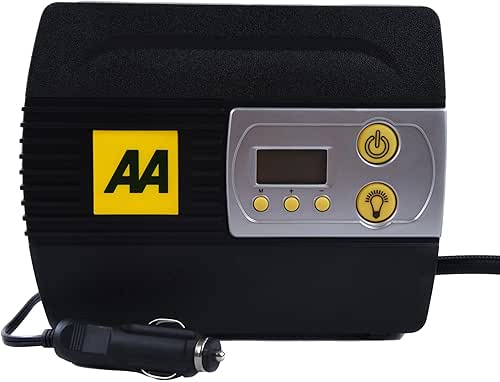
Meet the AA5502 12V Digital Tyre Inflator, a compact, cordless-style pump that keeps cars, bikes, and balls properly inflated with a precise digital gauge. We’re looking at a portable car air compressor with a digital display that measures PSI, BAR, and KPA. It inflates quickly and offers pre-set pressures with automatic shut-off, plus three LED lamp settings for visibility. Adaptors cover other inflatables, and a 3m cigarette lighter cord keeps us flexible. Built by AA Car Essentials, it weighs about 789 g and uses 12 volts. It’s economical by maintaining correct tyre pressures and supports reliable on-the-go topping up.
Best For: drivers who need a portable, easy-to-use 12V inflator with a digital gauge to quickly top up tires on the go and inflate other inflatables.
Pros:
- Digital gauge with PSI, BAR, and KPA readings for precise inflation
- Pre-set pressure with automatic shut-off for convenience and safety
- 3m cigarette lighter cord and multiple adaptors for versatility
Cons:
- Uses a 12V car power source, which may limit use to vehicles with a lighter socket
- Battery type listed as Lithium Metal may raise replacement considerations
- Relies on car battery power; performance may vary on very low tire pressures or long continuous use
Industrial Air Blow Gun with Extendable Stainless Nozzle
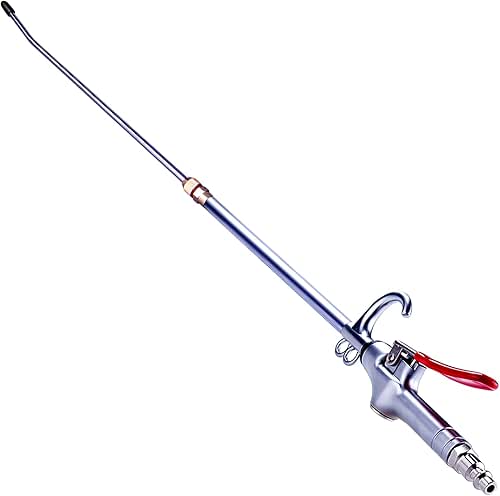
Our pick shines for reach and control with an extendable stainless steel nozzle that covers tight spots from 14 to 21 inches. We’re reviewing the High Volume Powerful Industrial Air Blow Gun, model JABG-01C by JASTIND. Built with all-metal construction and a stainless steel nozzle, it delivers up to 17.7 CFM at 80–110 psi. Its extended edition reaches 26 inches total, easing access to confined areas. Use it for dust, water, or debris removal, industrial or home use. Remember not to disassemble to avoid leaks. Compatible with 1/4 in fittings, it’s backed by standard Amazon return options. Noise stays around 71 dB.
Best For: those who need extended reach and precise control for cleaning tight, hard-to-reach areas in both industrial and home settings.
Pros:
- Extended stainless steel nozzle providing 14–21 inches reach for hard-to-access spots.
- All-metal construction with high-pressure resistance for durable performance at 80–110 psi.
- Moderate noise level (~71 dB) and compatible 1/4 in fittings for easy setup.
Cons:
- Requires an air compressor and proper 1/4 inch female coupling; may be overkill for simple household tasks.
- Extension and disassembly caution to avoid leaks; not user-serviceable beyond standard use.
- Weight (~0.22 kg) and length (26 inches extended) may feel bulky for very small workspace or handheld tasks.
Factors to Consider When Choosing Pneumatic Air Compressors
We look at how pressure range, tank size, and port compatibility shape what you can do with a compressor. We’ll weigh power options, portability, and weight so you can pick a model that fits your tasks. Let’s consider these factors together to guide a clear, practical choice.
Pressure Range Considerations
When choosing a pneumatic compressor, the pressure range you pick should align with your system’s required operating pressure and its maximum duty pressure. We look for a unit rated to meet the steady needs, such as a system running 100–200 PSI in on-board or portable setups, while still handling peak bursts up to 250–300 PSI when needed. Continuous operating pressure defines the reliable ceiling we design around, guiding component selection and duty cycles. We also consider maximum pressure ratings to understand safety margins, ensuring hoses and fittings won’t fail during surges. Multi-stage or multi-pressure designs offer flexibility, delivering full duty at one level and higher output under partial throttle for demanding tools. Portable or on-vehicle setups require inlet/outlet compatibility and appropriate fittings to maintain target pressure at the point of use.
Tank Capacity Relevance
Tank capacity matters because it determines how much stored air is available between cycles, shaping your tool run time and refill intervals. We look at how a larger tank translates to longer bursts for intermittent tools, though it adds weight and occupies space. A higher capacity can reduce how often the pump cycles, potentially extending motor life and minimizing voltage fluctuations. For continuous heavy use, we should match the tank size to your tool’s air demand in CFM at the operating pressure. Remember, capacity isn’t a stand‑alone metric; it must be balanced with the compressor’s PSI max and CFM. Oversizing or undersizing the tank relative to performance risks wasted energy or insufficient flow, so pick a size that aligns with intended tasks and duty cycles.
Port Compatibility Check
Port compatibility matters at a glance: do the ports, fittings, and threads line up across the compressor and accessories so air can flow without leaks or adapters? We verify port types and sizes on the compressor and accessories, such as BSPT 1/4 or PT 1/4 threads, to ensure direct compatibility. We check inlet and outlet port counts and whether multiple ports meet our distribution needs. We confirm hose fittings and coupling standards (e.g., NPT 1/4, PT 1/4) are consistent across components to prevent leaks. We ensure the manifold or hose’s maximum working pressure matches or exceeds the compressor’s operating pressure (up to 200 PSI or 145 PSI in examples). We assess material and thread durability (aluminum, brass, or steel) to maintain seal integrity under load.
Power Source Options
Power source options substantially shape how you use a pneumatic compressor, blending portability with practicality. We weigh 12V DC from a vehicle battery against AC mains (110/220V) with an optional converter, since each path changes where and how you operate. Oil-free designs cut maintenance but bring distinct filter and cooling needs compared to oil-lubricated models. Portable units often incorporate dual power or integrated 12V, ideal for field work, while stationary models rely on standard AC for continuous operation. For high-pressure needs—up to 4500 psi for PCP systems—you’ll want power arrangements that deliver sustained current and a suitable duty cycle. Safety features like thermal protection, automatic shut-off, and electrical protection (IP ratings) guide the right source for reliable performance.
Portability And Weight
When we look at portability and weight, the goal is to balance ease of transport with practical run time. Lighter units around 7 kg offer greater portability for field work and easy site-to-site moves. A smaller footprint, such as compact housings under 20 cm in length, enhances bench-top setups and mobile use. Versatility comes from 12V DC or portable AC/12V dual-power options, letting us run on vehicles or mains power as needed. Integrated handles, slim profiles, and included compact hoses reduce bulk and improve maneuverability. For longer operation between fills without sacrificing portability, higher-density tanks like 3-gallon/12-liter models are ideal. In short, choose a unit that trims weight and bulk while boosting sustained performance.
Durability And Material
Durability and material choices define how long a pneumatic compressor lasts under real-world use. We look for solid construction that resists corrosion, wear, and contamination. Aluminum manifolds, like PATIKIL models, offer leak-proof performance with corrosion and wear resistance from repeated connections. Heavy-duty rubber hoses rated to 300 PSI, such as Neilsen CT0002, deliver high burst resistance (900 PSI) and bendability for tight spaces. Tools with oil-free, stainless steel housings, such as PCP air compressors, cut maintenance needs and resist contamination that erodes longevity. Extended metal nozzles and robust fittings (BSPT 1/4 or PT) bolster structural integrity and sealing under high pressure. Protective housings with IP67 safeguard electronics in dusty or wet environments, enhancing overall system longevity.
Frequently Asked Questions
How Loud Are These Pneumatic Compressors During Operation?
These compressors run fairly loud, but we mitigate it with mufflers and housings; we hear a steady buzz around 70–90 dB in typical garage use, and we recommend hearing protection for prolonged sessions with dense noise.
Do These Models Require a Dedicated Circuit or Power Outlet?
These models almost scream “need power!”—yes, they typically require a dedicated circuit or outlet. We strongly suggest checking the product’s amperage rating and your shop’s wiring to prevent trips, overheating, or performance drops in busy sessions.
What Maintenance Is Needed for Long-Term Reliability?
We perform regular oil checks, drain moisture daily, swap filters per schedule, inspect hoses for wear, tighten fittings, and test safety valves monthly to ensure long-term reliability and safe operation for your compressor setup.
Can They Run Continuously Without Overheating or Shutting Down?
Yes, they can run continuously, but we pace them like a careful river: steady, cooling, and protected. We monitor temps, use proper sizing, and avoid overtaxing duty cycles, so we prevent heat waves and unexpected shutdowns.
Are Replacement Parts Readily Available and Affordable?
Replacement parts are generally readily available and affordable, especially for popular models; we’ll shop around, compare prices, and stock common spares so you’re never left waiting.
Conclusion
We understand these seven pneumatic powerhouses can turn any project from “meh” to mind-blowingly swift. With portable tanks, tough aluminum manifolds, and leak-proof fittings, you’ll wonder how you ever DIYed without them. When you need speed, precision, and reliability—these compressors deliver like a freight train on turboMode. Choose one, or combine a few, and your toolbox will practically roar to life. Get ready to crush tasks you didn’t think possible. Your future self will thank you endlessly.