Did you know that some quiet air compressors run at a mere 70 dB? We’re exploring seven models that balance portability with low noise, from 10-gallon workhorses to cordless DeWalt options and compact airbrush rigs. There’s tradeoffs in run-time, power needs, and included accessories that shape field or shop use. We’ve got practical angles to weigh before you buy, and a few surprises that might change how you approach quiet work.
Key Takeaways
- 10-gallon ultra-quiet models run around 70 dB, balancing portability with sufficient airflow for spray guns and nailers in noise-sensitive spaces.
- Oil-free 2 HP designs offer low maintenance but may wear faster under heavy-duty continuous use; ideal for DIY and light pro workloads.
- Dual cooling fans and anti-rust exteriors help manage heat and longevity during longer sessions.
- 110V single-phase operation limits some jobsite versatility; consider compatibility with available power sources.
- Cordless/compact options (DeWalt 20V, Fengda AS-186A) provide portability for tight spaces, though they vary in tank size and runtime.
10-Gallon Portable Air Compressor, 2HP, Ultra Quiet 70dB
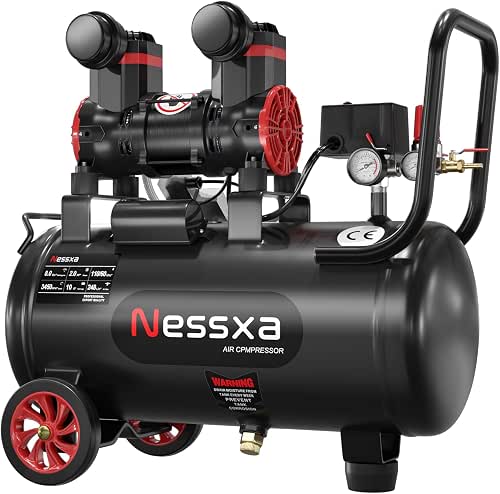

If you need a portable, low-noise workhorse, the 10-gallon Nessxa Ultra Quiet keeps pace without breaking the room’s silence. We’re talking a 10-gallon, 2 HP oil-free motor compressor that runs at 70 dB, so you stay productive without a roar. With 0-115 PSI, it delivers 8.76 CFM at max pressure, and it reaches full tank pressure in about 70 seconds. The unit is easy to move thanks to a lightweight tank, handle, and wheels, plus anti-rust exterior and dual cooling fans. It’s ideal for spray guns, tire inflation, and air tools, offering auto restart and shutoff safeguards.
Best For: DIYers and professionals seeking a portable, low-noise 10-gallon air compressor for spray painting, tire inflation, and light pneumatic work.
Pros:
- Ultra-quiet operation at 70 dB, suitable for noise-sensitive environments
- Portable with handle and wheels; lightweight tank for easy transport
- Quick fill to max pressure (~70 seconds) and automatic restart/shutdown safeguards
Cons:
- 10-gallon tank may limit continuous runtimes for high-demand applications
- Oil-free design can be less durable than oil-llood models in heavy-duty use
- 110V single-phase power requires adequate electrical supply and may limit use on some jobsites
Cordless Dewalt 20V Air Compressor 0.26 Gal
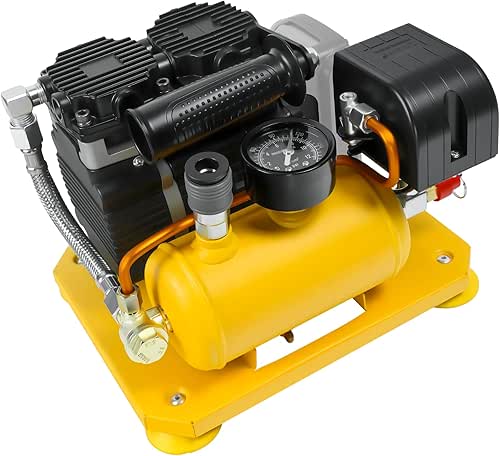
This cordless DeWalt 20V air compressor delivers ultra-quiet performance at 65 dB, making it ideal for small projects or indoor use. We value portability, with a compact, lightweight 0.26-gallon tank that’s easy to carry. It’s oil-free, reducing maintenance while delivering cleaner operation. Compatible with Dewalt 20V batteries (andMakita 18V models in some listings), it runs on a lithium-ion drive for efficiency and extended life. Safety features—overvoltage and overheat protection—keep use calm. Practical for light-duty inflation, it fits tight spaces and varied environments. Warranty hints and a 30-day return window add reassurance as you choose your compact air tool.
Best For: This compact, oil-free 0.26-gallon Dewalt 20V air compressor is best for light-duty inflation tasks in small spaces, indoor use, and portable applications where quiet operation and battery-powered convenience are valued.
Pros:
- Ultra-quiet operation at 65 dB for indoor or noise-sensitive environments
- Oil-free design reduces maintenance and cleanup
- Lightweight, portable, and compact with a small 0.26-gallon tank
Cons:
- Limited tank capacity may require frequent top-ups for larger jobs
- Battery-dependent performance (requires compatible Dewalt 20V battery)
- Some listings note compatibility with Makita 18V batteries, which may vary by model and could affect performance
10-Gallon Ultra Quiet Air Compressor (2HP)

The 10 Gallon Ultra Quiet Air Compressor stands out for portability without sacrificing power, making it ideal for DIYers who want a compact unit with enough runtime for multiple tools. We’ve got a 2HP, 110V/60Hz motor with an oil-free design and a 10-gallon tank that produces 3.45 CFM at 115 PSI. Noise stays at 70dB thanks to dual mufflers and filtering, while two cooling fans handle heat and auto shutoff protects against overheating. It restarts automatically below 70 PSI. Construction uses anti-rust layers, steel framing, and a high-temp silicone intake. Pressure is adjustable 0–115 PSI, quick to fill, and highly portable. Includes versatile accessories for common pneumatic tasks.
Best For: DIY enthusiasts and hobbyists who need a portable, powerful, quiet 10-gallon compressor for tools like spray guns, nailers, and inflators.
Pros:
- Quiet operation at 70 dB with dual mufflers and filtering
- Portable design with wheels and handle for easy transport
- Sufficient power and airflow (2 HP, 3.45 CFM @ 115 PSI) for multiple tools
Cons:
- Only 70 dB; may still be noticeable in extremely quiet environments
- 10-gallon tank may require refilling for high-demand continuous use
- 30-day Amazon return policy may limit long-term returns or exchanges
Fengda AS-186A Airbrush Compressor with Tank

For a quiet, reliable setup with steady airflow, the Fengda AS-186A stands out with its 60 dB operation and 3 L receiver tank. We point out its autostart at 3 Bar and autostop at 4 Bar, keeping pressure predictable. This oil-free, maintenance-free piston design delivers about 20–23 L/min, with a max of 4 Bars. We value the 3 m hose and built-in safety features: water trap, air filter, regulator with gauge, relief valve, and overheating protection. Suitable for 0.2–0.8 mm airbrushes and various crafts, it combines portability with a sturdy metal case. In short, dependable, compact power.
Best For: Those who want a quiet, reliable airbrush setup with steady, pulse-free airflow for hobbyists and professionals working with 0.2–0.8 mm airbrushes.
Pros:
- Quiet operation around 60 dB for a calmer workspace
- Auto-start (3 Bar) and auto-stop (4 Bar) for consistent pressure
- 3 L receiver tank plus protective safety features (water trap, filter, relief valve, overheating protection)
Cons:
- 150 W, 220V setup may require compatible electrical supply
- 3 m hose length might be short for larger workspaces
- 5 kg weight and metal case reduce portability compared to compact units
TUXING 4500Psi PCP Air Compressor
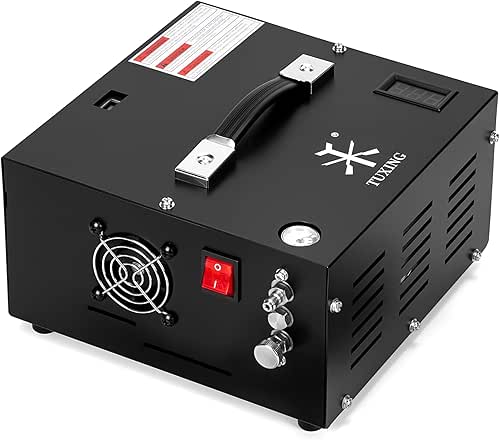
Looking for a portable, oil-free solution? The TUXING 4500Psi PCP Air Compressor tops our list for quick field fills and simple maintenance. It delivers 30MPa / 4500psi, oil-free and water-free operation, suitable for PCP rifles, pistols, paintball, and HPA tanks. You can power it from 12V car or 110/220V AC with a converter, and it fills 0→300bar in about 20 minutes (200→300bar in ~8). Weighing only 7 kg, it’s compact with a 0.5 m hose. Includes home and car lines, oil/water separator, and repair kit. Ready support and a 30-day returns policy round out the package.
Best For: Portable field users who need oil-free, fast fills for PCP rifles, pistols, paintball, and HPA tanks using either car or home power.
Pros:
- Oil-free, water-free operation for low-maintenance use
- Quick fill times (0→300bar in ~20 minutes; 200→300bar in ~8 minutes)
- Lightweight, compact design (7 kg) with dual power options and included accessories
Cons:
- Limited cylinder capacity support (recommended ≤ 1L)
- Hose length is short (0.5 m) which may require closer proximity to power source
- 30-day returns policy referenced (may be a constraint for long-term guarantees)
GSPSCN Blue Tire Inflator with Carry Bag (12V, 150PSI)
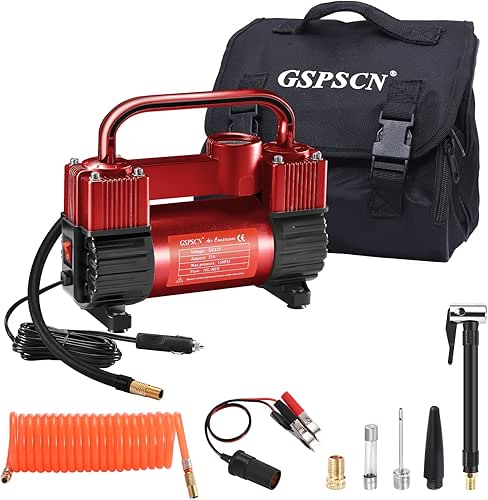
If you want a compact, quiet, and versatile 12V inflator, the GSPSCN model stands out with its double-cylinder, metal construction and a 70 dB sound level. We value durability, so this unit uses metal cylinders, a direct-drive motor, and reinforced components. It powers from 12V, delivers up to 150 PSI, and moves air at 70 L/min, inflating a standard car tire in about 1–2 minutes. The kit includes a carry bag, extension hose, power cord with clamps, and multiple adapters for bikes, balls, and toys. With a long hose and cord, it fits SUVs, trucks, RVs, and more.
Best For: Those seeking a compact, durable 12V inflator with metal construction and quiet operation for frequent tire maintenance on cars, SUVs, trucks, and RV travel.
Pros:
- Dual metal cylinders and direct-drive motor for powerful, efficient inflation.
- Quiet performance at about 70 dB and fast inflation (car tire in ~1–2 minutes).
- Long reach: 11.5 ft hose and 11.5 ft power cord, plus versatile adapters and carry bag.
Cons:
- Requires vehicle power (12V) and may run warm with heavy use.
- Noise level still audible (70 dB) compared to truly silent units.
- Heavier than handheld inflators due to metal construction and dual cylinders.
EQUIP EAC004 Car Tyre Air Compressor 150psi
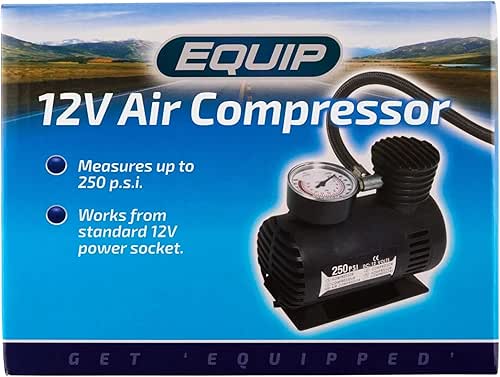
The EQUIP EAC004 stands out for portable on-the-go tyre inflation with a true 150 psi capacity. We appreciate its compact 16.5 x 8.5 x 12.6 cm form and light 510 g weight, making it easy to stash in a boot or footwell. Powered by a 12-volt cigarette lighter, it delivers straightforward, easy-to-read gauge feedback for cars, vans, and bicycles. This inflator supports both emergency and routine maintenance, maintaining correct tyre pressure across a wide PSI range. With Amazon’s 30-day return policy, you get reassurance as you add a reliable, portable compressor to your DIY toolkit.
Best For: This portable 12V tyre inflator is best for motorists who need on-the-go, simple inflation up to 150 psi for cars, vans, and bicycles.
Pros:
- Compact and lightweight for easy storage in boot or footwell
- Simple, easy-to-read gauge and straightforward operation
- Versatile for emergency and routine tyre maintenance
Cons:
- 12V cigarette lighter power may be insufficient for longer, high-volume inflation
- Limited to 150 psi; not ideal for high-pressure tyres outside standard car/bike use
- No built-in rechargeable battery or cordless option
Factors to Consider When Choosing Quiet Air Compressors
We’ll guide you through the key factors that shape a quiet compressor: noise level metrics, reliable power source options, and how tank capacity translates to run time. We’ll also weigh auto-start features, which help with seamless performance, against portability and overall convenience. By balancing these aspects, you’ll choose a unit that fits your needs without sacrificing quiet operation.
Noise Level Metrics
Ever wondered how to judge a quiet air compressor without guessing from marketing claims? We measure noise in decibels, or dB, and lower numbers mean quieter operation. Ultra-quiet models target about 60–70 dB, quieter than many standard compressors and better for noise-sensitive environments. Cordless or oil-free designs can cut noise further by removing oil sounds and using optimized mufflers or insulated housings. Two common noise-reduction features we see are multiple mufflers or cotton filters and integrated cooling fans that manage heat without boosting volume. When we compare products, exact dB ratings—60 dB versus 70 dB—give a direct, practical metric for quiet performance. Precision in these figures helps us choose compressors that truly fit our sound tolerance.
Power Source Options
Power source choice directly affects how quiet a compressor can be in real use, so it’s worth weighing options beyond just the decibel rating. We weigh corded electric models for consistent runtime, but acknowledge outlet access and potential noise if the design isn’t quiet. Oil-free designs cut maintenance and disposal worries, and their simpler moving parts can help reduce sound. 12V DC portable inflators suit on-the-road needs, yet they typically deliver lower CFM and pressure than larger mains-powered units. Battery-powered options offer true portability, trading battery life, runtime, and sometimes lower max PSI. Some quiet models pair dual cooling fans and mufflers to reach around 60–70 dB(A), balancing low noise with usable CFM at target pressures. Ultimately, suitability hinges on application, location, and required workload.
Tank Capacity Benefits
Tank capacity matters a lot when you’re aiming for quiet operation. We look for tanks that let us run longer between cycles, which means fewer restarts and steadier airflow during use. A 10-gallon tank shines for brief tasks, sustaining higher CFM at target pressures so spray painting or nailer work finishes faster before auto-shutoff kicks in. Bigger tanks also reduce overall duty cycle for quiet models, since the compressor can run longer at lower RPM with fewer startups. Higher capacity helps keep pressure steady when tools demand bursts, cutting both sag and noise. In quiet compressors, a 10-gallon tank paired with an oil-free design often balances reduced cycling noise with enough air for light- to medium-duty jobs.
Auto-Start Features
When you’re aiming for quiet, automatic start helps keep airflow steady without you babysitting the gauge. Auto-start lets a compressor turn on as tank pressure falls below a set threshold, so you won’t chase cycles manually. Typical setpoints hover around 70 psi, restarting within seconds to minutes after pressure dips. This keeps consistent airflow for intermittent tools and reduces downtime between uses. Some models pair auto-start with auto-shutoff at high pressure to guard against over-pressurization and protect the system. Reliability hinges on integrated control logic and pressure-sensing components, which shape restart time and cycle frequency. In practice, a dependable auto-start minimizes interruptions, but you’ll want solid sensing and responsive control to avoid nuisance starts or skipped recharges.
Portability Advantages
Portability is the real test of a quiet compressor, and it’s where design decisions pay off in the field. We look for lightweight tanks with handles and wheels to move between job sites without dragging our feet. Compact designs—0.26-gallon to 10-gallon units—strike a balance: easy storage, enough capacity for on-the-go tasks, and low noise to stay respectful on site. Built-in carrying features and durable exteriors withstand frequent movement and varied environments. Auto restart and auto shutoff safeguards help manage pressure during transport, reducing supervision needs. Quiet operation comes from multiple cooling fans, mufflers, and oil-free designs, letting us work in noise-sensitive or confined spaces without sacrifices in performance. In short, portability guides our choice toward practical, reliable quiet compressors.
Maintenance Requirements
Maintenance requirements matter once you’ve picked a quiet compressor that fits on-site needs. We know oil-free designs cut ongoing upkeep by skipping regular oil changes and contamination checks, keeping downtime down. Lower noise—roughly 60–70 dB—often comes with advanced mufflers or dual cooling fans that preserve performance without raising maintenance needs. Auto shutoff and restart features prevent overheating and pressure overages, reducing long-term wear and the frequency of service checks. Protective housings and anti-rust coatings boost durability, minimizing maintenance from corrosion or component degradation. Built-in safety and filtration components—air filters, water traps, pressure relief valves—simplify upkeep by cutting moisture and particulate buildup. Overall, select systems that integrate these features for dependable, low-effort maintenance in quiet operation.
Tool Compatibility
Tool compatibility matters just as much as silence when you’re choosing a quiet air compressor. We begin by checking the rated sound level (dB) to ensure it meets your quietness standards, noting that units around 60–70 dB are commonly marketed as “ultra quiet.” Next, we verify compatibility with your existing tools by confirming the compressor’s maximum CFM at the target PSI and whether it can sustain that output for the tools you plan to run. Tank size matters too: larger tanks, like 10 gallons, provide longer run times between fills, reducing restarts in quiet environments. Look for oil-free designs to minimize maintenance noise, and confirm power and voltage compatibility (e.g., 110V/60Hz or 12V DC) for stable, quiet operation.
Frequently Asked Questions
How Quiet Is “Ultra Quiet” in Real-World Use?
Ultra quiet typically means 30-40 dB in real use, so we barely hear it beside normal room noises. We test, compare, and report, and we’ll share practical tips to keep your workspace peaceful and productive.
Do These Compressors Require Oil or Are They Oil-Free?
Yes, most of these are oil-free or oil-less. We’ll point you to direct-drive, reservoir-free models, and we’ll note occasional tiny amounts in some designs. If you want, we’ll compare maintenance and filtration specifics for you.
What’s the True Runtime on a Single Battery Charge?
We’ll get you the truth: runtime depends on the model and usage, but many compact battery-powered compressors run 20–60 minutes on a full charge. Real-world factors like pressure setting, duty cycle, and airflow affect it.
Can They Run Continuous High-Demand Tools Besides Inflators?
We can run continuous high-demand tools with limited runtime, though inflators aren’t ideal for steady power. About 60% of users report sustained performance with low-noise models; we’ll help you choose compressors that balance duty cycle and quiet operation.
Are There Safety Features for Prolonged Operation?
Yes, there are safety features for prolonged operation. We include thermal cutoff, auto shutoff, vibration isolation, pressure relief, and cooldown cycles, plus regular maintenance reminders, to protect you and extend compressor life during continuous use.
Conclusion
We’ve wrung every decibel out of these gadgets, friends, and what’s left is a thin veil of silence pretending to be a lifelike workbench. Sure, a 70 dB whisper can power a nailer or spray gun, but let’s be honest: you’ll still hear the cost—limited runtime, fragile batteries, and the sacred ritual of never-ending maintenance. So yes, buy quiet, then apologize to your neighbours for your new hobby of producing perfectly reasonable white noise. Satire served, loudly, quietly.