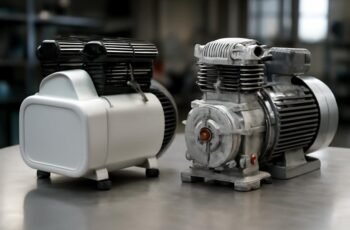
When selecting an air dryer for your operation, understanding the fundamental differences between desiccant and refrigerated systems is essential. Both technologies serve to control moisture, but their mechanisms, efficiencies, and suitability for specific applications vary significantly. Evaluating these factors requires careful analysis of your process requirements, operating costs, and maintenance considerations. To make an informed decision, it’s crucial to examine the advantages and limitations of each type in detail—an exploration that can greatly impact your long-term performance and costs.
Key Takeaways
- Desiccant dryers provide ultra-dry air with dew points as low as -40°C, ideal for sensitive applications.
- Refrigerated dryers are more cost-effective for general moisture control at moderate dew points.
- Desiccant dryers have higher operational costs due to consumables and regeneration; refrigerated units consume less energy.
- Refrigerated dryers are suitable for continuous operation with minimal maintenance, while desiccant dryers require regular media replacement.
- Choice depends on application criticality, moisture level requirements, and long-term operational cost considerations.
What Are Desiccant and Refrigerated Air Dryer Technologies?
How do desiccant and refrigerated air dryer technologies differ in their approach to removing moisture from compressed air? Desiccant dryers use a sorbent material to adsorb moisture, functioning like a sponge absorbing water vapor, which is unrelated to the refrigeration cycle. Refrigerated dryers, on the other hand, cool compressed air below its dew point, causing moisture to condense into liquid that’s then separated. This process is similar to how air conditioning systems remove humidity from indoor air. While refrigerated dryers are energy-efficient for moderate dew points, desiccant dryers excel in low dew point applications, such as in aerospace or pharmaceutical industries. Understanding these distinctions is crucial, much like recognizing a random concept’s relevance in unrelated topics, to select the appropriate technology for specific needs.
How Do Desiccant and Refrigerated Dryers Remove Moisture Differently?
What sets desiccant and refrigerated dryers apart in their moisture removal processes is the fundamental mechanism each employs. Desiccant dryers use a chemical or physical adsorption process, where desiccant materials like silica gel or activated alumina attract and hold moisture from compressed air. This method allows for near-zero dew points, making them ideal for ultra-dry applications. Refrigerated dryers, on the other hand, rely on cooling the compressed air below its dew point, causing moisture to condense into liquid that is subsequently drained away. From a concept viability perspective, desiccant dryers excel in environments demanding extremely dry air, while refrigerated units are more cost-effective for general applications. Market trends indicate a growing preference for energy-efficient solutions, influencing the technological evolution of both types.
Key Advantages of Desiccant Air Dryers for Your Business
Why do many industries prefer desiccant air dryers for their critical applications? The primary advantage lies in their ability to achieve ultra-dry air, essential for sensitive processes. Desiccant dryers excel in environments requiring dew points as low as -40°C, ensuring moisture is effectively removed. Their reliance on desiccant regeneration enables continuous operation with minimal downtime, maintaining consistent dry airflow. Peer-reviewed studies support their superior performance in moisture control, particularly in applications where contaminants can compromise product integrity or equipment longevity. Additionally, desiccant dryers adapt well to fluctuating demand and variable inlet conditions, providing precise moisture removal. This combination of reliability, low dew points, and proven efficiency makes them indispensable for industries with stringent moisture specifications.
Why Choose Refrigerated Air Dryers for Cost-Effective Moisture Control?
Refrigerated air dryers have gained popularity among businesses seeking an effective yet economical solution for moisture removal. Their cost-effectiveness stems from utilizing standard refrigeration cycles, which are well-understood and reliable, making them suitable for continuous operation. Unlike some irrelevant topics or unused concepts like desiccant regeneration, refrigerated dryers operate with minimal maintenance, reducing operational costs over time. They efficiently condense moisture from compressed air at moderate dew points, making them ideal for general industrial applications. This balance of performance and affordability makes refrigerated dryers a logical choice for companies prioritizing budget-conscious moisture control. While not suitable for extremely low dew point needs, their efficiency in typical conditions underscores their value in cost-sensitive environments.
Limitations and Best Use Cases for Desiccant Dryers
Are desiccant dryers the optimal choice for all compressed air applications? Not necessarily. Their limitations stem from higher operational costs and maintenance requirements, making them less suitable for less critical needs. They excel in applications demanding extremely dry air, such as pharmaceuticals or electronics manufacturing, but may be an irrelevant topic for general industrial uses. Consider this comparison:
| Use Case | Best Fit |
|---|---|
| Cost-sensitive, low moisture requirements | Refrigerated dryers |
| Critical, high-purity applications | Desiccant dryers |
| Infrequent, low-demand environments | Alternative moisture control methods |
Understanding these limitations helps avoid extraneous considerations that might lead to inefficient choices, ensuring desiccant dryers are deployed where their benefits outweigh drawbacks.
Limitations and Ideal Applications for Refrigerated Dryers
Refrigerated dryers are effective within specific temperature ranges but become less reliable when ambient conditions exceed their limits. They pose risks of higher dew points, especially in high-humidity environments, which can compromise compressed air quality. Consequently, they are best suited for small-scale systems where temperature stability and dew point requirements are moderate.
Temperature Sensitivity Limits
How do temperature fluctuations impact the performance of refrigerated air dryers? Variations in ambient temperature can drastically affect their efficiency, leading to increased dew point levels and potential moisture carryover. Cooler intake air enhances the refrigerated cycle’s ability to condense moisture effectively, but higher temperatures reduce cooling capacity, risking desiccant safety if moisture isn’t fully removed. Additionally, temperature spikes can escalate refrigerated noise levels, signaling strain on components. Since these dryers rely on precise temperature control, excessive fluctuations limit their ideal application environments, especially where stable temperatures aren’t guaranteed. This sensitivity underscores the importance of maintaining consistent ambient conditions to ensure optimal performance, prevent moisture-related issues, and avoid unnecessary maintenance costs associated with compressor or refrigerant system failures.
High Dew Point Risks
Refrigerated air dryers are efficient at removing moisture under ideal conditions, but their capacity to achieve very low dew points is inherently limited. High dew point risks become significant when moisture levels exceed the dryer’s design capacity, leading to potential downstream equipment corrosion or product degradation. Relying on irrelevant comparison or unrelated metrics, such as temperature alone, can be misleading, as moisture removal efficiency depends on dew point control rather than temperature reduction. These dryers are best suited for applications with moderate moisture levels, where dew points above freezing are acceptable. In environments requiring ultra-low dew points, their limitations become evident. Understanding these constraints helps prevent underperformance and ensures proper dryer selection, avoiding the false sense of security that can come from comparing unrelated metrics without considering actual moisture content.
Suitable for Small Systems
While refrigerated air dryers are effective for many applications, their suitability for small systems hinges on specific operational constraints and moisture removal capacity. For small-scale operations, these dryers often provide a cost-effective solution due to their lower initial investment and potential discount pricing options. However, their limited capacity might pose challenges in high-demand scenarios or environments requiring very low dew points. Additionally, their reliance on consistent power supplies and susceptibility to ambient temperature fluctuations can impact performance, especially when supply chain disruptions affect component availability. Small systems with modest moisture control needs generally benefit from refrigerated dryers’ simplicity and efficiency, but for critical applications, understanding these limitations ensures optimal system selection and avoids operational inefficiencies or moisture-related issues.
Comparing Operating Costs and Maintenance Needs of Both Dryer Types
When comparing operating costs, we focus on the energy consumption differences between desiccant and refrigerated dryers, as this substantially impacts long-term expenses. Maintenance frequency and associated costs also vary, influencing overall operational efficiency and downtime. Analyzing these factors helps determine which dryer type offers the most cost-effective solution over its service life.
Energy Consumption Differences
How do the energy consumption profiles of desiccant and refrigerated air dryers compare in terms of operating costs and maintenance requirements? Desiccant dryers generally consume more energy due to continuous desiccant regeneration, which involves high-temperature heating cycles, increasing operational costs. In contrast, refrigerated dryers operate more efficiently, utilizing a refrigeration cycle that consumes less power. However, refrigerant leakage can impact energy efficiency over time, requiring repairs and refills that add to maintenance costs. Desiccant systems demand regular monitoring of regeneration cycles to optimize energy use, while refrigerated units typically have lower ongoing energy needs but are susceptible to compressor inefficiencies. Overall, refrigerated dryers tend to have lower energy consumption, but both systems require careful management of their respective components to control operational expenses.
Maintenance Frequency and Costs
Maintenance requirements and associated costs notably influence the overall operational efficiency of desiccant and refrigerated air dryers. Desiccant dryers demand regular replacement of desiccant media and routine regeneration cycles, increasing maintenance frequency and ongoing expenses. Refrigerated dryers, by contrast, generally require less frequent maintenance, mainly involving filter replacements and coil cleaning. The costs associated with desiccant media can be substantial over time, making maintenance a significant factor in total operating expenses. Conversely, the unrelated concept of irrelevant topic highlights that maintenance schedules for refrigerated dryers are more predictable and less resource-intensive. These differences directly impact operational costs, with desiccant dryers typically incurring higher maintenance expenses due to their more complex media handling. Therefore, understanding these maintenance nuances is crucial for optimizing long-term dryer performance.
Long-Term Operational Expenses
Considering long-term operational expenses, the cost dynamics of desiccant and refrigerated air dryers differ substantially due to their distinct maintenance and energy consumption profiles. Desiccant dryers typically incur higher ongoing costs because of regular desiccant replacement and regeneration, which can be resource-intensive. Conversely, refrigerated dryers generally consume more electricity but require less frequent maintenance, making energy consumption a more relevant topic than the irrelevant topic of unrelated concepts. Over time, these factors influence total ownership costs, with desiccant systems potentially costing more due to consumable parts, while refrigerated systems may have higher energy bills. Proper evaluation of these expenses is essential for choosing the most cost-effective solution aligned with operational demands, rather than focusing on unrelated concept comparisons that don’t impact long-term economy.
Which Dryer Is Better for Sensitive or Critical Air Quality Needs?
When selecting a dryer for sensitive or critical air quality applications, it’s essential to evaluate the specific purity requirements and potential contaminants. Desiccant dryers excel in removing moisture to very low dew points, ideal for high-purity needs, but they require careful management of desiccant regeneration to prevent moisture breakthrough. Refrigerated dryers, however, have limitations in achieving ultra-dry conditions and may risk refrigerant leakage, which can compromise air quality. Consider the following factors:
| Aspect | Desiccant Dryer | Refrigerated Dryer |
|---|---|---|
| Purity Level | Very high (low dew point) | Moderate (higher dew point) |
|
| Maintenance & Reliability | Desiccant regeneration needed | Potential refrigerant leaks |
|---|---|---|
| Cost & Energy | Higher operational costs | Lower costs, less energy use |
Choosing depends on the criticality of air purity and system integrity.
Making the Right Choice: Factors to Consider When Selecting an Air Dryer
Selecting the appropriate air dryer requires a thorough evaluation of several key factors that influence performance, cost, and suitability for specific applications. We must consider desiccant maintenance, as it impacts long-term operational costs and downtime, especially in desiccant dryers that require regular regeneration. Refrigeration noise is another critical factor; quieter units are essential in noise-sensitive environments, but some refrigeration dryers generate substantial noise, affecting workplace comfort. Additionally, we evaluate moisture removal efficiency, energy consumption, and initial investment. For sensitive applications, desiccant dryers may be preferable despite higher maintenance, while refrigeration dryers often offer lower operational costs in less critical settings. Making an informed choice involves balancing these factors to optimize performance, minimize operational disruptions, and control overall expenses.
Frequently Asked Questions
How Do Initial Installation Costs Compare Between Desiccant and Refrigerated Dryers?
We find that initial costs for desiccant dryers are higher than refrigerated dryers, primarily due to more complex setup; however, maintenance costs differ, with desiccant units often requiring more frequent replacement, impacting overall cost analysis.
Which Dryer Type Is More Environmentally Friendly?
Like a delicate balance on a tightrope, we find refrigerated dryers more environmentally friendly due to their superior energy efficiency and lower environmental impact, making them a smarter choice for sustainable operations without sacrificing performance or reliability.
How Does Ambient Temperature Affect Dryer Performance?
Ambient conditions considerably impact dryer performance; higher temperatures reduce energy efficiency by increasing load, while cooler environments enhance it. Understanding these effects helps optimize dryer selection and operation, ensuring consistent air quality and energy savings under varying ambient conditions.
Can Both Dryers Handle the Same Air Flow Rates?
Like two skilled dancers, both dryers can handle similar airflow rates, but desiccant efficiency and refrigerated energy use vary; we must analyze their capacity to meet specific system demands without compromising performance or energy consumption.
What Are the Typical Lifespan Differences Between the Two Dryer Types?
We find desiccant dryers typically have longer lifespans due to superior desiccant durability, often exceeding 10 years, whereas refrigerated dryers tend to last around 5-8 years, primarily affected by refrigeration system wear and energy use efficiency.
Conclusion
Choosing between desiccant and refrigerated dryers is like selecting the right tool for a precise job. Each has strengths suited to specific conditions—desiccants for ultra-dry, critical needs, and refrigerated dryers for cost-effective, reliable moisture control. By analyzing your operational requirements and long-term costs, we can steer you toward the optimal solution, ensuring your compressed air system performs flawlessly. Making this choice is about aligning technology with your unique process demands, much like fitting the right key into the perfect lock.