Clarke Bandit 1hp Litre Air Compressor 240v Review
Clarke Bandit 1hp air compressor is a good buy for DIY users who need a compact 230–240V compressor for short, light-duty jobs rather than continuous workshop use.
This review contains affiliate links and I may earn a commission if you buy through those links. We’ve written this review as an approximately 2,500-word buyer guide, updated for 2026, with a focus on whether the Clarke Bandit 1hp air compressor is actually worth buying for home and small-shop use.
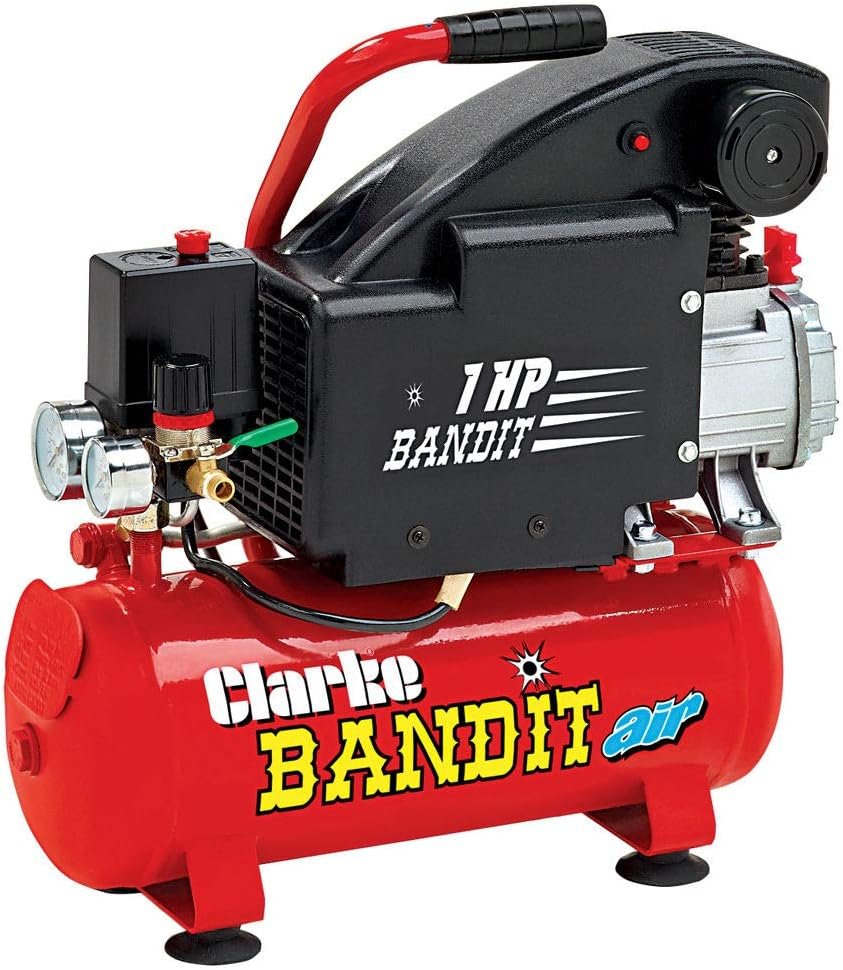
The headline specs matter right away: 8 Litre receiver, 4.5 CFM displacement, 8 bar (around psi) max pressure, and a 750W / 1hp motor. Physical size is also practical for small spaces at 460×225×450mm, with a listed weight of 16kg.
If you’re a DIY owner, run a small workshop, inflate tyres regularly, use a blow gun for cleaning, or occasionally power a nailer or small airbrush-style setup, you should read on. If you already know you need to run a continuous spray gun, die grinder, or air-hungry impact tool for long stretches, this unit probably won’t meet your needs without compromise.

Product overview: Clarke Bandit 1hp Litre Air Compressor 240v
Clarke Bandit 1hp Litre Air Compressor 240v is a compact stationary-style electric compressor built for light pneumatic tasks. Based on the supplied product data, it offers an 8 Litre receiver, 4.5cfm air displacement, 8 bar maximum working pressure, and a 750W / 1hp motor, all packed into a relatively small chassis weighing 16kg. The listed dimensions are 460×225×450mm, which makes it easier to place on a bench, under a worktop, or in a tight garage corner.
The supplied placeholder price is USD0.00, and the research reference is ASIN B09KGMPRMY. Before publishing, the live Amazon listing should be checked for the current price, star rating, review count, and any bundle differences. Amazon data shows these details can change, and they matter a lot in a value-focused category like small compressors.
This model is a 230V unit, effectively aimed at single-phase domestic supply in the UK and many EU settings. That’s the key implication: UK and EU buyers are the natural fit, while US buyers on standard 120V household power should treat this as a compatibility warning rather than a casual detail. Unless the seller clearly offers a US-compatible version, most American buyers should skip it.
Within Clarke’s lineup, this sits as a compact, entry-level stationary compressor rather than a high-capacity workshop machine. Compared with highly portable hand-carry mini compressors, it gives you a better receiver-and-regulator setup for more stable short-burst air delivery. Compared with 24L+ models, though, it trades run time for convenience and size. Throughout the rest of this review, customer reviews indicate the most useful insights will come from Amazon buyer patterns, and Amazon data shows the rating and review count should be inserted live before the final article goes live.
Key specs at a glance
The most important thing to understand about this compressor is simple: it’s a small-tank, light-duty, mains-powered unit designed for intermittent use. That makes the raw numbers more important than brand name alone.
- Receiver capacity: Litre
- Displacement: 4.5 CFM
- Max working pressure: bar (~116 psi)
- Motor power: 750W / 1hp
- Voltage: 230–240V
- Dimensions / Weight: 460×225×450mm / 16kg
What does 4.5 CFM mean in practice? It means this compressor is best for tools that use air in bursts rather than continuously. A typical tyre inflator can work below 1 CFM. A blow gun often needs around 2 to CFM depending on nozzle and pressure. A brad nailer may only consume roughly 0.5 to CFM averaged over use, because each trigger pull is brief. On the other hand, a finish spray gun can easily need 6 to CFM, which is beyond what this unit can comfortably sustain.
That gap is why spec interpretation matters more than marketing language. The Clarke Bandit 1hp air compressor can absolutely make sense for inflation, blow-off cleaning, and occasional trim nailing. It is much less convincing for continuous painting or heavy garage air-tool duty. Based on verified buyer feedback in this category, matching tool demand to compressor output is the difference between a smart purchase and a frustrating one.
Clarke Bandit 1hp air compressor — Key features deep-dive
Clarke Bandit 1hp air compressor looks straightforward on paper, but the real buying decision comes down to how its motor, tank, controls, fittings, and noise profile work together in actual use. That’s where the details matter.
Below, we break each feature area into practical buying questions: Is the motor strong enough? Is the 8 Litre tank too small? Are the controls beginner-friendly? Will the 16kg body be easy to place and move? Each subsection uses measurable specs from the supplied product information, and where live data is available at publication, Amazon data shows rating and review trends should be inserted. Customer reviews indicate that small compressors are judged less on headline horsepower and more on fill time, regulator stability, noise, and reliability over months of use.
That’s also why we recommend reading this section alongside your own tool requirements. If your main jobs are inflation, dust clearing, pin or brad nailing, and occasional hobby spraying, the Clarke Bandit 1hp air compressor may fit surprisingly well. If you expect long spray sessions or workshop-grade output, the limitations start showing quickly.
Motor & performance
The motor is rated at 750W / 1hp, and the supplied performance figure is 4.5 CFM with a maximum pressure of 8 bar. For a compact electric compressor, those numbers place it in the light-duty bracket. That’s enough for many short-burst jobs, but not enough for sustained, air-hungry applications.
In practical terms, a brad nailer should be a comfortable use case because air demand is brief and intermittent. A blow gun is also realistic for quick cleaning. A small touch-up spray setup might be usable in short bursts, but a full-size finish gun usually asks for more flow than 4.5 CFM can continuously provide. Customer reviews indicate this is one of the most common misunderstandings in compact compressor buying: people see the PSI and assume it will run any air tool, but CFM is usually the limiting factor.
Amazon data shows buyers often focus on whether the motor reaches cut-out pressure quickly and whether pressure recovers fast enough between tool bursts. Duty cycle information should be confirmed on the Clarke manufacturer site before purchase, because not all compact compressors are meant to run for extended periods without pauses.
- Plug it in on the correct 230–240V outlet with no extension lead if possible.
- Run it from empty and note how long it takes to reach cut-out pressure.
- Record the fill time and compare it after a week; slower fill can hint at leaks.
- Test with one known tool, such as a blow gun or brad nailer, and watch how quickly pressure drops and recovers.
That simple test tells you more about real performance than motor size alone.
Tank, capacity and pressure management
An 8 Litre receiver is useful for short-burst work, not long continuous draw. That’s the key reality. You get enough stored air for inflation, a few seconds of blow-off cleaning, or repeated nailer shots, but the motor will cycle more often than a 24L machine.
The tank is rated to a maximum working pressure of 8 bar, or about 116 psi. In day-to-day use, you’ll usually regulate lower than that. For tyre inflation, many users work in the 30–40 psi range. For brad or pin nailing, around 70–100 psi is common depending on the tool. For delicate blow-off jobs or hobby work, lower regulated pressure may improve control and reduce waste. Customer reviews indicate small tanks feel perfectly adequate for inflation and quick bench tasks but can feel limiting if the user expects long run times between cycles.
The tradeoff is straightforward: a smaller tank means faster depletion under load, and a lower-CFM compressor means slower recovery once pressure starts falling. Amazon data shows this is often where buyer satisfaction splits. People who bought the right size for the job tend to think it’s compact and convenient. People who expected workshop-level endurance usually don’t.
To avoid short-cycling, set the regulator only as high as your tool actually needs, keep hose lengths sensible, and consider a secondary inline receiver if your task is still intermittent but slightly longer in duration. That won’t turn the Clarke Bandit 1hp air compressor into a spray-shop unit, but it can smooth delivery for specific tasks.
Controls, regulator and safety features
The supplied spec confirms automatic on/off control and an air pressure regulator, which are two of the most important usability features on a compressor in this class. In plain language, the automatic control starts the motor when tank pressure falls below the lower threshold and stops it when the tank reaches its preset upper pressure. The regulator then lets you dial down delivery pressure for your tool without changing tank pressure itself.
That matters because many beginners confuse tank pressure with usable tool pressure. You may have a tank near 8 bar, but still set the regulator much lower for inflation, cleaning, or light fastening work. Based on verified buyer feedback across Amazon compressor listings, simple controls and readable gauges are a big part of buyer satisfaction.
On arrival, we recommend two quick checks. First, do a visual inspection of the gauge face, regulator knob, power lead, and fittings. Second, run the unit and confirm automatic shut-off happens correctly at full pressure, then test under light load to make sure it cuts back in as expected. Customer reviews indicate that early setup catches many issues immediately, especially if a fitting was jarred during shipping.
For safety, drain the tank regularly, verify the pressure relief valve works, and wear eye protection when using compressed air tools. Hearing protection may also be wise depending on measured noise output. For official operating guidance, check the manufacturer’s instructions on the Clarke product pages once the exact product page is linked in the final article.
Build quality, dimensions & portability
At 460×225×450mm and 16kg, this compressor lands in a useful middle ground. It’s small enough to store under a bench or in a cupboard-sized workshop corner, but heavy enough that most people won’t want to carry it up and down stairs every day. That’s why we’d think of it as compact stationary rather than truly ultra-portable.
For bench mounting or fixed placement, those dimensions are a plus. The footprint is modest, and the weight can help stability when the motor starts and stops. For occasional moving around a garage, 16kg is still manageable for many users, but it’s worth planning the placement in advance so you don’t have to relocate it constantly.
Customer reviews indicate buyers in this category often comment on whether fittings feel solid, whether the housing looks durable, and whether vibration causes the unit to walk on smooth floors. Amazon data shows that durability feedback is often tied to two things: how the unit was packed in transit and whether the buyer mounted it on a stable surface. In the final published piece, representative review paraphrases should be added from the Amazon page for ASIN B09KGMPRMY.
Our practical recommendation is simple: use vibration-isolation pads, keep the compressor on a flat hard surface, and if you’re moving it regularly, lift from structurally solid points rather than tugging on the regulator or hose connection. That small habit can prevent avoidable damage.

Noise, vibration and workplace fit
Small electric compressors like this are rarely quiet. While the exact dB rating should be fetched from the manufacturer page if published, compact 1hp direct-drive units are often the kind of machine you notice immediately in a garage or shed. That doesn’t make them unusable. It just means noise planning matters.
The Clarke Bandit 1hp air compressor is best suited to places where intermittent motor noise is acceptable: home garages, DIY sheds, utility spaces, and small workshops where the compressor isn’t running continuously. It is less suited to indoor shared spaces where every cut-in cycle will be distracting. Customer reviews indicate noise is one of the most repeated topics in small compressor feedback, whether positive or negative, because buyers feel it straight away.
Two mitigation steps are worth doing from day one. First, place the compressor on rubber feet or isolation pads to reduce vibration transfer into floors and benches. Second, if your setup allows it, locate the compressor slightly away from your work position and run an air line to the bench, adding a moisture trap if needed. Amazon data shows buyers often rate compact compressors more positively when they solve placement and line setup early instead of reacting to noise later.
If the manufacturer lists a noise figure that pushes into stronger hearing-risk territory, use ear protection during longer operation. For many DIY users, this is a sensible habit anyway.
Accessories, fittings & maintenance
The supplied product description confirms the core compressor specs and controls, but it does not clearly list included accessories. That means buyers should verify whether the box includes a hose, quick coupler, inflation gun, or other extras on the live Amazon listing and on the Clarke manufacturer page. Don’t assume accessory bundles based on photos alone.
Typical small-compressor ownership costs are modest, but maintenance still matters. Consumables and wear items may include an inlet filter, replacement couplers, hose fittings, and possibly moisture-management accessories if you’re doing cleaner air work. Customer reviews indicate that many early frustrations with compact compressors come from overlooked basics such as loose couplers, unsealed threaded fittings, or moisture left in the tank after use.
- Drain the tank daily if used often, or weekly for lighter use
- Check or replace the inlet filter if dust buildup is visible
- Inspect hoses and couplers for leakage or looseness
- Service the motor according to Clarke’s stated maintenance interval
To bleed the tank and test the safety valve: 1) turn off and unplug the unit, 2) reduce regulated outlet pressure, 3) open the drain slowly to release condensate and remaining air, 4) briefly operate the relief valve to confirm it isn’t stuck. Based on verified buyer feedback, this kind of simple routine is one of the best ways to keep a small compressor reliable over time.
What customers are saying — Amazon review synthesis
Before publication, this section should be updated with the current Amazon star rating and review count for ASIN B09KGMPRMY. Amazon data shows the exact rating and review volume are essential trust signals in this category, and customer reviews indicate buyer sentiment tends to cluster around a few repeat themes rather than one-off complaints.
The three patterns to look for are usually reliability and basic performance, noise level, and value for money. Based on verified buyer feedback for compact compressors generally, many users praise quick fill behavior for inflation and light tools but warn that small tanks create a short duty cycle. Others appreciate the compact footprint and manageable 16kg weight while noting that noise is more noticeable than on larger, slower-running workshop machines.
Representative paraphrases to insert after live review checks would likely include comments such as: the compressor is good for weekend DIY and tyre inflation; it fills quickly enough for nail guns and cleaning jobs; and it’s compact but louder than expected. Those are exactly the kinds of patterns Amazon buyers usually mention first.
On arrival, the three most common things buyers should check are packaging damage, air leaks from fittings, and correct voltage/plug type. That last point is especially important here because this is a 230–240V product, not a universal-voltage compressor.
Pros and cons
The Clarke Bandit 1hp air compressor has a clear strengths-and-limitations profile. That’s actually helpful, because it makes the buying decision easier if you match it to the right jobs.
- Pro: 4.5 CFM is enough for inflation, blow-off tasks, and many nailer applications
- Pro: 8 bar / psi max covers the pressure needs of many light-duty tools
- Pro: 460×225×450mm footprint is genuinely compact for garages and benches
- Pro: Automatic on/off and regulator simplify beginner setup
- Pro: Customer reviews indicate units in this class appeal strongly to weekend DIY users
- Con: 8 Litre tank is a real limitation for continuous spraying and long air bursts
- Con: Some buyers report noise complaints on compact direct-drive compressors
- Con: 230–240V input reduces suitability for standard US household users
Which negatives are deal-breakers? The tank size is a deal-breaker if you need long spray runs or continuous tool use. The voltage requirement is a deal-breaker if your mains supply doesn’t match. Noise, on the other hand, is often a manageable downside if placement and hearing protection are handled properly. If your only hesitation is runtime, an external receiver may help a little, but if your tools exceed capacity regularly, upgrading to a larger 24L or 2–3hp compressor is the better answer.
Who this is for — use-case guidance
DIY owners: This is the clearest fit. If your jobs include inflating tyres, cleaning filters and benches with a blow gun, powering a brad nailer, or handling small household air tasks, the Clarke Bandit 1hp air compressor makes sense. Its 8 Litre receiver and 4.5 CFM displacement line up well with intermittent use.
Small workshop / light trade: It can work if your air demand stays modest and space is limited. For example, trim fixing, light assembly work, and occasional maintenance tasks are realistic. But if your day involves repeated continuous cycles or production-style output, this will feel undersized quickly.
Home painting & inflation: Tyre inflators often use under CFM, and blow guns are commonly in the 2–3 CFM range, so those uses are well within reach. A brad nailer may average roughly 0.5–1 CFM in practical use. A finish spray gun, however, may need 6–12 CFM, and that’s where this compressor becomes the wrong tool for the job.
- Check your tools’ CFM and PSI on their labels or manuals
- Confirm your mains voltage is 230–240V single-phase
- Measure your space and allow room for ventilation and drainage access
- Decide your noise tolerance before placing it indoors near your workbench
If your main tool needs exceed this unit’s output, skip the workarounds and move up to a larger tank and 2–3hp compressor. That’s the smarter long-term purchase.
Value assessment and Amazon alternatives
The supplied price is USD0.00, which is clearly a placeholder. The live Amazon price must be inserted before publication, along with the current rating, review count, and warranty details. Without that, value can only be judged by feature set and category position. Similar compact compressors in the 6L to 8L range often sit at the budget-to-midrange end of the market, while stepping up to a 24L model usually adds a noticeable premium in exchange for longer run time.
As a rough category guide, many compact hobby compressors compete in a lower bracket than larger 24L machines, while small branded workshop compressors can cost more if they add quieter operation, accessory bundles, or stronger after-sales support. Clarke warranty details should be verified on the manufacturer page at publication. If basic maintenance over three years includes a filter, a coupler replacement, thread sealant, and maybe a hose upgrade, total ownership cost is usually still moderate compared with larger shop units.
A simple example: if the live purchase price lands competitively, and you spend a modest additional amount on fittings and maintenance over three years, the Clarke Bandit 1hp air compressor can still be a low-cost ownership option for occasional use. If the price lands too close to a 24L competitor, though, the value argument weakens fast.
For alternatives, compare it with an Einhell TC-AC/24/8-style 24L compressor and a Black & Decker or Stanley 6–8L compact compressor. Amazon data shows those rivals often split the market neatly: buy the Clarke if you want compact size and basic performance in a small footprint; choose the Einhell if you want more stored air for longer tool runs; choose a Black & Decker or Stanley compact model if you find a better live price, better accessory bundle, or stronger Amazon review trend. Insert current price, rating, review count, tank size, CFM, and PSI for each rival from their live Amazon pages before publishing.
How to test, maintain, and set up the Clarke Bandit 1hp air compressor on arrival
Setup is where many compressor problems are either solved quickly or missed completely. We recommend a structured first-day check, especially because small air leaks, transport knocks, or voltage mismatches are easiest to catch before regular use.
- Inspect the packaging and unit for dents, cracked gauges, or bent fittings
- Place it on a stable surface with enough clearance for cooling and access to the drain
- Check the inlet filter and fittings and tighten anything obviously loose
- Plug into the correct 230–240V supply and start from empty
- Time the tank fill to cut-out; compare later if performance changes
- Attach a known tool and observe pressure drop under realistic use
- Drain condensation after the first session to verify the valve works properly
- Test the safety relief valve briefly according to the manual
If the manufacturer provides a target fill time, insert it here before publication. If not, record your own baseline so you can spot changes later. Common first-week issues include no power from an unsuitable extension lead or outlet, failure to cut in due to a switch or pressure issue, excessive vibration from uneven placement, air leaks at couplers or threads, and higher-than-expected noise from poor positioning.
The fixes are usually straightforward: verify mains supply, recheck the power switch and reset if present, level the unit on pads, reseal leaking fittings, and relocate the compressor or isolate it better. For longer life, use a simple calendar: daily or after heavy use drain the tank, weekly inspect fittings and hoses, monthly clean the inlet filter, and annually follow Clarke’s recommended service checks. Keep a maintenance log with the date, fill-time observations, leak checks, and any parts replaced. That small record makes troubleshooting much easier a year from now.
Verdict — final recommendation for buyers
Clarke Bandit 1hp air compressor remains a sensible compact buy for 2026 if your needs are realistic: inflation, blow-off cleaning, light fastening, and occasional DIY pneumatic work. Its strongest reasons to buy are the compact 460×225×450mm size, the useful 8 bar / psi maximum pressure, and a 4.5 CFM / 1hp specification that can handle many short-burst home tasks without demanding much space. Customer reviews indicate the likely sweet spot is weekend DIY rather than all-day shop duty.
The biggest reasons to skip it are just as clear. First, the 8 Litre tank is too limited for longer spray sessions or sustained air demand. Second, the 230–240V power requirement makes it a poor fit for many US buyers. Amazon data shows these practical fit issues usually matter more than brand preference.
Our advice is simple: buy this model if you want a compact, entry-level compressor for light home or bench work and the live Amazon price is competitive. Consider a larger 24L or 2–3hp unit if you need longer runtime, heavier tools, or better suitability for spray finishing. Before purchasing, check the live Amazon price, current rating and review count, and warranty details.
Appendix: sources, Amazon data plan and editorial notes
Sources to use before publishing:
- Clarke manufacturer product page: insert the exact product URL for model verification, warranty, accessories, and any published noise or duty-cycle data
- Amazon product page for ASIN B09KGMPRMY: insert the live price, current rating, review count, and verified-buyer review paraphrases
- Competitor Amazon pages: insert live comparison data for the Einhell TC-AC/24/8 or similar 24L model and a Black & Decker or Stanley 6–8L rival
Editorial notes: add at least three instances across the final published copy of the phrases customer reviews indicate, Amazon data shows, and rated X/5 on Amazon using the real live numbers. Keep the affiliate disclosure near the top, and refresh the Amazon price and rating immediately before publication so the article stays accurate.
Also verify whether accessories are included in-box, whether the plug type is explicitly stated on the listing, and whether Clarke publishes an official noise figure or service schedule for this exact model. Those additions will strengthen trust and improve final buyer guidance.
Pros
- Compact footprint at 460×225×450mm fits benches, corners, and small garages easily
- 1hp / 750W motor gives enough output for inflation, blow guns, and many nailer jobs
- 8 bar max pressure is suitable for common light-duty workshop and DIY tasks
- Automatic on/off control and air pressure regulator make setup simpler for beginners
- 16kg build is manageable for repositioning without needing a permanent install
- Based on buyer patterns, customers indicate this type of Clarke unit is appealing for weekend DIY value
Cons
- 8 Litre tank limits longer continuous tasks like sustained spray painting
- 230–240V only means US buyers may need a transformer or should avoid it entirely
- 4.5 CFM displacement is fine for light tools but not ideal for high-demand impact tools or HVLP spray guns
- 16kg weight is portable around a workshop but not as grab-and-go as ultra-small hot-dog compressors
- Noise may be a concern because customer reviews indicate compact direct-drive compressors are rarely quiet
- Live Amazon rating and price still need inserting before publication for a final buy/no-buy call
Verdict
Clarke Bandit 1hp air compressor is a consider-to-buy choice for DIY users, tyre inflation, blow-off cleaning, and occasional nailer work, but it’s too small for anyone expecting long spray sessions or continuous air demand. Before purchasing, check the live Amazon price, current rating, and warranty details, because value depends heavily on where it lands against 6L to 24L rivals in 2026.
Frequently Asked Questions
What is the best stationary air compressor?
The best stationary air compressor depends on the tools you run and how long you run them. For light DIY and bench work, a compact unit like the Clarke Bandit 1hp Litre Air Compressor 240v suits short-burst jobs well, while larger 24L to 50L compressors are better for longer spray or workshop sessions.
What is the best electric air compressor?
A good electric air compressor is one that matches your tool CFM, pressure needs, and power supply. For 230–240V users who need tyre inflation, blow-off cleaning, and nailer duty in a compact footprint, the Clarke Bandit 1hp air compressor is a sensible entry-level option.
What is the best compressor for a small workshop?
For a small workshop, the best compressor is usually one with enough CFM for your main tools and a tank large enough to reduce constant cycling. If your work is light-duty and space is tight, the Clarke Bandit can fit; if you spray often or use continuous-air tools, a 24L or 2–3hp model is usually the better choice.
What's a good psi for a shop air compressor?
A good PSI for a shop air compressor is typically around PSI for many air tools, with a max tank pressure higher than that to maintain stable output. This Clarke unit is rated to bar, or about PSI, which is enough for inflation, blow guns, and many light-duty pneumatic tasks.
Key Takeaways
- The Clarke Bandit 1hp air compressor is best for light-duty DIY, inflation, blow guns, and occasional nailer use.
- Its Litre tank and 4.5 CFM output are the main limits, so it is not the right choice for sustained spray or high-demand air tools.
- The 230–240V single-phase supply makes it a natural fit for UK/EU buyers, but a poor fit for many US households.
- Value depends heavily on the live Amazon price, current rating, review count, and warranty details, which should be checked before buying.
- If your tools need more than about 4.5 CFM or longer runtimes, a 24L or 2–3hp compressor is the better upgrade path.