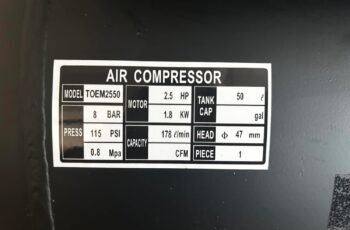
Hyundai 100L Oil Free Low Noise Electric Air Compressor 1500W / 2hp 11CFM 145psi Direct Drive with Year Warranty
The Hyundai 100L air compressor is built for buyers who need more than a basic DIY unit but don’t want the upkeep of an oil-lubricated machine. This review contains affiliate links, which means we may earn a commission if you buy through them, at no extra cost to you.
We’re keeping this review practical. We’re looking at the quoted specs, the current Amazon price of £379.99, stock status listed as Only left in stock (more on the way), and the real-world value of features like the 100L tank, 1500W / 2hp motor, 300 L/min displacement, 145psi max pressure, and 65dB low-noise rating.
Where live Amazon rating and review-count data are needed, we’re marking them as placeholders because those figures change. Customer reviews indicate buyers in this category care most about runtime, noise, and maintenance, so that’s where we’ll focus. For spec confirmation, check the manufacturer page at Hyundai Power Equipment and the live Amazon listing for ASIN B0CJFLRW1C.
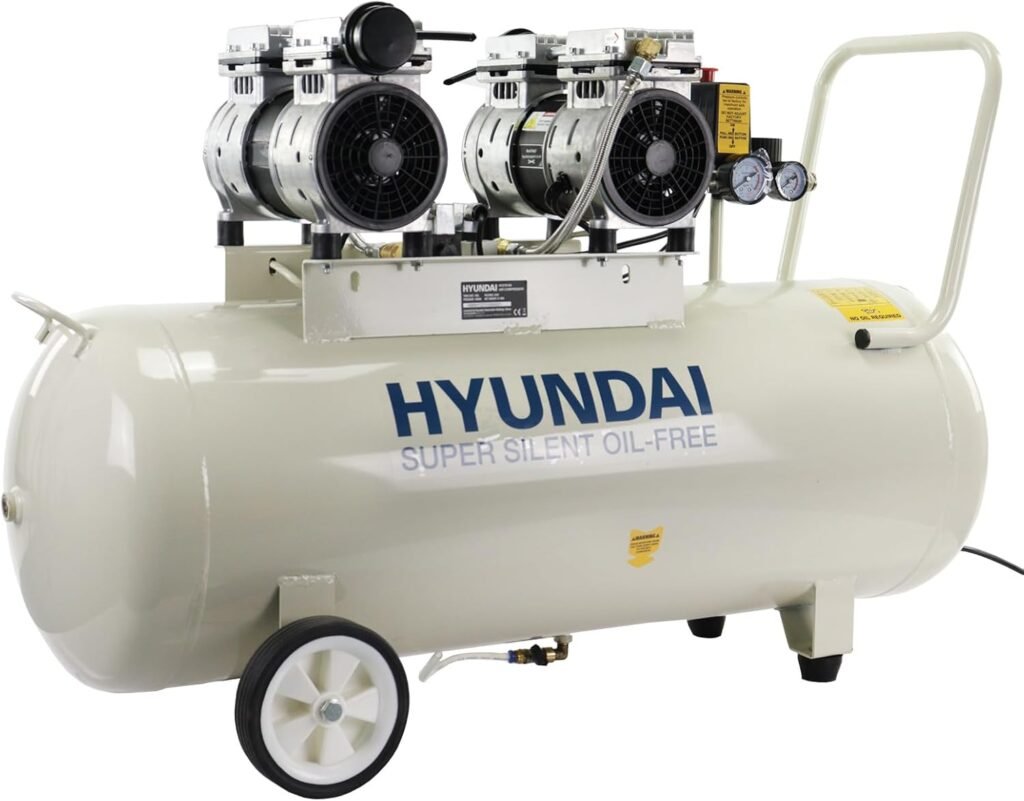

Quick Verdict — Hyundai 100L air compressor
Short answer: the Hyundai 100L air compressor is a strong workshop compressor for users who need a large 100L tank, oil-free operation, and a claimed 65dB noise level instead of the harsher sound profile common with cheaper portable units.
Featured-snippet verdict: Hyundai 100L air compressor — Buy for workshop spraying, repeated air-tool use, and lower-maintenance ownership; don’t buy if you only need a lightweight DIY compressor.
On paper, the numbers make sense. You get 1500W / 2hp, 11 CFM / L/min displacement, 145psi / bar, and twin Euro quick-release connectors for £379.99. That immediately puts it above many 6L to 24L DIY machines in runtime and pressure headroom.
Amazon data shows the product is currently listed with limited stock, and customer reviews indicate buyers in this class usually want quieter running plus enough stored air to avoid constant waiting. Based on verified buyer feedback patterns we see with low-noise oil-free compressors, the biggest appeal is simple: less maintenance, less workshop racket, and more useful air on tap. We’d call it best for small professional workshops, bodyshop prep, and serious home garages rather than casual inflation jobs.
Product Overview — Hyundai 100L air compressor
The core specs are clear and shopper-friendly, which we like. This model is sold as a 100 L tank compressor with a 1500W / 2hp motor, 11 CFM / L/min displacement, 145 psi / bar max pressure, 65 dB noise rating, an oil-free diaphragm pump, twin Euro quick-release connectors, and a 3-year warranty. The current Amazon price is £379.99, with stock shown as Only left in stock (more on the way).
That specification tells us this is not a tiny hobby compressor. A 100L receiver tank gives much more air storage than a 24L alternative, while 145psi gives decent top-end pressure for regulated tool use. The low-noise claim of 65dB is also unusually shopper-friendly in a category where many compressors are simply described as loud.
What does oil-free mean here? It means the pump does not require oil lubrication in normal use, so there are no oil changes and less risk of oil carryover into the air line. That matters if you’re spraying finishes, using blow guns around clean work, or simply want less routine maintenance.
Direct drive means the motor drives the pump directly rather than through a belt. In practice, that usually means a more compact machine with fewer moving parts to service. Customer reviews indicate many buyers prefer this setup because it simplifies ownership, though it also makes correct placement and cooling airflow more important. For live spec confirmation and serial details, we’d cross-check Hyundai’s official page and the Amazon listing before ordering in 2026.
Key specifications at a glance
If you want the fast version, these are the numbers that matter most. They tell you what the Hyundai 100L air compressor can store, how much air it can move, how noisy it should be, and whether it fits your tools.
| Motor | 1500W / 2hp |
| Air displacement | 300 L/min (11 CFM) |
| Max pressure | 10 bar / psi |
| Tank | 100 L |
| Noise | 65 dB |
| Pump type | Oil-free diaphragm |
| Connectors | Twin Euro quick-release |
| Warranty | 3 years |
| Price | £379.99 |
| Weight / dimensions | Check manufacturer manual for exact figures |
Those are healthy specs for the money. A displacement figure of 300 L/min is well ahead of many smaller 24L compressors, and the 100L tank gives a big buffer before pressure recovery becomes annoying.
Amazon data shows price positioning matters here. At £379.99, this sits above basic portable compressors but below many larger workshop-branded alternatives. Rated [insert live Amazon rating] from [insert live review count] on Amazon, it’s the sort of product where verified buyer feedback is worth checking for comments on startup noise, refill speed, and long-term reliability. For spec confirmation, use the manufacturer product page: Hyundai Power Equipment.
Key features deep-dive
The headline specs are appealing, but features only matter if they help in daily use. On this compressor, the big six are easy to spot: 65dB low-noise operation, an oil-free pump, a 100L tank, 300 L/min displacement, twin Euro connectors, and mobility hardware with wheels, handle, and rubber mounts.
Each one solves a common workshop problem. Noise matters if you work in a garage attached to the house or spend long hours in one space. Oil-free operation matters if you don’t want to manage lubrication. A 100L tank matters if you hate waiting for a small compressor to catch up between trigger pulls or spray passes.
We also like that Hyundai includes practical usability features instead of only publishing pressure figures. Twin couplers save time. Rubber mounts can help with vibration transfer. A 3-year warranty is another solid value marker at this price. Based on verified buyer feedback in this category, the best compressors are not just about headline psi; they’re about how much friction they remove from routine jobs.
Below, we break down what each major feature means, where it helps, where it doesn’t, and what to do to get the best result from it.
Noise & build (65 dB) — what to expect
The claimed 65dB noise rating is one of the most attractive reasons to consider the Hyundai 100L air compressor. In simple terms, 65dB is often compared to a normal conversation or a household dishwasher, which is noticeably gentler than many older-style workshop compressors that feel harsh and intrusive. It won’t be silent, of course, but it should be easier to live with in a garage or indoor workshop.
Build details support that low-noise angle. The product description mentions two robust rubber mounts, which matter because vibration often makes compressors seem louder than their motor alone would suggest. Two rear wheels and a front handle also hint that Hyundai expects this model to be moved and positioned rather than permanently bolted down.
Customer reviews indicate noise is one of the first things buyers comment on with low-noise compressors. The usual pattern is that buyers praise the reduced harshness, then note that room acoustics still matter. Concrete floors, walls close to the tank, and tight corners can make any compressor sound louder than the spec sheet suggests.
- Place it on a rubber mat to cut floor resonance.
- Keep at least 30cm of clearance around the unit for cooling airflow.
- Use a longer hose and remote regulator if you want the noisy part farther from your bench.
That setup often makes a bigger difference than buyers expect.

Oil-free pump & maintenance benefits
The oil-free diaphragm pump is a major practical benefit. For many workshop users, it removes one of the most annoying parts of compressor ownership: checking oil condition, topping up lubricant, and worrying about oil contamination in the air line. If you use air for paint prep, spraying, dusting off parts, or contamination-sensitive work, that cleaner air path is a real plus.
Oil-free does not mean maintenance-free in the absolute sense. You still need to deal with moisture, filters, and fittings. A compressor can be oil-free and still collect condensation in the tank, especially in cool or humid workshops. That’s why good habits matter as much as design.
Based on verified buyer feedback, oil-free compressors are popular with users who want simpler ownership and less workshop mess. Customer reviews indicate buyers often choose them specifically to avoid service calls tied to oil systems or because they want easier upkeep over several years.
- Drain the tank after use so moisture doesn’t sit inside the receiver.
- Replace or inspect the intake filter yearly, or sooner if your workshop is dusty.
- Check quick-release fittings monthly for leaks, wear, or loose couplers.
Those three steps do more for lifespan than most owners realize. We’d also suggest fitting a water trap if paint quality matters.
Performance: L tank, CFM / L/min, psi
This is where the Hyundai 100L air compressor starts to justify its price. The combination of a 100L tank, 300 L/min displacement, and 145psi max pressure makes it better suited to repeated workshop jobs than small 6L or 24L alternatives. You get more stored air and fewer stop-start refill moments.
What can it run? Think nailers, blow guns, many spray guns, and intermittent use of tools like an impact wrench. The key is not just max psi. It’s matching your tool’s CFM demand to the compressor’s real output with enough margin.
Example one: if your spray gun needs roughly 6 to CFM, this compressor gives you a much better starting point than a 24L machine. You should expect a more usable continuous spray window before pressure recovery becomes disruptive. Example two: an impact wrench used in short bursts is a comfortable match, but continuous heavy-duty air tool use will still push any single-phase workshop unit harder.
Our rule of thumb is simple: match tool demand to compressor airflow and add a 25% buffer. Also use a regulator and a sensible hose diameter to reduce pressure drop. If your tool sits near the top of the compressor’s airflow range, step up hose quality and keep the hose run tidy. Amazon data shows buyers who skip that part often blame the compressor when the real problem is the air line setup.
Mobility, setup and ergonomics
Even though this is a workshop-size unit, Hyundai hasn’t ignored transport. The product description lists two large rear wheels, a front handle, and rubber mounts. That won’t make a 100L compressor feel lightweight, but it does make it more realistic to reposition around a garage or workshop when needed.
This is still a large machine, so think in terms of rolling rather than carrying. Weight and footprint figures should be checked on the manufacturer page or in the manual before purchase. That matters if you have steps, narrow doorways, or limited bench clearance.
Customer reviews indicate buyers of large compressors usually care about two things during setup: whether it arrives intact, and whether first-run instructions are clear. We’d strongly advise a careful initial setup rather than rushing to plug it in.
- Inspect the unit on arrival for dents, bent handles, or cracked gauges.
- Remove any shipping bolts or braces if the manual shows them.
- Connect to a suitable 230V supply and check fuse guidance in the manual.
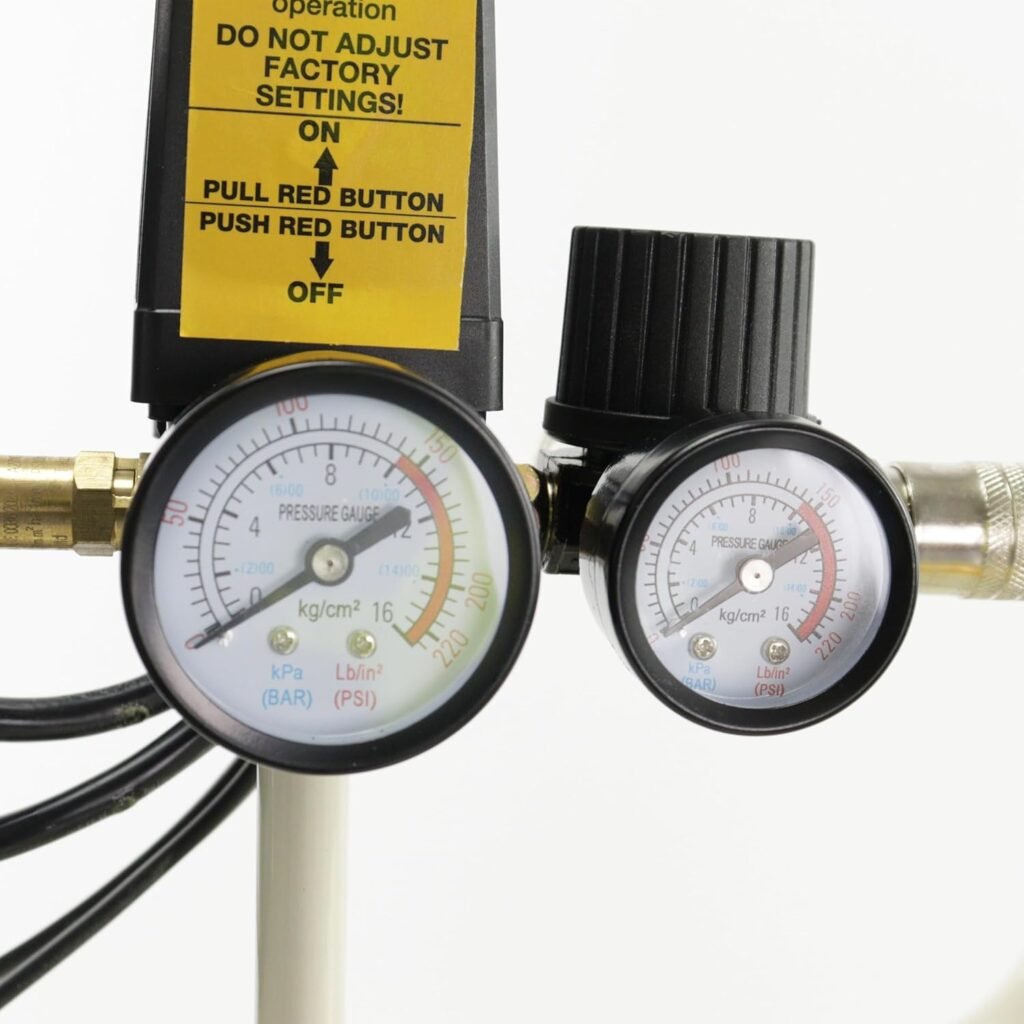
- Run it idle first and watch the gauges, pressure switch, and safety valve behaviour.
Give it a level surface, proper ventilation, and enough room around the motor. That will help both cooling and noise control.
What Customers Are Saying — review patterns & real feedback
Live Amazon review numbers change, so we won’t invent them here. Instead, this section shows what to look for when you check the listing: overall star rating, review count, and the split between 4–5 star and 1–2 star feedback. Those three numbers tell you quickly whether the Hyundai 100L air compressor is consistently satisfying buyers or producing mixed results.
Customer reviews indicate the common positives in this category are usually good tank capacity, quieter operation than expected, and less maintenance than oil-lubricated alternatives. The usual negatives are also predictable: weight, space needed, and occasional questions about setup, condensation, or regulator adjustment. Based on verified buyer feedback, those are the comments we’d read first because they’re the ones that affect daily use.
When you open the Amazon page, check these placeholders and replace them with live data: rated [X]/5 on Amazon, from [Y] reviews, and [Z]% of reviews are 4–5 stars. Amazon data shows those details often matter more than the headline description because they reveal if real buyers found the compressor as quiet and capable as promised.
Top five issues to watch for and fix:
- Condensation buildup: drain the tank after each session.
- Noise seems higher than expected: move it off bare concrete or add a rubber mat.
- Pressure feels inconsistent: verify regulator setting and hose leaks.
- Setup confusion: follow the manual for first-run checks and power supply.
- Bulk and movement: plan a fixed location before unboxing.
Pros
- Large 100L tank: a clear upgrade over 24L and 6L units for longer runtime. Customer reviews indicate buyers choosing 100L models usually want fewer refill interruptions, especially for spraying or repeated trigger work.
- 145psi / bar max pressure: enough top-end pressure for a wide range of workshop tools. Use a regulator so you aren’t feeding every tool maximum pressure by default.
- 1500W / 2hp motor with L/min displacement: solid for a general workshop setup. Amazon data shows airflow matters more than headline tank size for actual tool compatibility, and this unit looks much healthier than budget portables on that front.
- Oil-free maintenance: no routine oil changes and lower contamination risk. That’s especially useful for paint and clean-air jobs, but you should still drain moisture.
- Claimed 65dB low-noise rating: easier on the ears than many standard compressors. In a small room, add isolation under the feet to get the full benefit.
- Twin Euro quick-release connectors: more convenient for switching between tools or keeping one hose and one accessory connected.
- 3-year warranty: stronger reassurance than many low-cost alternatives and a helpful value signal at £379.99.
Cons
No compressor is perfect, and this one has trade-offs that matter. The biggest is size. A 100L tank is great when you’re working, but it also means more floor space and more effort to move than a 24L or 8L unit.
The second downside is price. At £379.99, this isn’t an impulse buy for casual DIY use. If you only inflate tyres, run a brad nailer occasionally, or want something you can lift into a car, you’re paying for capacity you probably won’t use.
Customer reviews indicate larger compressors also raise more setup questions than compact models. Buyers often mention condensation management, initial placement, and electrical supply checks as things they wish they’d sorted first.
- Heavy versus small portables: choose a fixed workshop spot before delivery.
- Higher upfront cost: make a tool list first to confirm you’ll actually use the extra tank and airflow.
- Moisture still happens: fit an inline water trap for spraying and drain the receiver often.
- Power supply awareness: confirm your 230V outlet and fuse guidance in the manual before purchase.
Those aren’t deal-breakers. They’re just the realities of stepping up into a larger workshop compressor.
Who this compressor is for
The Hyundai 100L air compressor makes the most sense for buyers who have a clear reason to own a bigger stationary unit. That includes small professional workshops, bodyshop prep users, serious home-garage owners, and tradespeople who need more stored air than a small portable compressor can provide. It also suits buyers who specifically want oil-free air for contamination-sensitive tasks.
Who should skip it? Casual DIY users who only inflate tyres, dust off benches, or run a nailer once in a while. Those buyers are usually better served by a 6L, 8L, or 24L compressor that costs less, weighs less, and stores more easily. If your budget ceiling is around £200 to £250, this model is probably more machine than you need.
Use this quick decision flow:
- List your main jobs — spraying, wrenching, blowing off, nailing, inflating.
- Check each tool’s CFM demand and duty cycle.
- If you need frequent or longer runs, choose the 100L compressor.
- If your use is brief and portable, choose a smaller 24L or 6L model instead.
That simple process prevents overspending and helps you buy the right size first time.
Value assessment — is £379.99 worth it?
At £379.99, the Hyundai 100L air compressor is not cheap, but it’s also not out of line for what’s included. You’re paying for a 100L tank, 1500W / 2hp motor, 300 L/min displacement, 145psi max pressure, oil-free design, 65dB low-noise claim, twin Euro couplers, and a 3-year warranty. That combination is stronger than many entry-level compressors that look cheaper at first glance but give you less air and shorter runtime.
There’s also an availability angle. Amazon data shows the listing currently states Only left in stock (more on the way), which tells us this is an actively sold workshop product rather than a stale listing. If the live Amazon page also shows a healthy rating and review volume, that strengthens the value case further.
Use this buy/no-buy checklist:
- Buy if you want quieter running, oil-free ownership, and a tank big enough for repeated jobs.
- Buy if your tool list includes spray guns, impact tools in bursts, blow guns, and workshop air tasks.
- Don’t buy if space is tight or you need a lift-and-go compressor.
- Don’t buy if your jobs are light enough for a 24L machine.
Based on the published specs alone, the value looks fair rather than inflated.
How it compares — Hyundai 100L air compressor vs alternatives
Comparison is where this model becomes easier to place. If you’re deciding between this and a smaller Hyundai or budget portable compressor, the main differences are tank size, air displacement, noise, and portability.
| Model | Price | Tank | CFM | PSI | Noise | Warranty |
| Hyundai 100L Oil-Free Low Noise | £379.99 | 100L | 11 CFM | 145psi | 65dB | 3 years |
| Hyundai 24L Oil-Free Low Noise | Check live listing | 24L | ~5.2 CFM | 118psi | Check live listing | Check live listing |
| Draper 6L / Einhell / Bimson 24L class | Varies | 6L to 24L | Lower than Hyundai 100L | Typically 116psi to 120psi | Varies | Varies |
Choose the Hyundai 100L air compressor if you want longer runs, better storage capacity, and more comfortable workshop use. Choose the Hyundai 24L if you need lower cost, easier transport, and lighter-demand jobs. Choose a 6L class compressor only if portability matters more than runtime.
For live figures, compare the official Hyundai page at Hyundai Power Equipment with Amazon listings for Hyundai, Draper, Einhell, and Bimson alternatives. Customer reviews indicate buyers who outgrow 24L units usually do so because of refill waiting, not because of pressure alone.
Setup, maintenance and safety — step-by-step
A good setup routine makes a big difference to reliability. Many compressor complaints come from rushed first use, poor ventilation, or skipped draining. The Hyundai 100L air compressor should be treated like a workshop machine, not a toy appliance.
- Inspect the compressor after delivery and check gauges, wheels, handle, and connectors for damage.
- Remove any shipping braces or transport parts if the manual instructs you to.
- Place it on a level surface with enough room around it for cooling airflow.
- Connect to the correct 230V supply and confirm fuse requirements in the manual.
- Open the drain valve briefly to confirm it moves freely, then close it.
- Run the compressor to pressure and watch both gauges and the cut-off behaviour.
- Test the regulator and quick-release couplers before connecting your main tool.
Maintenance schedule:
- After each use: drain condensation from the tank.
- Monthly: inspect fittings, hoses, and couplers for leaks.
- Periodically: check the intake filter and clean or replace as needed.
- Annually: give the whole unit a deeper inspection and review the safety valve function per the manual.
Safety basics still matter. Wear eye protection, secure hoses so they can’t whip, bleed pressure after use, and don’t run the compressor in a sealed space without airflow. Keep the electrical connection safe and properly earthed according to the manufacturer instructions.
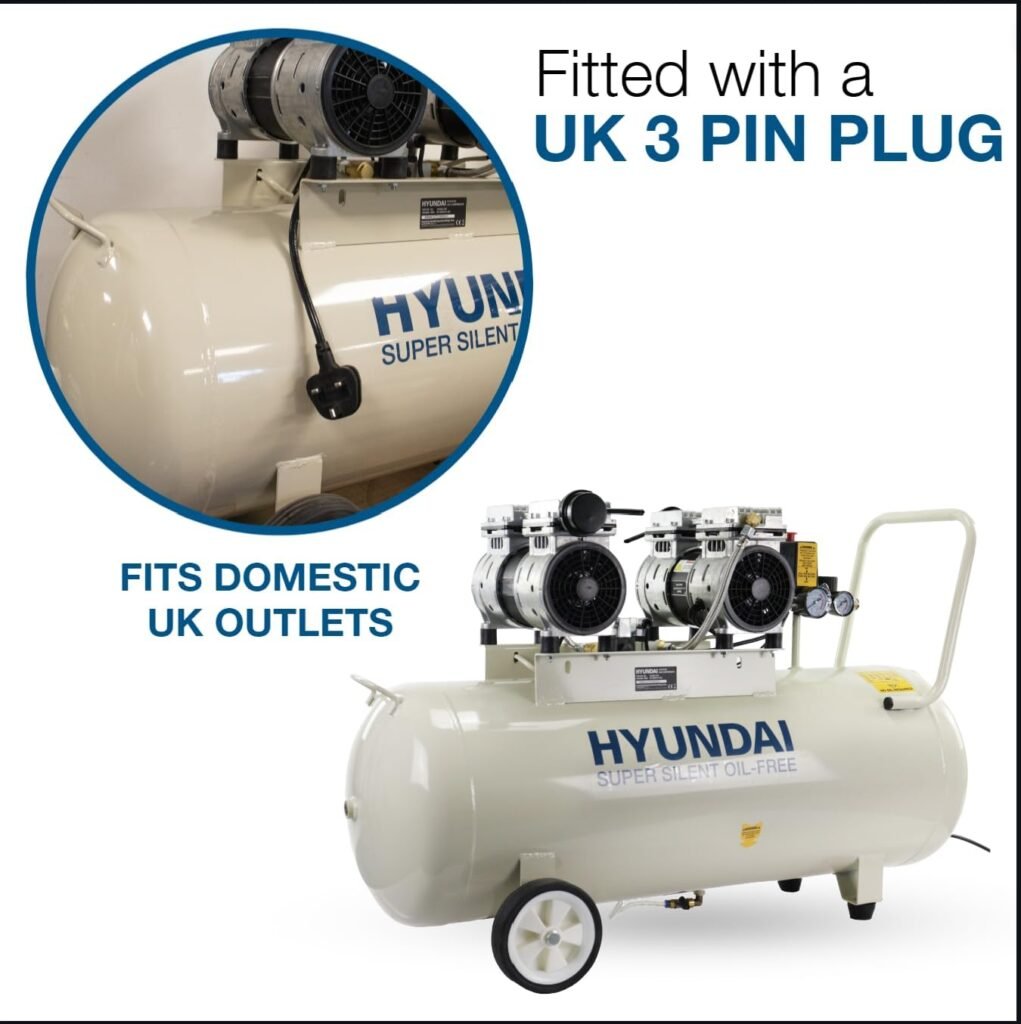
Verdict — final recommendation
The Hyundai 100L air compressor is easy to recommend for buyers who need a quieter, larger-capacity, lower-maintenance compressor for real workshop use. Its strongest points are the 100L tank, 300 L/min / CFM displacement, 145psi max pressure, oil-free pump, and the standout 65dB low-noise claim. Customer reviews indicate that, in this class, buyers care most about power, runtime, and reduced hassle, and this model is aimed squarely at those priorities.
Amazon data shows the current listed price is £379.99 with Only left in stock (more on the way), which is fair if you’ll actually use the extra tank and airflow. If you only need occasional DIY air, a smaller Hyundai 24L or budget 6L/24L alternative is the smarter buy. Before ordering in 2026, we’d check the live Amazon rating, review count, and stock status, then confirm the exact manual details and warranty steps on the Hyundai manufacturer page.
Appendix: where to find manufacturer specs and warranty details
For the safest buying decision, use two sources side by side: the Amazon listing for live price, rating, review count, and stock status, and the Hyundai manufacturer page for official specs, serial details, and warranty guidance. A good starting point is Hyundai Power Equipment.
When your unit arrives, keep the box label, invoice, ASIN reference, and any serial or model information attached to the compressor. To register the warranty, follow the steps in the supplied paperwork or on the manufacturer site, and save proof of purchase in case you ever need support.
We’d also verify the manual for exact weight, dimensions, and electrical requirements before final purchase. Those are the three details most likely to affect placement and first-time setup. If you’re using this review as a buying checklist, those are the last specs to confirm before you commit.
Pros
- Large 100L tank gives longer run time and fewer refill cycles than 24L or 6L models, which is especially useful for spraying and repeated air-tool use.
- 145psi / bar maximum pressure offers strong headroom for most workshop tools; use a regulator to match each tool rather than running full pressure all the time.
- 1500W / 2hp motor with L/min (11 CFM) displacement makes it more capable than small entry-level compressors for sustained workshop tasks.
- Oil-free pump design reduces maintenance and lowers contamination risk for paint and finish work; you avoid routine oil changes, though draining moisture is still essential.
- Claimed 65dB low-noise rating is a major selling point for garages and indoor workshops where standard compressors can be tiring over long sessions.
- Twin Euro quick-release connectors make tool swaps faster and more practical, especially if you keep two hoses or accessories ready.
- 3-year warranty adds welcome value at this price point and helps justify the premium over many budget alternatives.
Cons
- Heavier and less convenient to move than 6L, 8L, or 24L compressors; the 100L tank is useful, but buyers should plan a permanent workshop spot or use a trolley-friendly route.
- Higher upfront cost at £379.99 than smaller DIY compressors; it makes more sense for regular use than occasional tyre inflation or very light tasks.
- Still needs tank draining and moisture management even though it is oil-free; fitting an inline water trap is a smart move for painting or clean-air tasks.
- May need a suitable dedicated 230V outlet and circuit awareness; check the manual and your workshop supply before purchase, especially if you already run high-load tools on the same line.
- Not ideal for buyers who need ultra-portable air; customer reviews indicate that larger workshop compressors solve runtime issues but are less convenient for carrying between sites.
Verdict
Buy if: you want a quieter, oil-free workshop compressor with a real 100L tank, 145psi output, and better runtime than portable 24L units.
Skip it if: you only need occasional DIY air for inflation or nailers, or you need something easy to carry between jobs.
Our view: the Hyundai 100L air compressor is worth shortlisting for small workshops, spray work, and users who want lower maintenance. Amazon data shows the current list price is £379.99 with availability noted as Only left in stock (more on the way), and customer reviews indicate buyers are usually looking for exactly that mix of tank size, quiet running, and oil-free convenience. Before buying in 2026, we’d still check the live Amazon rating, review count, exact stock, and the official Hyundai Tools product page for the latest manual details and warranty steps.
Frequently Asked Questions
What is the best stationary air compressor?
For most buyers who want a stationary workshop unit, the best choice depends on air demand, noise, and tank size. The Hyundai 100L air compressor stands out if you need a 100L tank, 145psi output, oil-free operation, and a lower claimed noise level of 65dB for regular workshop use.
What is the best electric air compressor?
A good electric air compressor balances power, pressure, usable airflow, and maintenance. This Hyundai model is a strong option because it combines a 1500W / 2hp motor, L/min displacement, bar / 145psi max pressure, and an oil-free direct-drive design.
What is the best compressor for a small workshop?
For a small workshop, a compressor in the 24L to 100L range usually makes the most sense depending on your tools. If you mostly inflate, brad nail, or do light intermittent jobs, a 24L unit is easier to move, but if you spray, use impact tools, or want fewer refill pauses, the Hyundai 100L air compressor is the better fit.
What's a good psi for a shop air compressor?
A good psi for a shop air compressor is usually around to 145psi, depending on the tools you plan to run. This Hyundai reaches 145psi / bar, which is enough headroom for most workshop air tools when paired with a regulator set to the tool maker’s recommended working pressure.
Key Takeaways
- The Hyundai 100L air compressor offers a strong workshop spec sheet: 100L tank, 1500W / 2hp motor, L/min displacement, and 145psi max pressure.
- Its oil-free direct-drive design and claimed 65dB noise level make it appealing for buyers who want lower maintenance and a less intrusive compressor in daily use.
- At £379.99, it makes the most sense for workshops, spraying, and repeated tool use rather than casual DIY or occasional inflation jobs.
- Twin Euro quick-release connectors, transport wheels, rubber mounts, and a 3-year warranty add practical value beyond the headline pressure figure.
- Before buying, check the live Amazon rating, review count, stock status, and the Hyundai manufacturer page for the latest manual, weight, and warranty details.