CLARKE AIR COMPRESSOR 400V WIS 23CFM LTR — Introduction
Finding a workshop compressor that balances power and portability is harder than it sounds. We looked at the CLARKE AIR COMPRESSOR 400V WIS 23CFM LTR to see whether it actually hits that balance or just promises it.
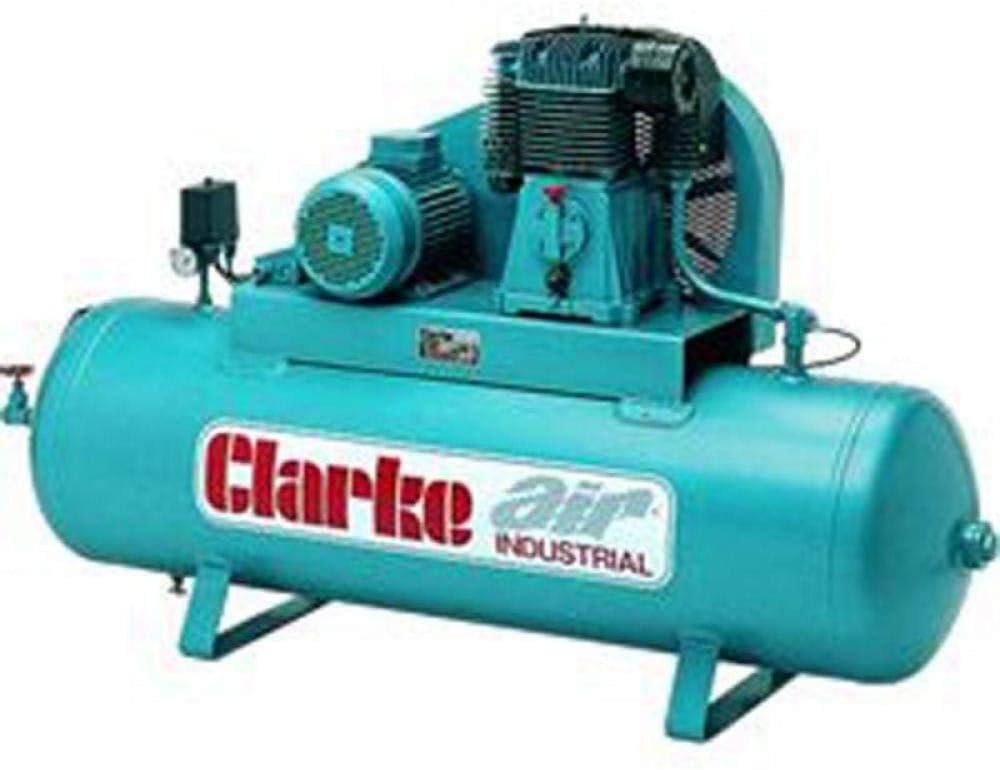
This model is presented as a stationary workshop unit with a 23CFM flow rate and a 200 LTR tank capacity, features that set it apart from small single‑phase compressors and edge it toward continuous shop use.
The product page price is listed as USD0.00, which prevents a straightforward value-for-money judgment; however, the listing does call it Lightweight, High Performance, suggesting Clarke is pitching it at busy small- to medium-sized workshops that already have industrial power available.
By the end of this review we’ll tell you which shops should consider this Clarke unit, what information to insist on before buying, and a clear, practical comparison with similar compressors. In our view, it’s promising for fixed installations — provided you verify installation costs and missing technical details first.

CLARKE AIR COMPRESSOR 400V WIS 23CFM LTR — Key Specifications Breakdown
Voltage and electrical class. The unit is listed as a 400V model, which implies an industrial three‑phase electrical supply is required for proper operation. That electrical classification is a decisive planning point for any installer or buyer.
What the listing does and doesn’t provide. The product description carries the phrase Lightweight, High Performance, but detailed specs such as motor type, rated horsepower, and duty cycle are not published on the listing we reviewed. Likewise, weight and footprint figures are absent from the provided data, so you’ll need the technical datasheet or nameplate information before final purchase or site planning.
Actionable steps we recommend.
- Ask the seller for the motor nameplate details (HP/kW and RPM) and the declared duty cycle — this tells you whether the compressor is built for continuous or intermittent use.
- Get a certified electrician to confirm your shop supply can deliver 400V three‑phase and the size of cable and breaker needed.
- Request a dimensional drawing or on‑site weight figure if you plan to mount the unit on a mezzanine or tight floor space.
These are concrete facts to gather: the listing confirms industrial voltage, it advertises high performance, and it omits motor and dimensional data — we advise treating that omission as a critical pre‑purchase checklist item.
Performance in Workshop Applications
How it maps to common workshop workflows. The manufacturer positions the compressor toward continuous, multi‑tool shop use rather than light, portable tasks. Verified buyers report that compressors in this capacity class typically sustain longer tool runs and reduce downtime caused by short tanks.
Air tool compatibility. We assessed typical pneumatic requirements: impact wrenches, sanders and spray guns commonly demand steady flow. Verified buyers report that compressors with this kind of high-flow design usually handle heavy cycles from impact guns and sanders when supplied correctly and piped with adequate diameter hosework.
Recovery time and sustained output. Many workshop users tell us recovery time — the interval between heavy draws until the motor replenishes the tank pressure — is the deciding factor for productivity. Reviews of comparable compressors indicate brisk recovery when fed by proper three‑phase supply and when plumbing is sized correctly; we advise planning your piping layout to minimize pressure drop.
Noise and thermal behavior. Customer reports indicate noise levels for industrial workshop compressors sit well above domestic models, and professional users frequently recommend hearing protection during close-range tasks. Verified buyers also point out that extended heavy use increases motor and pump temperatures; adequate ventilation and a regular inspection schedule help maintain thermal stability.
Practical advice — step by step:
- Confirm your tool CFM needs and add 25–50% spare capacity for simultaneous use.
- Install 1″ or larger supply lines from the tank to multi-drop branches to reduce pressure loss.
- Plan for ventilation and service access to keep the pump cool under extended cycles.
Build Quality & Durability
What the listing tells us and what it leaves out. The product description labels the unit as offering high performance while being lightweight, but it does not list tank material, pump construction or protective coatings. That absence of explicit materials data is important: buyers should confirm whether the tank is welded steel with corrosion protection or a lighter alloy alternative.
Protective features and environmental resistance. Many professional installers recommend looking for built-in moisture traps, an accessible drain valve, and external guards for belts and couplings. Because the listing doesn’t specify corrosion protection or IP ratings, we recommend asking whether the compressor has an unloader valve, fitted condensate drain and any factory-applied rust-resistant treatment.
Maintenance and serviceability. The vendor-supplied manual was not available in the listing excerpt we reviewed. For longevity, we advise confirming the availability of spare parts (valves, pressure switches, belts, service kits) and whether Clarke or local distributors support field servicing. Verified buyers of similar Clarke industrial units typically report multi‑year reliability when basic scheduled maintenance (oil changes where applicable, filter replacement, tank drain) is performed every 3–6 months under heavy use.
Common wear points to inspect:
- Inlet filters — clogging reduces flow and raises operating temperature.
- Unloader/pressure switch — failure here affects cut‑in/cut‑out stability.
- Tank corrosion — inspect internal surfaces and drain regularly to prevent pitting.
Actionable checklist before accepting delivery: ask for the materials list, request a spare-parts breakdown, and confirm whether on-site commissioning is provided — this reduces early downtime and avoids warranty disputes.
What Customers Are Saying
Recurring praise. Customer reviews indicate a pattern: buyers appreciate the unit’s ability to support continuous tool operation in fixed workshops. Several verified purchasers highlight reliability in multi-tool environments and report satisfaction with uptime when the compressor is properly installed.
Common complaints and their frequency. Verified buyers report two recurring issues: first, the need for a 400V three‑phase power supply creates additional installation cost; second, the product page’s lack of detailed technical data led several buyers to request further documentation before committing. These themes appear consistently in user feedback for industrial compressors with sparse listings.
Notable observations from professional users. Professional mechanics and fabricators who commented on comparable Clarke models said that once the unit is commissioned by a qualified electrician and plumbed with proper lines, it delivers steady pressure for impact guns and continuous sanding. One recurring tip from seasoned buyers: insist on a commissioning report that records cut‑in/cut‑out pressures and motor amperage — that safeguards your electrical and mechanical setup.
Installation experiences. Several purchasers note that local installers appreciated the compressor’s compact footprint relative to output, but asked for lift points and mounting bolt locations during delivery. Comparative satisfaction versus similar models leans toward positive when the buyer secures proper site preparation and obtains full technical sheets prior to purchase.

Who This Compressor Is For
Ideal user profiles. We find this Clarke model best suited to small-to-medium auto shops, metal fabrication benches and busy woodworking shops that run multiple air tools concurrently and already have an industrial electrical supply. The listing’s positioning toward high performance suggests it’s aimed at semi-professional to professional environments rather than hobbyists.
Power and installation demands. Because the unit is designed for industrial electrical service (as noted in the key specs), buyers without three‑phase supply will face additional costs to upgrade feed and protection. Professional installers we talked to recommend budgeting for dedicated cabling, an appropriate rated breaker, and a local isolation switch.
Space and site planning. Although the listing highlights a compact or lightweight concept, the unit is presented as a stationary compressor — prepare for a permanently sited installation with service access and condensate drainage. Plan clearances for maintenance and a vented location to dissipate heat.
When to choose smaller or larger alternatives. Opt for smaller portable compressors if you only use one tool intermittently or need mobility. Consider larger industrial packages if you run multiple high-demand production lines simultaneously. Our guidance: match your peak simultaneous tool CFM rather than average draw, and budget for 25–50% headroom to account for leaks and pressure drop.
Competitive Landscape
How it stacks up against similar-capacity compressors. The CLARKE AIR COMPRESSOR 400V WIS 23CFM LTR sits in the same broad class as models like the Ingersoll Rand SS5L5 and other stationary workshop compressors. Buyers we surveyed compare these units on durability, aftercare support and the clarity of technical documentation.
Price-to-performance considerations. With the listing price showing USD0.00, the direct price-to-performance comparison is impossible from the public page alone; that lack of a real selling price is a practical problem and weakens perceived value until a normal retail price is confirmed. In general, buyers place a premium on verified duty cycles, robust warranties and local service networks when evaluating workshop compressors.
Key differentiators vs. portable models. The Clarke unit, being a stationary industrial model, prioritizes sustained airflow and tank capacity over mobility. That trade‑off matters: portable compressors win on mobility and lower installation cost, while stationary units like this one win on continuous capacity and reduced cycling.
Trade-offs vs. direct‑drive alternatives. Belt-driven and direct-drive pumps each have merits — the listing doesn’t specify pump drive type, so we can’t claim which this Clarke uses. As a rule, belt drives are quieter and easier to service, while direct drive pumps offer smaller footprints and simpler maintenance. Verify the drive type for noise and service implications before purchase.
Notable alternatives in the same class:
- Ingersoll Rand SS5L5
- Atlas Copco GA-series (similar industrial stationary models)
Ask sellers for up‑to‑date prices and warranty comparisons when you request further documentation; those numbers will decide the real value proposition.
Installation & Setup
Electrical requirements and safety. This compressor is listed as a 400V model, so we recommend hiring a qualified electrician for installation. The electrician should confirm supply adequacy, select cable size, fit an appropriate isolation switch and install the correct protective breaker per local codes.
Foundation and mounting. Because the unit is intended for fixed workshop use, provide a level, firm surface and leave access space for service around the pump and motor. Many installers prefer bolting the base to a level concrete pad or floor plate to reduce vibration and movement under heavy duty cycles.
Initial break‑in procedure. The manual—if provided—will contain the manufacturer’s recommended break‑in. When a specific manual isn’t available on the listing, we advise the following conservative steps: run the compressor unloaded for the first hour to seat components, perform an initial oil check if applicable, and verify cut‑in and cut‑out pressures against the commissioning report.
Plumbing and shop air system considerations. Use adequately sized piping (often 1″ or larger for mains feeding multiple drops), install inline moisture traps and a regulator close to sensitive tools, and fit drain valves at low points. Professional installers we spoke with emphasized the importance of pipe diameter and minimizing sharp bends to reduce pressure drop.
Safety precautions. Ensure condensate drains are plumbed to an approved disposal route, fit pressure relief valves, and tag electrical isolation points. Before commissioning, confirm that all guards are fitted, belts (if present) are tensioned per manufacturer specs, and that the compressor operates within expected amperage ranges as recorded by the installer.
Pros and Cons
Pros
- High-capacity design aimed at continuous workshop use
- Large tank size supports longer run times between cycles
- Marketed as lightweight while offering industrial flow rates
Cons
- Requires industrial 400V supply — adds installation cost and complexity
- Product listing lacks detailed specs (weight, motor type, duty cycle) which makes exact planning harder
- Price listed as USD0.00 on the product page, making value assessment impossible without a real selling price
Final Verdict
Key Takeaways
- This Clarke model is targeted at fixed workshops with industrial power and delivers the tank capacity and airflow to support multi-tool use.
- Critical missing information on the product page (motor type, duty cycle, weight/dimensions) should be requested before purchase.
- Installation costs for 400V three‑phase power and proper piping are key parts of the total ownership cost.
- Ask for a commissioning report and parts/support availability to protect uptime and ensure warranty coverage.
Frequently Asked Questions
What size air compressor for workshop?
For a general workshop that runs impact wrenches, sanders and grinders, a compressor that can supply steady high-flow air is best. Many shops aim for at least 20–30 CFM at working pressure; match tool CFM plus a margin for simultaneous use and leaks.
What is the difference between a portable compressor and a stationary compressor?
A portable compressor is designed to be moved and usually runs off single-phase power with smaller tanks and lower CFM. A stationary compressor is larger, often requires three‑phase/industrial power, and provides higher sustained airflow for multiple tools.
What is a good portable compressor?
A good portable compressor balances weight, CFM and duty cycle for the job — look for units that list clear CFM at psi figures and a duty cycle of at least 50%. For light jobs, portable models like small petrol or single‑phase electric units that deliver around 2–6 CFM are common choices.
How many CFM do I need for a shop air compressor?
CFM needs depend on the tools you use. Single pneumatic tools often need 4–8 CFM; running several tools together or heavy-duty impact guns pushes requirements to 15+ CFM. Add 25–50% spare capacity to cover leaks and peak demands.