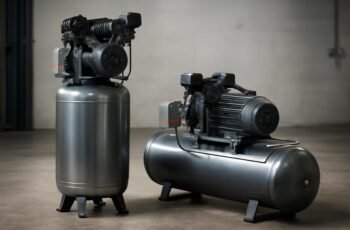
Did you know that the fundamental difference between reciprocating and rotary screw compressors lies in their compression mechanisms and suitability for specific operational demands? While reciprocating models deliver high-pressure bursts suitable for intermittent tasks, rotary screws provide continuous airflow ideal for steady-duty applications. Understanding these distinctions is crucial for selecting the right compressor, but the decision becomes more complex when considering factors like maintenance and total cost of ownership, which we’ll explore further.
Key Takeaways
- Reciprocating compressors are ideal for high-pressure, intermittent tasks, while rotary screw compressors suit continuous, high-flow applications.
- Rotary screw units generally offer lower energy costs and require less maintenance compared to reciprocating models.
- Reciprocating compressors tend to be noisier and more portable, making them suitable for smaller or mobile jobs.
- Rotary screw compressors provide stable airflow with minimal fluctuations, enhancing efficiency in long-term operations.
- Choice depends on application needs: reciprocating for short bursts and variable pressures, rotary screw for constant, high-volume use.
What Are Reciprocating and Rotary Screw Compressors?
Have you ever wondered how different types of air compressors generate the pressurized air used in various industrial applications? When analyzing reciprocating and rotary screw compressors, it’s essential to avoid irrelevant comparison and unrelated metrics. Reciprocating compressors operate via pistons driven by a crankshaft, creating high-pressure air through a reciprocating motion. They excel in delivering high pressure in short bursts, making them suitable for specific tasks. Conversely, rotary screw compressors use two intermeshing helical screws to continuously generate pressurized air, offering high flow rates and smooth operation. These fundamental differences influence their efficiency, maintenance needs, and operational costs, rather than relying on irrelevant comparison that might focus on unrelated metrics like horsepower alone. Understanding these distinctions is critical when selecting the appropriate compressor for an application.
How Do Reciprocating Air Compressors Work?
Reciprocating air compressors operate through a straightforward mechanical process that converts rotational power into linear motion to compress air. The reciprocating basics involve a piston moving within a cylinder, driven by a crankshaft connected to a motor. As the piston moves down, it draws in air through an intake valve; as it moves up, it compresses the air into a discharge chamber. This cycle repeats continuously, producing high-pressure air. Unlike the rotary screw nuance, which uses meshing rotors for continuous compression, reciprocating compressors rely on a piston’s reciprocation. This design offers precise compression control but may involve more maintenance. Understanding these fundamental mechanisms helps clarify the operational differences from rotary screw compressors, emphasizing the reciprocating system’s suitability for varying pressure ranges and intermittent use.
How Do Rotary Screw Air Compressors Operate?
Rotary screw air compressors operate through a continuous meshing of interlocking helical rotors that generate compression. As the rotors turn, air is drawn into the space between the rotors and progressively compressed as it moves toward the outlet. This process maintains a relatively stable operating temperature, typically lower than reciprocating types, due to their continuous operation and efficient heat dissipation. Startup noise is minimal compared to reciprocating compressors, thanks to the smooth rotation of the rotors. The design ensures consistent airflow and pressure, making rotary screw compressors ideal for continuous use. Precise control of rotor clearance and lubrication is essential to maintain optimal operating temperature and prevent overheating. Overall, their operation emphasizes efficiency, stability, and reduced noise during startup and operation.
Comparing Performance: Efficiency and Continuous Use
When comparing the efficiency and suitability for continuous operation, we focus on energy consumption, runtime capabilities, and maintenance demands. Rotary screw compressors typically offer lower energy costs and stable performance over extended periods, whereas reciprocating units often consume more power and require more frequent maintenance. Analyzing these factors helps determine the most suitable choice for specific operational demands.
Energy Consumption Differences
How do the energy efficiencies of reciprocating and rotary screw air compressors compare during continuous operation? Reciprocating compressors typically exhibit higher energy consumption due to their cyclical piston movements, resulting in longer reciprocal timelines that cause fluctuations in power use. Conversely, rotary screw compressors maintain more consistent power delivery, leading to superior efficiency over extended periods. The steady operation reduces peak loads and minimizes energy waste, especially under continuous use. Additionally, rotary screw units generally operate with lower rotary noiselevels, which can indirectly improve overall energy management by reducing system strain.
- Reciprocating units have higher fluctuations in energy consumption during cycles.
- Rotary screw compressors provide more consistent, efficient operation.
- Noiselevels influence cooling and energy efficiency indirectly.
Runtime Capabilities
Do reciprocating and rotary screw compressors differ substantially in their ability to sustain continuous operation over extended periods? Yes. Rotary screw compressors excel in continuous use due to their positive displacement design, enabling consistent airflow with minimal fluctuations. They typically employ oil-injected lubrication methods that ensure optimal sealing and reduce wear, supporting extended uptime. Reciprocating compressors, while capable of continuous operation, often require more frequent cooling and lubrication adjustments, which can limit their long-term efficiency. Additionally, rotary screw units generally feature noise reduction enhancements, making them more suitable for prolonged operation in noise-sensitive environments. Overall, rotary screw compressors provide higher reliability and efficiency for continuous use, whereas reciprocating models are better suited for intermittent or shorter-duration applications.
Maintenance Requirements
Are reciprocating and rotary screw compressors equally demanding in terms of maintenance to sustain optimal performance and efficiency? Not quite. Reciprocating compressors typically require more frequent maintenance scheduling, driven by more complex valve and piston systems. Lubrication intervals are shorter, demanding regular oil changes to prevent wear. Rotary screw compressors generally benefit from longer lubrication intervals due to their continuous, sealed operation, reducing downtime. However, they still require periodic checks of filters and oil levels to maintain efficiency. Both types demand diligent maintenance, but the nature and frequency differ significantly. Proper scheduling ensures minimal operational disruptions and prolongs compressor lifespan. Understanding these distinctions helps optimize performance and manage operational costs effectively.
- Maintenance scheduling frequency
- Lubrication intervals and oil management
- Wear and component inspection requirements
Assessing Maintenance and Operating Costs
Evaluating the maintenance and operating costs of reciprocating versus rotary screw air compressors requires a detailed comparison of their design complexities, component durability, and energy efficiency. Reciprocating compressors often demand more frequent maintenance scheduling due to wear on pistons and valves, leading to higher upkeep costs. They typically generate more noise, which may influence ongoing operational expenses related to noise mitigation. Conversely, rotary screw compressors have fewer moving parts, resulting in lower maintenance requirements and less downtime. Their continuous operation tends to be more energy-efficient, reducing operational costs over time. Noise considerations are generally less problematic with rotary screw units, which operate more quietly. Overall, the cost dynamics hinge on component longevity, maintenance frequency, and energy consumption, making precise assessment crucial for informed investment.
Which Compressor Fits Your Industry and Application?
Choosing the right compressor depends on industry-specific performance requirements and application demands. We need to evaluate factors such as continuous operation, pressure stability, and duty cycle to determine suitability. By analyzing these criteria, we can identify which compressor type aligns best with your operational needs.
Industry-Specific Performance Needs
Determining the most suitable compressor for a specific industry requires a detailed understanding of the application’s unique performance demands. Different industries face distinct requirements shaped by economy trends and consumer markets. For example, manufacturing demands consistent high-volume output, favoring rotary screw compressors for their efficiency and reliability. Conversely, industries requiring intermittent, high-pressure bursts may benefit from reciprocating compressors.
Key considerations include:
- Continuous operation versus intermittent use
- Pressure and flow stability needs
- Energy efficiency in response to changing market conditions
Understanding these factors ensures optimal performance and cost-effectiveness. Selecting the right compressor hinges on aligning industry-specific performance needs with the compressor’s operational profile, ensuring compatibility with industry demands and market dynamics.
Application Suitability Factors
When selecting the appropriate compressor for your industry, understanding how application-specific factors influence performance is essential. Noise levels and portability are key considerations. Reciprocating compressors typically generate higher noise levels, making them less suitable for noise-sensitive environments. Conversely, rotary screw compressors operate more quietly, ideal for continuous operation in open or enclosed spaces. Portability also varies: reciprocating models often have a compact, lightweight design, facilitating movement across job sites, whereas rotary screw units are bulkier, primarily suited for fixed installations.
| Factor | Reciprocating Compressor | Rotary Screw Compressor |
|---|---|---|
| Noise Levels | Higher | Lower |
| Portability | Greater | Less Portable |
| Usage Duration | Intermittent | Continuous |
| Load Handling | Variable | Consistent |
| Maintenance | Simpler | More Complex |
Pros and Cons of Reciprocating Compressors
What makes reciprocating compressors a viable option for certain applications? Their high-pressure capabilities and precise control over output make them suitable where specific pressure requirements are critical. However, their disadvantages include complex maintenance due to multiple moving parts, potential for higher vibration, and noise levels. These factors can lead to increased operational costs over time. An irrelevant topic often discussed is the extraneous discussion about their efficiency in continuous operation, which can mislead decision-makers. The main pros and cons are:
- High pressure output suitable for specialized tasks
- Higher maintenance and operational costs
- Greater noise and vibration levels affecting workplace environment
While effective in specific contexts, they may not be optimal for applications demanding continuous, low-cost operation.
Pros and Cons of Rotary Screw Compressors
Are rotary screw compressors a more efficient choice for various industrial applications? They typically offer high operational efficiency, especially in continuous-duty environments. Their design ensures consistent airflow with minimal fluctuations, reducing energy consumption. Compared to reciprocating compressors, rotary screws generally produce lower noise levels, making them suitable for noise-sensitive settings. Additionally, their startup reliability is superior, as they operate smoothly without the abrupt pressure surges common in reciprocating models. However, maintenance can be more complex and costly due to their intricate components. While initial costs are higher, the long-term energy savings and reduced downtime often justify the investment. Overall, rotary screw compressors excel where reliable, quiet, and efficient performance is essential for demanding industrial processes.
Which Air Compressor Should You Choose?
Choosing the right air compressor depends on evaluating specific operational needs, budget constraints, and the environment in which it will operate. For continuous, high-demand applications, rotary screw compressors offer efficiency and lower maintenance costs, making them suitable for industrial settings. Conversely, reciprocating compressors excel in intermittent use and lower capacities, ideal for small workshops or maintenance tasks.
Factors to consider include:
- Flow rate: High or low demand determines compressor type.
- Operational environment: Temperature, humidity, and space influence selection.
- Budget: Initial investment versus long-term operational costs.
Irrelevant topics, like aesthetic design, should be secondary to technical performance and reliability. Selecting the appropriate compressor requires balancing these elements for optimal efficiency and longevity.
Frequently Asked Questions
What Are the Noise Level Differences Between These Compressor Types?
We find reciprocating air compressors typically produce higher noise levels and vibration, whereas rotary screw compressors operate more quietly with lower vibrations, making them suitable for noise-sensitive environments due to their smoother, more consistent vibration characteristics.
How Do Initial Purchase Costs Compare?
We find that reciprocating compressors generally have a lower initial purchase cost, making reciprocating cost more economical upfront, while rotary screw compressors tend to be more expensive initially but offer better long-term efficiency and operational savings.
Are There Specific Safety Considerations for Each Compressor?
We recognize that safety protocols and maintenance scheduling are vital for both compressor types. Reciprocating compressors require careful handling of high-pressure components, while rotary screw units demand vigilant lubrication and electrical safety measures for optimal operational safety.
Can These Compressors Be Used for Portable Applications?
About 60% of portable compressors are reciprocating, offering reliable portable power. They typically require more maintenance, but their design suits mobility needs. Rotary screw compressors, while less common, provide continuous operation with lower maintenance for portable applications.
How Do Environmental Impacts Differ Between the Two?
We see that reciprocating compressors typically generate higher noise levels and have greater environmental impacts due to increased energy consumption, while rotary screw compressors operate more efficiently and quietly, reducing their overall ecological footprint and noise pollution.
Conclusion
Ultimately, choosing between reciprocating and rotary screw compressors is like selecting the right tool for a specific job — each has its strengths and limitations. By carefully analyzing your operational demands, budget, and maintenance capacity, you can align your choice with your industry’s unique needs. Just as a precise instrument shapes the outcome, selecting the proper compressor ensures efficiency and longevity, turning your investment into a reliable foundation for ongoing success.