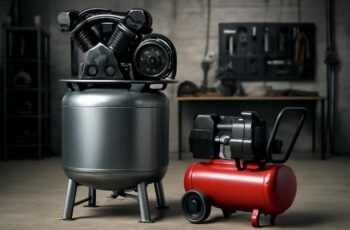
When it comes to choosing the right air compressor, the decision isn’t simply about capacity but about aligning technology with specific operational demands. We often find ourselves weighing high pressure units against standard models, each with distinct advantages and limitations. Understanding these differences is essential for optimizing performance and controlling costs. As we explore the technical nuances and practical applications, you’ll see why the choice can greatly impact your project’s efficiency and longevity.
Key Takeaways
- High-pressure compressors generate air exceeding 300 psi, while standard units operate around 100-150 psi.
- High-pressure models use reinforced components for durability under elevated stresses; standard units prioritize simplicity and volume.
- Standard compressors provide consistent flow suitable for general tasks; high-pressure units may have variable flow due to design focus.
- High-pressure compressors are more expensive, require specialized parts, and are used for industrial, testing, or high-altitude applications.
- Standard compressors are cost-effective, easier to maintain, and ideal for powering tools, inflation, and typical manufacturing tasks.
What Are High Pressure and Standard Air Compressors?
Have you ever wondered how different air compressors are tailored for specific applications? High-pressure compressors are designed to generate extremely compressed air, often exceeding 300 psi, suitable for industrial processes, high-altitude environments, or specialized manufacturing. They typically feature robust, high-strength components and may include oil-free designs to prevent contamination, especially in sensitive applications like food or pharmaceuticals. Standard air compressors, on the other hand, operate at lower pressures, generally around 100-150 psi, and are optimized for general tasks such as powering tools or inflation. Oil-free variants are common in both types to ensure clean, contaminant-free air, particularly important at high altitudes where atmospheric conditions can influence compressor performance. Understanding these distinctions helps determine the right compressor for specific operational needs.
How Do High Pressure and Standard Compressors Differ in Design and Functionality?
How do the designs and functionalities of high-pressure and standard air compressors fundamentally differ? High-pressure compressors are engineered for elevated output pressures, often exceeding 300 bar, utilizing robust components like reinforced cylinders and specialized valves to withstand extreme stress. They are designed for applications such as high altitude operations or industrial processes like palm oil extraction, where precise, high-pressure air is critical. Conversely, standard compressors prioritize volume over pressure, with lighter construction and simpler valve systems suited for general tasks like inflation or cleaning. The core distinction lies in their ability to generate and sustain higher pressures without compromising safety or efficiency. These design differences directly influence functionality, with high-pressure units offering fine control and durability under demanding conditions, unlike their standard counterparts optimized for steady, lower-pressure outputs.
When Should You Use a High Pressure Air Compressor?
We typically recommend using a high pressure air compressor when specific application requirements demand elevated pressure levels. These scenarios often include industrial processes or equipment that require higher pressure thresholds for optimal operation. Understanding the precise pressure demands helps determine when a high pressure compressor is the appropriate choice.
Specific Application Requirements
Determining the appropriate application for a high-pressure air compressor hinges on specific operational requirements that demand elevated pressure levels. These applications typically adhere to strict design standards, ensuring safety and efficiency at higher pressures. Industries such as automotive testing, hydraulic system operation, and specialized manufacturing often require compressed air beyond standard levels, making high-pressure units essential. Noise reduction becomes a critical factor in these environments, as higher pressure systems tend to generate increased sound levels. Selecting a compressor with optimized noise mitigation features can improve workplace safety and compliance with regulatory standards. Ultimately, if your application necessitates precise, high-pressure airflow with attention to noise management and adherence to rigorous design standards, a high-pressure air compressor is the appropriate choice.
Higher Pressure Demands
When should you consider deploying a high-pressure air compressor? If your applications require pressures above 3000 psi, standard compressors fall short, necessitating high-pressure units. These are essential for tasks like specialized testing or certain industrial processes, where unanticipated higher pressure demands arise. Clipped discussions often overlook the significance of pressure-specific requirements, leading to unrelated topic distractions. To clarify, here’s a comparison:
| Application Type | Typical Pressure Range | Recommended Compressor Type |
|---|---|---|
| General Industrial Use | 100-150 psi | Standard Air Compressor |
| High-Precision Tasks | 3000+ psi | High Pressure Air Compressor |
| Specialized Testing | Varies, often >3000 psi | High Pressure Air Compressor |
This table illustrates when higher pressure demands justify high-pressure compressor deployment.
Industrial Usage Scenarios
Have you considered the specific industrial applications that necessitate high-pressure air compressors? These scenarios typically demand higher PSI levels for optimal operation, unlike irrelevant topics or unrelated aspects of standard compressed air systems. Industries such as manufacturing, hydraulic power, and pneumatic tools often require elevated pressures to ensure efficiency and safety. High-pressure compressors are essential when precision and performance are critical, as in aerospace component testing or underwater equipment operations. Using a standard compressor in these scenarios can lead to inadequate performance or equipment failure. Therefore, understanding the distinct requirements of each industrial process helps determine when a high-pressure air compressor is necessary, ensuring reliable operation and avoiding unnecessary equipment strain or downtime.
Ideal Applications for Standard Air Compressors
What makes standard air compressors suitable for specific applications? Primarily, their moderate pressure output and consistent flow rate align with tasks requiring steady, lower-pressure air. These compressors excel in manufacturing environments, automotive repair shops, and woodworking, where high-pressure output isn’t critical. They handle tasks like powering pneumatic tools, spray painting, and inflating tires efficiently. An irrelevant topic, such as unrelated concept, might distract from their core strengths. Standard compressors provide reliable performance without the complexity or cost of high-pressure units, making them ideal for applications with predictable, moderate demands. Their design ensures ease of maintenance and operation, offering a cost-effective solution where high-pressure capabilities are unnecessary, and operational simplicity is prioritized.
Comparing Performance: Pressure, Flow Rate, and Efficiency
When comparing high pressure and standard air compressors, we focus on their pressure capacity differences, flow rate variability, and energy efficiency levels. These performance metrics directly influence suitability for specific applications and operational costs. Analyzing these aspects helps identify which compressor delivers optimal performance under various demands.
Pressure Capacity Differences
How do pressure capacities truly compare between high pressure and standard air compressors? High pressure compressors are designed to deliver significantly greater pressure outputs, often exceeding 300 psi, whereas standard air compressors typically operate around 100-150 psi. This substantial difference directly impacts their performance capabilities. High pressure units are engineered for applications requiring compressed air at elevated pressures, such as industrial spraying or testing. Conversely, standard air compressors prioritize volume over pressure, making them suitable for general tasks like powering pneumatic tools. The key distinction lies in their pressure capacity limits, which determine their suitability for specific tasks. While high pressure compressors excel in specialized, high-demand environments, standard air compressors offer versatility for everyday applications.
Flow Rate Variability
Flow rate variability is a critical factor that distinguishes high pressure air compressors from standard units, especially when evaluating their performance in practical applications. High pressure compressors often exhibit more inconsistent flow rates due to their design focus on achieving elevated pressure levels, which can impact overall efficiency metrics. Variability in flow rate affects the stability of compressed air delivery, making it less predictable compared to standard models that maintain a more consistent flow. In applications requiring precise airflow, this fluctuation can lead to inefficiencies and increased operational complexity. Analyzing flow rate performance involves examining how fluctuations influence efficiency metrics, such as power consumption relative to output. Understanding these differences helps in selecting a compressor optimized for specific demands, balancing flow stability with pressure requirements.
Energy Efficiency Levels
While high pressure air compressors often exhibit greater flow rate variability, their energy efficiency levels can differ markedly from standard units due to design priorities focused on pressure output. High-pressure models typically operate at higher power consumption levels to achieve elevated pressures, resulting in lower overall efficiency compared to standard compressors. However, advancements in design have incorporated features for noise reduction, which also contribute to reduced energy waste by minimizing operational losses. Despite their high energy demands, these compressors can be optimized through intelligent control systems that improve efficiency during variable load conditions. Ultimately, while high-pressure units excel in delivering the required pressure, their efficiency hinges on balancing flow rate, pressure, and noise reduction to minimize energy costs and environmental impact.
Factors to Consider Before Choosing Between High Pressure and Standard Compressors
What critical factors should we evaluate when deciding between high pressure and standard air compressors? Key considerations include application requirements, system compatibility, and long-term reliability. High pressure models often promise greater performance but may involve misleading marketing claims and specific warranty exclusions. Compatibility issues may arise if existing systems aren’t designed for higher pressures, increasing the risk of equipment failure. Additionally, the availability of parts and service support varies, influencing operational continuity.
| Factor | Impact | Consideration |
|---|---|---|
| Application Needs | Determines pressure and volume requirements | Match compressor specs to task demands |
| Warranty Terms | Affects repair costs and support | Review warranty exclusions and coverage |
| System Compatibility | Ensures seamless integration | Check existing system capacity and specs |
| Marketing Claims | Avoids falling for misleading marketing | Verify claims with independent data |
| Reliability & Support | Ensures long-term operation | Assess manufacturer reputation and service |
Cost and Maintenance Differences: Which Is More Cost-Effective?
Are high pressure air compressors more cost-effective over their lifespan compared to standard models? In terms of initial investment, high pressure units tend to be more expensive, but their durability and ability to produce higher pressure levels can reduce overall operational costs. Maintenance requirements often differ; high pressure compressors generally need specialized parts, which can be a costly irrelevant topic for some users, but they benefit from longer service intervals when properly maintained. Conversely, standard compressors typically have lower upfront costs but may incur higher long-term expenses due to more frequent repairs or replacements. Evaluating cost-effectiveness involves analyzing not just purchase price but also energy consumption, maintenance frequency, and lifespan. Unrelated concepts like unrelated concept may seem irrelevant but can impact overall operational efficiency.
Common Mistakes When Selecting an Air Compressor
Choosing the right air compressor involves careful analysis, yet many overlook common pitfalls that can lead to costly mistakes. One frequent error is selecting a model based solely on capacity without considering actual operational demands. For instance, an unrelated topic like random comparison shows that bigger isn’t always better; similarly, an oversized compressor can cause energy inefficiency and increased wear. Conversely, undersized units fail under load, leading to downtime. Another mistake is ignoring future expansion needs, which results in frequent replacements. Additionally, focusing only on initial cost disregards long-term expenses related to maintenance and energy consumption. Failing to evaluate pressure requirements and duty cycles can compromise performance and equipment longevity. Understanding these common mistakes helps prevent costly errors and ensures optimal compressor selection aligned with specific operational requirements.
Which Air Compressor Is Right for Your Needs? A Quick Guide
Determining the right air compressor for your needs requires a clear understanding of your specific operational demands and future growth plans. This involves evaluating factors such as required pressure levels, volume needs, and duty cycles, which influence whether a high pressure air compressor or a standard model is appropriate. An unrelated topic like energy efficiency should also be considered to prevent extraneous concepts from clouding your decision.
- Capacity and flow rate requirements
- Maximum pressure needed for your applications
- Space constraints and portability
- Long-term operational costs and maintenance
Frequently Asked Questions
How Does Noise Level Differ Between High Pressure and Standard Air Compressors?
We find that high-pressure compressors generally produce higher noise levels due to increased vibration impact, resulting in more operational noise. Standard compressors tend to be quieter, with less vibration, making them preferable for noise-sensitive environments and detailed technical assessments.
Are There Size or Weight Differences Impacting Portability?
We find that high pressure air compressors typically have a larger size and weight due to advanced components, affecting portability. Design differences emphasize durability over compactness, making standard compressors more portable but potentially less robust for high-pressure applications.
What Safety Precautions Are Unique to High Pressure Compressors?
We prioritize safety labeling and pressure relief mechanisms for high-pressure compressors, ensuring proper operation and preventing over-pressurization risks. These safety precautions are essential for maintaining system integrity and protecting users from potential hazards.
How Do Energy Consumption and Efficiency Compare Over Time?
Like a finely tuned engine, high-pressure compressors often deliver higher energy efficiency over time, reducing long-term maintenance costs. However, standard compressors may initially consume less energy, making the comparison dependent on usage patterns and operational demands.
Can High Pressure Compressors Operate Continuously Without Overheating?
High pressure compressors can operate continuously, but effective high temperature management is essential to prevent overheating. Continuous operation limitations depend on design and cooling systems, requiring careful monitoring to guarantee safe, reliable performance without thermal stress.
Conclusion
Ultimately, choosing between a high-pressure and standard air compressor is like selecting the right tool for the job—it’s all about matching capabilities to your specific needs. While high-pressure units are robust and precise, they come with higher costs and complexity. Standard compressors offer simplicity and affordability for everyday tasks. By carefully analyzing your application’s pressure, flow, and budget, you’ll guarantee your investment performs reliably—turning your compressor choice from a gamble into a calculated success.