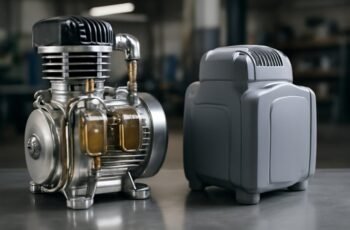
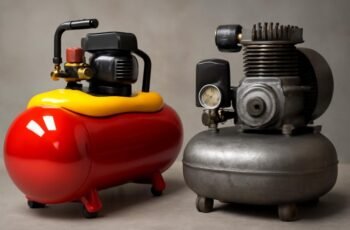
Did you know that despite their shared purpose, portable and stationary air compressors are designed with fundamentally different priorities that impact their performance and suitability? While portable units emphasize mobility and quick setup, stationary models focus on sustained power and durability. These distinctions influence not only operational capabilities but also long-term costs and maintenance needs, making the right choice less straightforward than it seems. Understanding these core differences can markedly affect how well a compressor meets your specific project requirements.
Key Takeaways
- Portable compressors are lightweight and mobile, ideal for on-the-go tasks, while stationary units are durable and suited for continuous, high-demand use.
- Stationary models offer higher airflow, pressure, and longer lifespan, whereas portable ones prioritize compactness and ease of transport.
- Portable compressors typically cost less upfront but may have higher operational and maintenance costs over time.
- Stationary units are more expensive initially but provide lower maintenance costs and greater durability.
- Noise levels are generally higher in portable compressors due to smaller cooling systems, while stationary units operate more quietly.
How Do Portable and Stationary Air Compressors Differ in Design and Functionality?
How do portable and stationary air compressors differ in design and functionality? Portable models prioritize efficiency in mobility, featuring compact, lightweight frames with integrated handles or wheels, enabling easy transport and quick deployment. Their design minimizes space requirements, making them suitable for on-the-go tasks, but often at the expense of reduced power capacity. Conversely, stationary compressors emphasize durability and continuous operation, built with robust materials meant to withstand long-term, heavy-duty use. Their larger, fixed structures support higher airflow rates and pressure outputs, optimized for consistent performance in industrial or workshop environments. While portable units excel in flexibility and convenience, stationary models deliver the reliability necessary for sustained, high-demand applications, illustrating a clear distinction in their core design principles aligned with their functional roles.
Which Factors Should You Consider When Choosing Between Portable and Stationary Compressors?
When deciding between portable and stationary air compressors, several critical factors must be evaluated to ensure the equipment aligns with specific operational needs. Key considerations include portability considerations, space constraints, durability tradeoffs, and noise levels. Portable compressors excel where mobility and quick deployment are essential but often sacrifice some durability and operate at higher noise levels. Stationary units typically offer increased durability and lower noise, suitable for fixed installations, yet they require substantial space. The table below summarizes these factors:
| Factor | Portable Compressors | Stationary Compressors | Suitability |
|---|---|---|---|
| Portability | High, easy to move | Low, fixed installation | Mobile or temporary tasks |
| Space Constraints | Minimal, compact design | Larger footprint | Limited space environments |
| Durability Tradeoffs | Moderate, designed for portability | High, built for continuous use | Long-term, heavy-duty applications |
| Noise Levels | Higher, due to smaller design | Lower, suitable for noise-sensitive areas | Environments requiring quiet operation |
What Are the Cost Implications of Portable vs Stationary Air Compressors?
Considering the significant investment involved, understanding the cost implications of portable versus stationary air compressors is essential for making informed procurement decisions. Portable models generally entail lower upfront costs, making them attractive for smaller or temporary operations. However, their limited capacity may lead to higher operational costs over time, especially if they require frequent use or replacement. Stationary compressors typically involve higher initial expenses but benefit from enhanced durability, lower maintenance costs, and longer longevity, which can offset the initial investment. Maintenance costs are also a critical factor; stationary units often have easier access for repairs and longer service intervals, reducing downtime and expenses. Ultimately, evaluating these cost implications helps determine the most cost-effective solution aligned with operational demands and long-term budget considerations.
How Do Maintenance and Longevity Compare for Portable and Stationary Models?
Maintenance requirements and longevity are critical factors in evaluating portable versus stationary air compressors. Portable models generally require more frequent maintenance scheduling due to their exposure to varying conditions and limited cooling, impacting motor heat management. Stationary units benefit from integrated cooling systems and stable operating environments, extending service life.
| Feature | Portable Compressors | Stationary Compressors | Longevity Implication |
|---|---|---|---|
| Maintenance Scheduling | More frequent, adaptable | Less frequent, consistent | Longer lifespan for stationary models |
| Motor Heat Management | Less effective, risk of overheating | Better cooling, enhanced durability | Stationary units tend to last longer |
| Wear and Tear | Higher due to transport and use | Lower, fixed location | Stationary models often outperform portable ones |
Which Type Is Better Suited for Your Specific Projects and Workspace Needs?
Determining the ideal air compressor for your projects depends heavily on your specific workspace environment and operational requirements. For tasks demanding a compact workflow, portable compressors excel due to their mobility and space efficiency. Conversely, stationary models suit continuous, high-demand operations where stability and capacity are critical. Consider these factors:
Choosing between portable and stationary air compressors depends on workspace size, noise needs, and project duration.
- Workplace Space and Layout: Limited space favors portable units, while larger workshops benefit from stationary systems.
- Noise Tolerance: Environments with noise restrictions require quieter portable compressors or soundproofed stationary models.
- Project Scope and Duration: Short-term, flexible tasks align with portable units; long-term, constant use favors stationary setups.
Assessing these aspects helps determine which compressor type enhances productivity without compromising workspace comfort or operational efficiency.
Frequently Asked Questions
Can Portable Air Compressors Handle Industrial-Grade Tasks?
We find portable air compressors generally lack the portable efficiency and motor reliability required for demanding industrial-grade tasks, as they often can’t sustain prolonged operation or high airflow demands, making stationary units more suitable for such rigorous applications.
Are Stationary Compressors Suitable for Mobile Work Sites?
Stationary compressors, anchored like sturdy trees, aren’t suited for mobile work sites; their fixed nature limits portable mobility and power source flexibility, making them less adaptable for dynamic, on-the-go tasks where flexibility is essential.
How Loud Are Portable Versus Stationary Compressors?
We find portable compressors generally produce more noise than stationary ones, but their portability benefits often justify this. The noise comparison varies based on size and design, yet stationary models tend to operate more quietly, enhancing their suitability for fixed locations.
What Safety Precautions Are Necessary for Each Type?
We prioritize safety precautions like wearing protective gear and conducting maintenance checks to prevent catastrophic failures. For portable compressors, secure connections are essential, while stationary units require stable placement and regular inspection to avoid dangerous vibrations or leaks.
Do Portable Compressors Require Special Storage Considerations?
Portable compressors require special storage considerations to maintain compressor portability and ensure safety. We recommend portable storage solutions that protect against moisture, dust, and impact, preserving efficiency and longevity while enabling easy transport and quick deployment.
Conclusion
Ultimately, choosing between portable and stationary air compressors hinges on your specific project demands and workspace constraints. Do you need quick, on-the-go power or a reliable, high-capacity system for long-term use? By analyzing your airflow requirements, mobility needs, and budget, you can make an informed decision that optimizes efficiency and cost-effectiveness. Which option aligns best with your operational goals and long-term maintenance considerations?