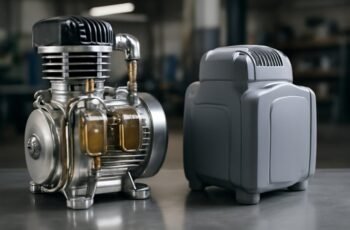
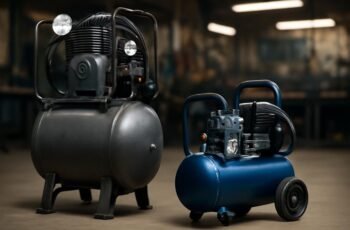
Choosing between a stationary and portable air compressor is like navigating a complex maze of technical specifications and operational needs. Each type is crafted with distinct design principles, impacting size, performance, and suitability for specific tasks. Understanding these differences is crucial for making an informed decision that aligns with your industry demands and logistical constraints. As we examine their core features and practical applications, you’ll find the key factors that can guide you toward the right choice.
Key Takeaways
- Stationary compressors are larger, fixed, and ideal for continuous, high-capacity industrial applications; portable units are compact and suited for mobility.
- Stationary units offer higher power, capacity, and stability, while portable compressors prioritize ease of transport and quick setup.
- Use stationary compressors for long-term, large-scale operations; portable compressors are best for short-term, on-site, or remote tasks.
- Stationary models are heavier, mounted on concrete pads, and less flexible; portable units include handles or wheels for easy movement.
- Cost and noise levels vary; stationary units are often more expensive and quieter, whereas portable units are budget-friendly and designed for quieter operation.
How Do Stationary and Portable Air Compressors Differ in Design and Size?
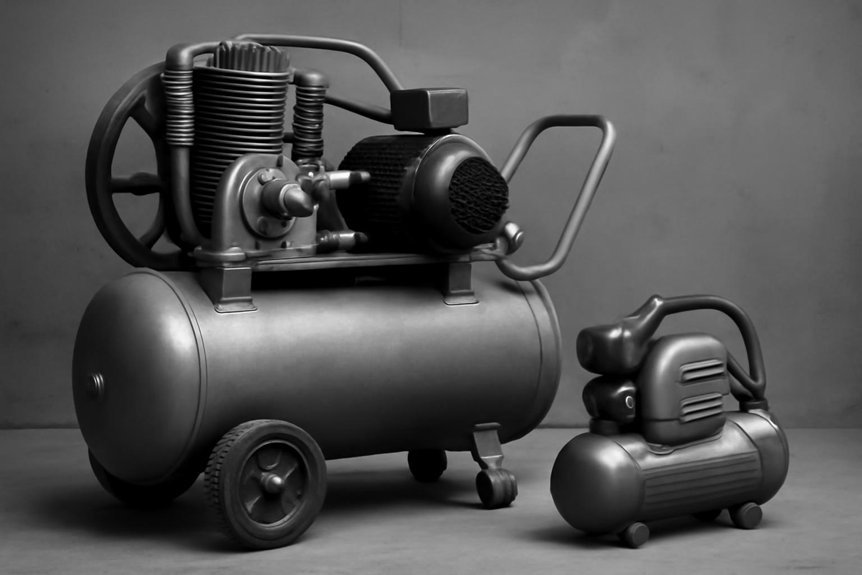
How do stationary and portable air compressors differ in design and size? Stationary compressors feature a robust stationary design, built for stability and continuous operation, often mounted on a concrete pad or frame. Their size is substantial, encompassing large tanks and heavy-duty components, which makes them less mobile. Conversely, portable compressors are designed with a compact, lightweight frame, emphasizing portability and ease of transport. Their portable size allows for quick setup and movement across job sites, often with integrated handles or wheels. The core distinction lies in their intended use: stationary models prioritize durability and high capacity, while portable units focus on maneuverability without sacrificing essential performance. Understanding these design and size differences helps in selecting the right compressor for specific operational needs.
What Are the Main Advantages of Stationary Air Compressors?
Stationary air compressors offer several key advantages that make them ideal for industrial and heavy-duty applications. Their stationary installation ensures stability, consistent performance, and reduced vibration, which enhances operational safety and longevity. Unlike portable battery powered units, stationary compressors can handle higher capacities, supporting continuous use in demanding environments. They also facilitate integration with large-scale systems, reducing downtime and maintenance costs. The fixed setup allows for easier management of cooling and lubrication systems, improving efficiency.
| Advantage | Description |
|---|---|
| Stability and Durability | Designed for continuous operation with minimal movement. |
| Capacity and Power | Supports larger air demands than portable units. |
| System Integration | Seamlessly connects with industrial infrastructure. |
| Maintenance Ease | Simplifies routine servicing and component access. |
When Should You Opt for a Portable Air Compressor?
Determining the best time to choose a portable air compressor depends on specific operational needs and logistical considerations. Portable power is advantageous when mobility is essential, such as on construction sites or remote locations. These compressors facilitate quick deployment without reliance on fixed infrastructure, enhancing operational efficiency. Noise considerations also influence this choice; portable units with lower decibel levels are preferable in noise-sensitive environments. Additionally, portability supports rapid maintenance and repositioning, reducing downtime. When tasks demand flexibility, or when space constraints prevent stationary setups, a portable compressor becomes the optimal solution. The ability to operate independently of power sources or air lines underscores its utility. Overall, scenarios requiring mobility, adaptability, and attention to noise levels justify opting for portable air compressors.
Which Factors Should You Consider When Choosing Between the Two?
Choosing between stationary and portable air compressors involves evaluating several key factors that directly impact operational efficiency and suitability. Critical considerations include power sources, noise levels, mobility needs, and operational environment. For off-grid power scenarios, stationary units with dedicated power supplies offer stability, while portable compressors excel where grid access is limited. Silent operation is essential in noise-sensitive settings, favoring models with noise reduction features. Mobility requirements determine whether fixed installation or lightweight design is more appropriate. Additionally, space constraints and usage frequency influence the choice. The table below summarizes these factors:
| Factor | Stationary Compressors | Portable Compressors | Relevance |
|---|---|---|---|
| Power Source | Mains, off grid options | Battery, portable generators | Off grid power compatibility |
| Noise Level | Higher, fixed installation | Lower, designed for quiet operation | Silent operation |
| Mobility | Fixed, less portable | Highly portable | Flexibility in use |
| Space Requirements | Larger footprint | Compact, space-saving | Suitable for tight spaces |
| Usage Frequency | Heavy, continuous use | Intermittent, quick deployment | Operational needs |
How Do Cost, Maintenance, and Durability Compare?
When comparing costs, maintenance, and durability between stationary and portable air compressors, it’s essential to analyze each aspect’s long-term implications. A thorough cost comparison reveals that stationary units often have higher initial investments but lower operational costs over time. Portable compressors typically involve lower upfront expenses but may incur higher maintenance due to frequent transportation and usage. Durability concerns are more prominent with portable options, which face increased wear from mobility and environmental exposure.
- Stationary compressors generally feature more robust construction for longevity
- Portable units are designed for mobility, often sacrificing some durability
- Maintenance for stationary models tends to be less frequent but more intensive
- Cost considerations should include both initial purchase and ongoing upkeep
- Durability differences directly influence long-term operational reliability
What Are Typical Use Cases for Stationary vs. Portable Compressors?
Stationary compressors are typically employed in manufacturing and industrial settings where continuous, high-volume air supply is essential. Portable compressors, on the other hand, are ideal for mobile maintenance tasks and on-site applications requiring flexibility. For DIY and home projects, compact units often provide the necessary power with greater convenience and ease of transport.
Manufacturing and Industrial Settings
Have you ever wondered how different compressor types serve manufacturing and industrial environments? The design evolution of stationary compressors emphasizes high capacity, durability, and noise mitigation, making them ideal for continuous, large-scale operations. Portable compressors, on the other hand, prioritize mobility and quick deployment, suitable for dynamic or temporary tasks.
Key use cases include:
- Powering assembly line tools in large factories
- Supporting maintenance and repair operations across sites
- Supplying compressed air for painting and surface finishing
- Use in construction sites for pneumatic tools
- Emergency backup in critical manufacturing processes
Stationary units excel in providing consistent, high-volume airflow with reduced noise levels, while portable models offer flexibility where space or infrastructure constraints exist. Both types are integral to efficient industrial workflows, reflecting their specialized design evolution.
Mobile Maintenance Tasks
Mobile maintenance tasks demand versatile and reliable compressed air sources that can adapt to various on-site conditions. When comparing Stationary vs. portable options, design differences play a crucial role. Stationary compressors are built for stability, with larger capacities and robust frames, making them ideal for continuous, high-demand tasks. Conversely, portable compressors feature lightweight, compact designs optimized for mobility, allowing quick deployment across multiple locations. These design differences influence their use cases: stationary units excel in facilities requiring constant air supply, while portable units are better suited for maintenance jobs, field repairs, or areas with limited space. Both types serve essential roles, but their distinct construction and intended mobility define their optimal application in mobile maintenance tasks.
DIY and Home Projects
In DIY and home project settings, choosing the right type of air compressor depends heavily on the specific tasks and workspace constraints. Stationary compressors excel in applications requiring continuous operation and higher CFM, making them suitable for tasks like framing, sanding, or spray painting. Portable compressors, on the other hand, are ideal for intermittent use and tasks that demand mobility, such as inflating tires or powering lightweight tools. Design considerations include size, power source, and noise reduction features, which influence usability in confined spaces. Noise reduction is particularly critical for home environments, favoring models with soundproofing or lower decibel ratings. Ultimately, the selection hinges on balancing power needs with workspace limitations, ensuring efficiency without compromising comfort or safety.
How Can You Determine the Best Air Compressor for Your Specific Needs?
To select the optimal air compressor, we need to evaluate your specific usage requirements and portability preferences. We should also consider the power capacity needed to meet your operational demands effectively. By analyzing these factors, you can identify the most suitable model that balances performance with practicality.
Intended Usage and Portability
How can you accurately determine the most suitable air compressor for your specific requirements? We consider intended usage and portability as key factors. For stationary setups, focus on models offering higher capacity, improved cost efficiency, and noise reduction features, ideal for long-term, continuous operation. Portable compressors excel in versatility, enabling quick deployment across job sites but often prioritize compactness over capacity.
Key considerations include:
- Frequency and duration of use
- Space constraints and mobility needs
- Power source availability
- Budget limitations and operational costs
- Noise sensitivity in the environment
Matching these factors ensures optimal performance, balancing cost efficiency with ease of transport. Proper assessment prevents over-specification or underperformance, aligning the compressor’s design with your operational demands.
Power and Capacity Requirements
Determining the appropriate power and capacity for your air compressor hinges on accurately evaluating your operational demands. For stationary vs portable power, consider airflow needs and pressure requirements. High-demand tasks like industrial equipment necessitate larger compressors with greater CFM (cubic feet per minute) and PSI (pounds per square inch). Conversely, smaller jobs or mobility needs favor portable compressors with moderate CFM and PSI.
| Feature | Stationary Air Compressor | Portable Air Compressor |
|---|---|---|
| Power Source | High horsepower, continuous | Lower horsepower, intermittent |
| Capacity (CFM/PSI) | 20+ CFM, 150+ PSI | Under 10 CFM, 120 PSI |
| Usage Type | Heavy-duty, industrial | Light-duty, on-the-go |
| Mobility | Fixed installation | Easily transportable |
Matching these factors ensures optimal performance aligned with your specific needs.
Frequently Asked Questions
What Safety Precautions Are Necessary for Operating Stationary Versus Portable Air Compressors?
We prioritize safety training and regular maintenance scheduling for both compressor types, ensuring proper operation. We also use protective gear, check for leaks, and follow manufacturer guidelines to prevent accidents and maintain ideal performance during compressor use.
How Does Energy Efficiency Compare Between Stationary and Portable Models?
Think of energy efficiency as the heartbeat of compressor choice; stationary models often optimize energy use for continuous tasks, lowering energy costs, while portable units prioritize mobility, sometimes sacrificing efficiency, impacting overall energy cost comparisons.
Are There Environmental Impacts Associated With Stationary Versus Portable Air Compressors?
We find stationary compressors often have a larger environmental footprint, influenced by energy use and manufacturing emissions, but recycling programs can mitigate impacts. Portable units tend to be more eco-friendly due to lower energy consumption and easier disposal aligned with environmental policies.
Can Portable Air Compressors Handle Heavy-Duty Industrial Tasks?
Portable air compressors generally can’t handle heavy-duty industrial tasks due to limited capacity, but they excel in portable maintenance, especially when budget constraints demand cost-effective, flexible solutions without the need for extensive, stationary equipment.
What Are the Typical Noise Levels of Stationary Versus Portable Air Compressors?
Like a whisper in a library, stationary compressors typically emit 70-80 dB, while portables are louder at 80-90 dB. The noise comparison highlights a tradeoff: portability often increases noise levels, affecting work environment considerations.
Conclusion
In assessing, choosing between stationary and portable air compressors hinges on a careful analysis of operational demands, mobility needs, and budget. While some might assume portability sacrifices power, advancements prove otherwise—portable units now deliver impressive performance for lighter tasks. Conversely, stationary compressors excel in high-demand, continuous applications. By evaluating your specific use case and future scalability, you can make an informed decision rooted in technical suitability, debunking myths about performance limitations and aligning equipment choice with operational efficiency.