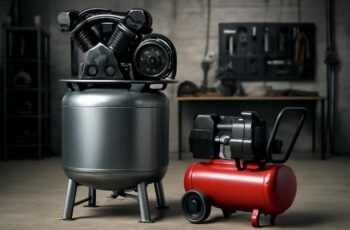
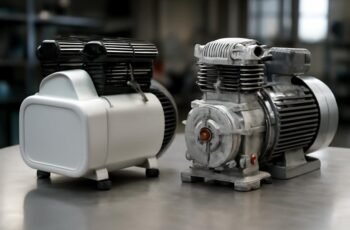
At the crossroads of efficiency and practicality, the choice between vertical and horizontal air compressors embodies a fundamental engineering decision. Each configuration reflects distinct design priorities—space optimization versus stability and capacity—that directly influence operational performance. Understanding the nuanced differences can determine a compressor’s suitability for specific environments and workloads. As we explore these options, it becomes clear that selecting the right model hinges on more than just size; it’s about aligning with your application’s demands and constraints.
Key Takeaways
- Vertical compressors save space and are ideal for limited areas, while horizontal models offer greater stability and capacity.
- Horizontal compressors are easier to move and integrate into existing systems, whereas vertical units are more compact and space-efficient.
- Vertical designs typically have a smaller footprint, making them suitable for confined spaces, unlike horizontal units that support heavier hardware.
- Horizontal compressors often provide higher capacity and better maintenance access compared to vertical models.
- Choice depends on space constraints, noise sensitivity, and operational needs, with vertical for tight spaces and horizontal for heavy-duty applications.
Understanding the Core Differences Between Vertical and Horizontal Air Compressors
Have you ever wondered how the orientation of an air compressor impacts its functionality and installation? The core difference between vertical and horizontal designs lies in their spatial configuration and how they manage internal components. A vertical design optimizes space efficiency, making it suitable for environments with limited floor area, and often simplifies maintenance due to its accessible layout. Conversely, a horizontal layout provides stability and easier integration into existing systems, especially when dealing with heavier units or extensive piping. These two word discussion ideas—vertical versus horizontal—highlight fundamental trade-offs: space-saving versus stability. Understanding these core differences helps determine which orientation aligns with operational needs, installation constraints, and maintenance considerations, ultimately influencing the compressor’s performance and longevity.
How Space and Portability Influence Your Choice of Compressor?
When selecting an air compressor, considering space constraints and portability needs is essential for optimal performance and operational efficiency. Space efficiency directly impacts installation flexibility, especially in limited environments. Portability factors influence ease of movement, maintenance, and deployment in different locations.
Choosing an air compressor requires balancing space efficiency and portability for optimal performance and flexibility.
Key considerations include:
- Size and footprint: Vertical compressors typically occupy less floor space, ideal for confined areas.
- Weight: Lighter units improve portability, facilitating relocation and setup.
- Mobility features: Casters or handles enhance ease of transport for horizontal models.
- Storage integration: Compact designs support efficient storage solutions, reducing workspace clutter.
Ultimately, understanding these factors helps tailor compressor selection to specific spatial and operational requirements, ensuring reliable performance without unnecessary space consumption.
Comparing Capacity and Performance for Various Industrial and Workshop Needs
Selecting an air compressor also involves evaluating its capacity and performance to meet specific industrial or workshop demands. Capacity, measured in CFM or PSI, determines how effectively the compressor can sustain continuous operations. Vertical and horizontal models often differ in their compact design, influencing how easily they integrate into different workspaces. Performance factors such as duty cycle and temperature stability directly impact operational reliability. Noise reduction is also crucial, especially in enclosed environments, affecting user comfort and compliance with regulations. Vertical compressors generally offer a smaller footprint, making them suitable for tight spaces, while horizontal units often provide higher capacities for demanding applications. Ultimately, choosing between these configurations hinges on balancing capacity, compact design, and noise considerations tailored to your specific industrial or workshop needs.
Pros and Cons of Vertical vs. Horizontal Compressors for Specific Applications
Are vertical and horizontal compressors truly suited for different applications, or do their inherent differences make one universally better? Vertical compressors offer enhanced vertical stability, making them ideal for limited floor space and installations requiring minimal footprint. They tend to have lower noise implications due to their compact design. Horizontal units excel in portability, allowing easier transportation and setup across diverse work environments. However, horizontal compressors generally provide better maintenance access, simplifying servicing routines.
Vertical compressors save space and reduce noise; horizontal models offer better portability and maintenance access.
- Vertical compressors are preferred where space is constrained and vertical stability is vital.
- Horizontal compressors suit applications demanding mobility and flexible positioning.
- Noise implications favor vertical units in noise-sensitive environments.
- Maintenance access is typically easier in horizontal models, reducing downtime for repairs.
Tips for Selecting the Right Air Compressor Based on Your Workspace and Usage
How can you determine the most suitable air compressor for your workspace and operational demands? First, assess your workspace size and layout to optimize for a compact workflow, ensuring the compressor fits without hindering movement or accessibility. Consider your usage frequency and required pressure levels to select a model with appropriate capacity and duty cycle. Noise considerations are essential; if your environment demands minimal disruption, prioritize quieter units designed with noise reduction features. For small or confined spaces, vertical compressors often conserve space, while horizontal models may offer higher capacity for extensive operations. Balancing these factors—space constraints, noise levels, and operational load—allows you to choose an air compressor that maximizes efficiency and minimizes disruptions, aligning with your specific workflow needs.
Frequently Asked Questions
Which Compressor Type Is More Energy-Efficient Over Long-Term Use?
We believe horizontal compressors often offer better energy efficiency over the long term due to easier maintenance and cooling options, reducing long-term costs. Vertical compressors may save space but can incur higher energy and maintenance expenses over time.
How Do Maintenance Requirements Differ Between Vertical and Horizontal Compressors?
Maintenance considerations differ mainly due to design implications; vertical compressors often require easier access to components, simplifying routine checks, while horizontal units may need more space and careful alignment, impacting maintenance efficiency and potential downtime.
Are There Any Safety Concerns Unique to Vertical or Horizontal Models?
Coincidentally, safety concerns in vertical models stem from their orientation, risking toppling or unstable mounting, while horizontal compressors mainly face hazards from uneven weight distribution, affecting stability and safety during operation.
Can Vertical Compressors Handle Higher Pressure Ratings Than Horizontal Ones?
Vertical compressors often handle higher pressure ratings due to their compact vertical design, which enhances capacity and efficiency. We find that their structural advantages typically support greater pressure thresholds compared to horizontal models, making them suitable for demanding applications.
How Does Noise Level Compare Between Vertical and Horizontal Air Compressors?
We find vertical compressors generally produce less noise, enhancing noise comparison, while their portability considerations often make them ideal for quieter, more mobile applications. Horizontal models may generate slightly more sound but excel in stability and capacity.
Conclusion
Ultimately, choosing between vertical and horizontal compressors depends on your specific workspace and operational demands. While vertical models excel in tight spaces, horizontal units offer greater capacity and mobility for larger setups. As the saying goes, “Know your tools, know your trade.” By analyzing your needs carefully, you ensure optimal performance and efficiency, making the right choice crucial for long-term success. A well-informed decision maximizes productivity while minimizing downtime and maintenance costs.