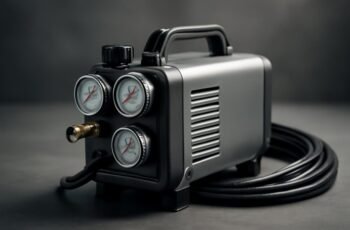
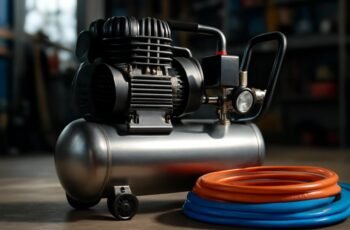
Like a master builder analyzing every component before construction begins, we understand the importance of selecting the right high pressure air compressor for demanding applications. With so many variables—pressure capacity, airflow, durability—making an informed choice requires a methodical approach. We’ll explore key features, types, and evaluation tips to ensure your investment meets your operational needs efficiently and safely, but the critical questions remain: how do you identify the best fit for your specific tasks?
Key Takeaways
- Determine required pressure (PSI) and airflow (CFM) to match your specific application needs.
- Evaluate the compressor’s durability, build quality, and safety features for long-term reliability.
- Consider maintenance ease, accessibility, and modularity to reduce downtime and service costs.
- Compare energy efficiency and operational costs alongside initial purchase price for true value.
- Select the compressor type (piston, diaphragm, scroll, rotary screw) based on space, flow rate, and portability requirements.
What Is a High Pressure Air Compressor and How Does It Work?
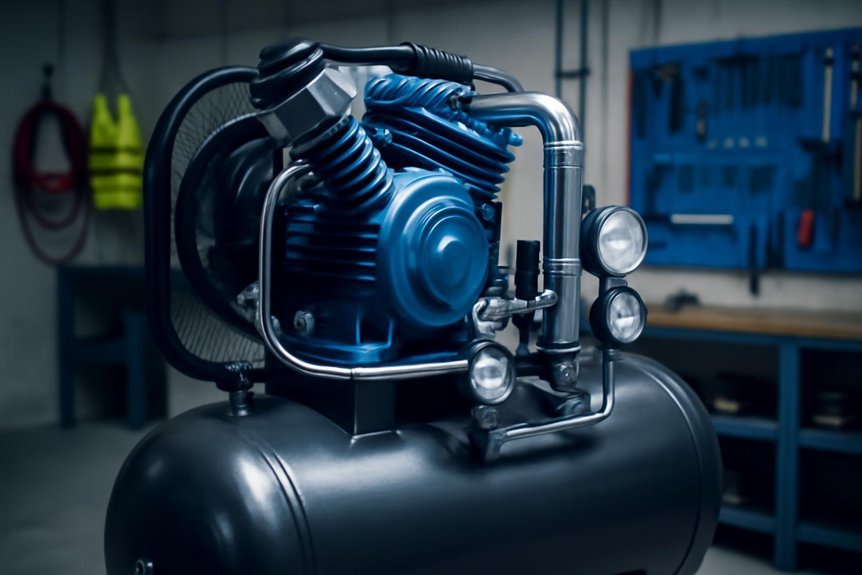
A high pressure air compressor is a device designed to generate and deliver compressed air at pressures considerably above standard levels, typically exceeding 300 psi. These compressors operate through advanced air compression techniques that increase the air’s density by reducing its volume. Using reciprocating or rotary vane mechanisms, they compress atmospheric air in stages, ensuring efficient high pressure output. The core principle involves controlling airflow and applying force to achieve the desired pressure, often involving intercooling to manage heat generated during compression. High pressure air compressors are essential in applications requiring intense air compression, such as industrial processes, testing, or specialized manufacturing. The precise control of pressure and flow rate is crucial, making these devices vital in scenarios demanding reliable, high-pressure air supply.
Key Features to Consider When Choosing a High Pressure Air Compressor
What critical features should we evaluate to select the optimal high pressure air compressor for demanding applications? First, we examine pressure capacity, ensuring the compressor can sustain the required PSI without fluctuations, similar to how unrelated topic choices impact decision-making in other fields. Next, we assess flow rate (CFM), which determines operational efficiency and cycle times. Durability and build quality are essential, especially for continuous duty cycles; materials like cast iron or stainless steel enhance longevity. Safety features, such as thermal protection and pressure relief valves, are non-negotiable. Noise levels also matter for off topic ideas like workplace environment. Finally, consider maintenance requirements and ease of serviceability, which directly influence long-term reliability and total cost of ownership. These key features are critical for selecting a high-pressure compressor suited for rigorous demands.
Different Types of High Pressure Air Compressors Explained
Have you ever wondered why different high-pressure air compressors are suited for specific applications? The variety primarily hinges on their design, capacity, and intended use. For instance, piston compressors excel in delivering high flow rates for industrial tasks, while diaphragm compressors provide portable power ideal for smaller-scale or field operations. Scroll compressors, with their compact design, are suitable where space efficiency is crucial, offering steady high-pressure output. Additionally, multistage rotary screw compressors combine high flow capabilities with energy efficiency, making them optimal for continuous operations. Understanding these distinctions helps match the compressor type to your specific needs, ensuring reliable performance and efficiency in high-pressure applications. Each type’s unique features directly influence its suitability for different operational environments and workload demands.
How to Determine the Right Pressure and CFM for Your Projects?
Selecting the appropriate pressure and CFM (cubic feet per minute) for your projects requires a clear understanding of your specific operational needs. To optimize cost efficiency, you should match the compressor’s pressure output to your tools’ requirements, avoiding over-specification that wastes energy. Accurate CFM ensures sufficient airflow without excess, reducing operational costs and minimizing unnecessary wear. It’s also crucial to consider noise reduction; higher pressure and CFM ratings often lead to increased noise levels. Balancing these factors involves assessing the maximum pressure needed and the continuous airflow demand of your applications. By precisely determining these parameters, you ensure efficient performance, lower energy consumption, and a quieter workspace—vital for long-term operational sustainability.
Tips for Evaluating Compressor Durability and Maintenance Needs
When assessing compressor durability, we focus on material and build quality to ensure long-term reliability under operational stresses. We also consider maintenance frequency and ease of service, as these factors directly impact operational uptime and total cost of ownership. Analyzing these points helps us select equipment that balances resilience with manageable upkeep.
Material and Build Quality
How can we accurately assess the durability and maintenance requirements of an air compressor? Focus on material sourcing and build quality, which directly impact longevity. High-quality components made from corrosion-resistant materials, such as stainless steel or treated aluminum, reduce degradation over time. Inspect the construction for sturdy welds and precision manufacturing, indicating robustness. Consider the compressor’s core parts—cylinders, valves, and tanks—for material stability under high pressure. Durability depends on how well these elements withstand operational stresses. Additionally, assess the protective coatings and finishes that shield against corrosion. A well-built compressor with superior material sourcing ensures lower maintenance needs and longer service life, making it a more reliable investment in demanding environments.
- Material sourcing and corrosion-resistant coatings
- Structural integrity of welds and joints
- Quality of critical components (cylinders, valves)
- Protective finishes and surface treatments
Maintenance Frequency and Ease
Evaluating a compressor’s maintenance frequency and ease begins with examining the design and accessibility of its key components. A well-designed compressor minimizes maintenance frequency by incorporating durable parts that resist wear and extend service intervals. Ease of maintenance is critical; accessible panels, straightforward component layouts, and clear service points reduce downtime and labor complexity. We assess how easily filters, oil reservoirs, and valves can be inspected, cleaned, or replaced. Compressors with modular components often simplify maintenance tasks, improving ease of maintenance. Additionally, automation features like monitoring systems can alert operators to impending issues, reducing unforeseen repairs. Overall, a compressor that balances low maintenance frequency with user-friendly accessibility ensures greater durability and operational efficiency over its lifespan.
Safety Tips and Best Practices for Operating High Pressure Compressors
What are the critical safety considerations we must prioritize when operating high-pressure air compressors? Ensuring proper safety training is essential to prevent accidents and maintain operational integrity. We must also address noise exposure, which can impair concentration and cause long-term hearing damage. Regular inspections of pressure gauges and safety valves prevent over-pressurization risks. Proper ventilation reduces the buildup of hazardous fumes and heat. Additionally, operators should wear appropriate personal protective equipment (PPE) and adhere to lockout/tagout procedures during maintenance. Maintaining clear communication and standardized operating procedures minimizes human error. By focusing on these safety practices, we mitigate potential hazards and ensure safe, reliable compressor operation.
Comparing Prices and Finding the Best Value for Your Investment
When comparing high-pressure air compressors, we focus on balancing initial costs with long-term value. Evaluating features relative to price helps identify units that deliver essential performance without unnecessary expenses. This approach guarantees our investment aligns with both budget constraints and operational requirements.
Budget Considerations and Costs
How do you determine the best value when comparing high-pressure air compressors? We analyze total cost of ownership, factoring initial purchase price, maintenance expenses, and lifespan. While price alone isn’t sufficient, understanding the long-term financial impact is crucial. It’s also essential to consider reliability and efficiency, as unrelated topic concerns like power consumption can significantly influence operational costs.
Key factors include:
- Equipment durability and warranty coverage
- Energy efficiency ratings and operating costs
- Compatibility with existing systems
- Hidden costs such as repairs or upgrades
Balancing these factors ensures you avoid overspending on features irrelevant to your needs, like excessive capacity, and focus on true value. This analytical approach helps prevent off topic concerns from skewing budget priorities, ensuring a financially sound investment.
Features Versus Price
Evaluating the relationship between features and price is essential to identifying the best value in high-pressure air compressors. We analyze how additional features—such as advanced cooling systems, integrated dryers, or automation—affect overall cost and performance. A balanced pricing strategy considers not only upfront cost but long-term efficiency, maintenance, and durability. Sometimes, an unrelated topic like premium brand reputation influences pricing without substantial functional benefits, so discerning true value is critical. We compare models with similar specifications, assessing whether higher prices justify enhanced features or if simplified units meet your needs at a lower cost. Ultimately, understanding this trade-off helps avoid over-investment and ensures your purchase aligns with both operational demands and budget constraints.
Common Mistakes to Avoid When Buying a High Pressure Air Compressor
One of the most common pitfalls in selecting a high pressure air compressor is focusing solely on maximum pressure ratings without thoroughly considering airflow capacity and duty cycle. This wrong topic idea often leads buyers to prioritize pressure specs while ignoring operational needs, resulting in equipment that underperforms or fails prematurely. Avoid an irrelevant focus that neglects the compressor’s ability to sustain continuous use or deliver sufficient airflow for your applications.
- Overlooking airflow requirements for specific tasks
- Ignoring duty cycle limitations impacting long-term operation
- Selecting based solely on maximum pressure, ignoring real-world performance
- Falling for irrelevant focus on brand or aesthetic, rather than technical specifications
Frequently Asked Questions
What Are the Environmental Impacts of High Pressure Air Compressors?
The environmental impact of high pressure air compressors mainly hinges on energy efficiency; less efficient models consume more power, increasing carbon emissions. We analyze energy usage to minimize ecological footprints, emphasizing sustainable design and operational practices for reduced environmental impact.
How Does Temperature Affect Compressor Performance and Lifespan?
Think of a compressor like a finely tuned engine; temperature effects, like overheating, reduce efficiency and cause wear. Elevated temperatures lower lubricant viscosity, increasing friction and decreasing lifespan, while optimal temps sustain performance and prolong compressor longevity.
Are There Any Government Regulations for High Pressure Air Compressor Use?
We find that government regulations mainly address environmental impacts and safety standards. These rules ensure compressor emissions are controlled and operational practices are safe, helping us comply and minimize environmental footprints, ultimately promoting sustainable industrial use.
Can Portable Compressors Deliver Consistent Pressure for Industrial Tasks?
Like a steady heartbeat, portable compressors can deliver consistent pressure for industrial tasks when designed for portable reliability. Regular flushing maintenance ensures optimal performance, making them dependable tools that adapt efficiently to demanding environments with minimal downtime.
What Are the Best Accessories and Attachments for High Pressure Air Compressors?
We find that compatible accessories like high-pressure hoses, quick-connect fittings, and specialized nozzles adhere to attachment standards, ensuring optimal performance. Evaluating accessories compatibility and adhering to attachment standards guarantees safe, efficient, and precise operation of high-pressure air compressors.
Conclusion
Just as a skilled navigator selects the right compass for a journey, choosing the right high pressure air compressor guides your projects safely and efficiently. By analyzing your needs—pressure, airflow, and duty cycle—and evaluating features like durability, safety, and cost, we ensure a precise fit. With careful consideration, you’ll avoid the pitfalls of ill-suited equipment and chart a course toward optimal performance, maximizing your investment and powering your success with confidence.