At the intersection of efficiency and durability, the choice between budget and premium air compressors acts as a crossroads for many professionals and hobbyists alike. We often see the trade-offs in build quality, performance, and long-term costs, yet understanding these differences is critical for making an informed decision. As we examine the core distinctions, it becomes clear that the right compressor depends on more than initial price—it’s about aligning features with real-world demands, which warrants a closer look.
Key Takeaways
- Premium compressors typically use higher-grade components, offering greater durability and longer lifespan compared to budget models.
- Higher upfront costs for premium units are offset by lower energy consumption and reduced maintenance expenses over time.
- Budget compressors are suitable for light-duty, occasional tasks, while premium models are designed for continuous, demanding use.
- Premium units generally feature better noise reduction, stability, and advanced thermal management for consistent performance.
- Cost considerations should include not just initial price but also energy efficiency, warranty coverage, and long-term reliability.
How Do Budget and Premium Air Compressors Differ in Build Quality?
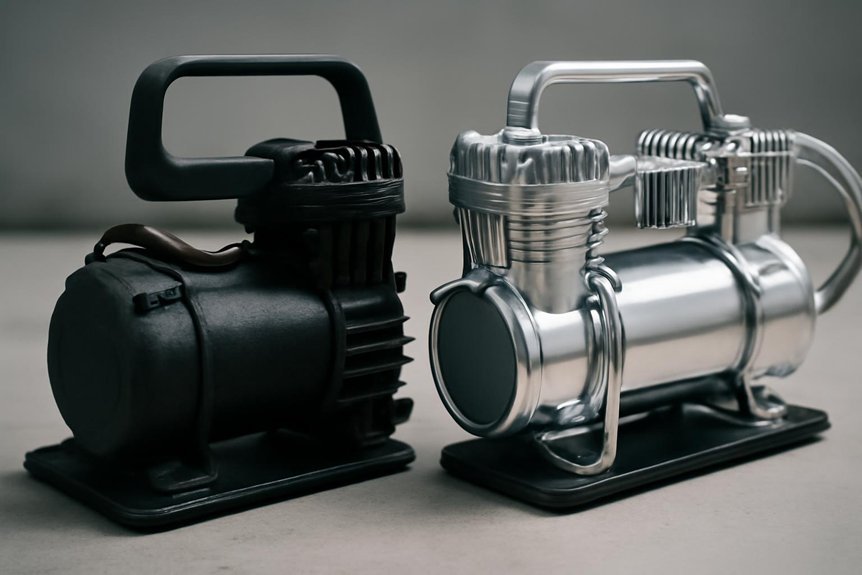
How do budget and premium air compressors differ in build quality? The answer lies in the materials used and manufacturing precision. Premium compressors typically feature higher-grade components, such as cast-iron cylinders and durable steel frames, which enhance overall robustness and longevity. Their build quality often emphasizes precision engineering, resulting in fewer vibrations and improved stability during operation. Budget models, by contrast, tend to utilize lighter, less durable materials like aluminum or plastics, which may compromise long-term reliability. While performance features are often comparable initially, the build quality of premium units ensures consistent performance over time, reducing maintenance needs. These differences directly impact operational efficiency, with premium compressors offering superior durability, stability, and resilience under continuous use.
What Performance Features Set Premium Compressors Apart From Budget Models?
Premium air compressors distinguish themselves through advanced performance features that optimize efficiency and reliability. These models typically incorporate higher-quality motors with increased horsepower, enabling sustained operation under demanding conditions. They often feature enhanced thermal management systems, reducing overheating risks and prolonging component life, which embodies premium performance. Additionally, premium compressors usually boast superior pressure stability and reduced pulsation, ensuring consistent airflow essential for precision tasks. These improvements translate into more efficient energy consumption, offsetting higher initial costs with lower operational expenses. In contrast, budget models prioritize practicality but often lack the refined performance characteristics necessary for continuous or heavy-duty use. Overall, premium compressors deliver a level of performance that ensures reliability, precision, and long-term value, setting them apart from more basic, budget-friendly options.
How Much Should You Expect to Spend on Different Types of Air Compressors?
Determining the appropriate budget for an air compressor depends heavily on the specific application and performance requirements. Budget models typically range from $200 to $1,000, focusing on essential features with limited friction dampening technology, which can affect efficiency and longevity. Premium units, often costing $1,500 to over $5,000, incorporate advanced friction dampening systems and precise color coding for easy identification of parts, enhancing maintenance and reliability. These enhancements reduce wear and energy consumption over time, justifying the higher initial investment. When considering costs, it’s important to evaluate the compressor’s capacity, durability, and efficiency features. While cheaper models may suffice for light, infrequent use, heavy-duty applications demand the robustness and optimized performance found in higher-end options.
Which Use Cases Are Best Suited for Budget Air Compressors?
Budget air compressors are well-suited for applications that involve infrequent or light-duty tasks where high performance and long-term durability are not primary concerns. They effectively address budget challenges by offering cost-efficient solutions for small-scale operations. However, feature tradeoffs—such as lower CFM output, reduced duty cycles, and basic components—limit their suitability for continuous or demanding use. These compressors excel in scenarios like occasional tire inflation, hobbyist woodworking, or small workshop tasks, where performance demands are minimal. While they may require more frequent maintenance or shorter lifespan, their affordability makes them attractive for users with limited budgets. Recognizing these constraints helps ensure that budget air compressors are deployed in appropriate use cases, avoiding overstated expectations and maximizing value within their inherent limitations.
Why Do Premium Air Compressors Typically Last Longer and Require Less Maintenance?
Durability and reliability are often rooted in the quality of components and engineering precision. Premium air compressors feature superior build quality, which enhances premium longevity and reduces maintenance needs. Their advanced performance features, such as enhanced energy efficiency and robust components, directly contribute to longer operational life and fewer breakdowns. This results in maintenance reduction and minimizes hidden costs over time. When selecting a compressor, understanding application requirements and aligning with budget priorities is essential. Premium units tend to offer better noise portability and overall efficiency, making them suitable for demanding environments. However, higher initial costs must be weighed against long-term benefits, including lower maintenance and operational expenses. An informed selection strategy considers these factors to optimize performance and cost considerations.
| Feature | Impact on Longevity & Maintenance |
|---|---|
| Build Quality | Enhances durability and reduces breakdowns |
| Performance Features | Improves efficiency and operational life |
| Energy Efficiency | Cuts ongoing energy costs |
| Noise Portability | Supports versatile, quieter operation |
How Do Noise Levels and Portability Compare Between Budget and Premium Options?
How do noise levels and portability differ when comparing budget and premium air compressors? Typically, premium models feature superior build quality, resulting in lower noise levels due to sound-dampening materials and optimized motor design. This enhances performance by reducing operational noise, which is vital for sensitive environments. In terms of portability, premium options often incorporate ergonomic handles, lighter materials, and compact designs, making them easier to transport and position. Budget models, conversely, tend to have higher noise levels due to less sophisticated construction and heavier, bulkier frames that hinder portability. While both categories may meet basic performance features, the premium units excel in integrating noise reduction and portability as part of their overall build quality, offering a more efficient and user-friendly experience.
What Are the Hidden Costs to Consider When Choosing a Budget or Premium Air Compressor?
When selecting an air compressor, we must consider hidden costs like ongoing maintenance and repair expenses, which can substantially impact total ownership. Additionally, energy consumption varies between models, affecting operational costs over time. Evaluating these factors ensures a thorough understanding of long-term affordability beyond initial purchase price.
Maintenance and Repair Expenses
Have you considered how maintenance and repair costs can substantially influence the total cost of ownership for air compressors? Budget models often incur higher amortization costs due to frequent repairs and shorter warranty longevity, which can lead to increased long-term expenses. Premium compressors typically offer extended warranties and more durable components, reducing the frequency and cost of repairs over time. These initial savings on purchase price may be offset by recurring maintenance costs if the equipment isn’t robust. Additionally, a longer warranty period can mitigate unexpected repair expenses, improving cost predictability. Ultimately, evaluating the balance between upfront investment and ongoing maintenance is critical, as hidden repair expenses can erode any perceived savings from choosing a budget model.
Energy Consumption Costs
Energy consumption costs often represent a significant and less immediately visible component of the total ownership expense for air compressors. When evaluating budget versus premium models, detailed pricing of energy use becomes critical, as higher efficiency units typically consume less power over their lifespan. Premium compressors often feature advanced motor designs and variable speed drives, reducing ongoing energy expenses despite higher initial costs. Conversely, budget models may appear cheaper upfront but can lead to increased operational costs due to higher energy consumption. Warranty terms also influence long-term costs; comprehensive warranties on premium units can mitigate future repair expenses, indirectly affecting energy efficiency and reliability. Ultimately, assessing the hidden energy costs requires a thorough comparison of detailed pricing, including energy use and warranty coverage, to determine true value over time.
How Can You Decide Which Air Compressor Fits Your Budget and Needs Best?
To determine the best air compressor for your budget, we must evaluate your financial constraints alongside the specific operational demands of your applications. Prioritizing essential features and understanding application-specific requirements enable a targeted selection that balances cost-effectiveness with performance. This approach guarantees the chosen compressor aligns with both your budget limitations and functional needs.
Budget Constraints and Priorities
Determining the most suitable air compressor within a fixed budget requires a clear understanding of your operational priorities and usage demands. Accurate budget assessment hinges on balancing initial costs against long-term expenses, emphasizing budget accuracy. We must consider performance longevity—how well a unit maintains consistent output over time—and whether lower-cost models can sustain operational efficiency without frequent repairs. Prioritizing performance longevity often justifies higher upfront investments, but if budget constraints are tight, we focus on reliable models that meet core needs without excessive features. Analyzing total cost of ownership, including maintenance and energy consumption, helps identify the compressor that aligns with both fiscal limits and operational durability. This strategic approach ensures we select equipment that optimizes value within financial boundaries.
Application Specific Requirements
How do we identify the most suitable air compressor based on specific application requirements? First, we analyze operational demands such as airflow, pressure, and duty cycle. These parameters determine whether a budget tradeoff is feasible or if a premium unit’s reliability benchmarks are necessary. For high-precision or continuous operations, investing in a more reliable compressor reduces downtime and maintenance costs, justifying higher upfront expenses. Conversely, for intermittent tasks or low-demand applications, a budget model may suffice, provided it meets minimum performance standards. We also consider environmental factors and energy efficiency, which impact long-term costs. Ultimately, matching application needs with compressor capabilities ensures peak performance while balancing budget constraints, leading to an informed decision aligned with operational priorities.
Frequently Asked Questions
Are There Specific Brands Known for Reliable Budget or Premium Air Compressors?
We find that reliable budget brands like Campbell Hausfeld and Porter-Cable are cost-effective, while premium brands such as Ingersoll Rand and Quincy deliver superior durability and performance. Choosing depends on your specific application and long-term needs.
How Does Energy Efficiency Differ Between Budget and Premium Models?
Isn’t it striking how premium models often outperform budget ones in energy efficiency, balancing durability against cost? We see these tradeoffs clearly; premium compressors typically use advanced technology, reducing energy use, while budget options prioritize initial affordability over long-term savings.
What Safety Features Are Typically Included in Premium Air Compressors?
Premium air compressors include safety features like premium safety mechanisms, additional protections such as thermal overload and pressure relief valves, addressing reliability concerns, and thorough warranty coverage, ensuring enhanced operational safety and minimizing risk of damage or failure.
Can Budget Air Compressors Handle Professional-Grade Tasks?
Like a fragile vessel steering stormy seas, budget air compressors often struggle with professional-grade tasks due to limitations in durability and power, making them less suitable for demanding applications, despite their affordability and basic operational capabilities.
How Often Should You Service or Replace Parts on Each Type?
We recommend scheduling maintenance every 1,000-2,000 hours for both compressor types, considering usage intensity. Premium models typically have lower noise levels, requiring less frequent parts replacement, while budget units demand more regular upkeep for ideal performance.
Conclusion
Ultimately, choosing between budget and premium air compressors is like selecting the right tool for a specific job—each has its place. By analyzing build quality, performance, costs, and intended use, we can make an informed decision that balances initial investment with long-term reliability. Carefully weighing these factors guarantees we avoid unnecessary expenses and downtime, much like fine-tuning an engine for peak performance—precise, strategic, and tailored to our needs.