Choosing an air compressor dryer is like navigating a complex maze, where each decision impacts your system’s efficiency and reliability. We understand that selecting the right dryer involves analyzing moisture removal needs, capacity demands, and operational constraints. This systematic approach ensures you avoid costly mistakes and optimize performance over time. To make informed choices, it’s essential to examine the differences between dryer types and their suitability for your specific application, opening the door to more precise, long-term solutions.
Key Takeaways
- Assess your system’s moisture removal requirements and select a dryer type (refrigerated or desiccant) based on dew point and application needs.
- Determine your peak air flow demand (CFM) to size the dryer appropriately, avoiding under- or over-capacity.
- Consider noise levels, startup time, and environmental conditions to choose a dryer that fits operational and space constraints.
- Evaluate maintenance needs, durability, and ease of service to ensure long-term reliability and minimal downtime.
- Balance initial costs, operating expenses, and lifespan to select a dryer offering optimal performance and value.
Understanding the Different Types of Air Compressor Dryers
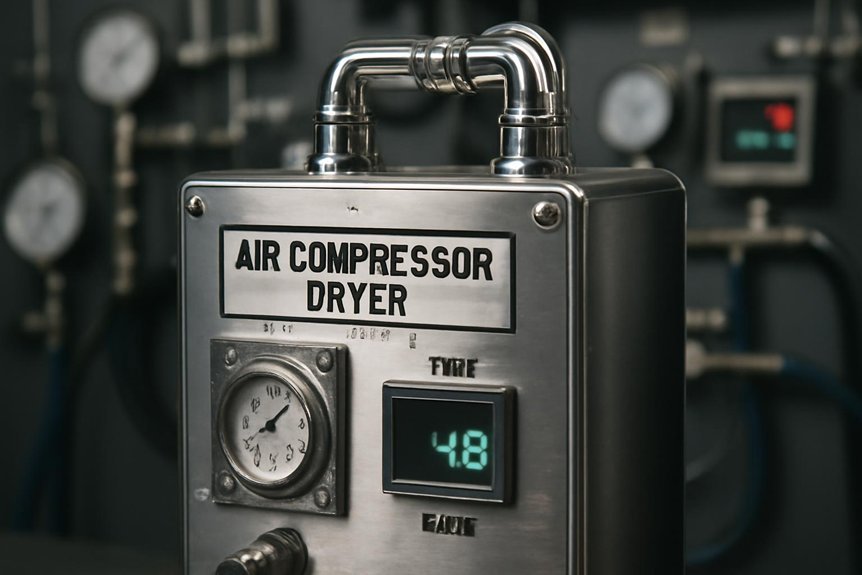
Air compressor dryers are essential components that guarantee the compressed air is free of moisture and contaminants, which can cause damage or inefficiency in various applications. When understanding different types, we evaluate their impact on rapid startup capabilities and noise reduction. Refrigerated dryers are popular for their quick response time, enabling rapid startup without significant delay. They also tend to operate quietly due to their hermetic compressor design, aiding noise reduction. Desiccant dryers, although effective at removing moisture, typically involve more complex systems that may prolong startup times and generate higher noise levels. Analyzing these factors systematically helps determine the most suitable dryer type based on operational demands. By understanding these technical distinctions, we can optimize performance, minimize downtime, and ensure consistent, clean compressed air output.
How to Assess Your Air Compressor’s Capacity Needs
How can you accurately determine your compressor’s capacity to meet operational demands? To ensure effective capacity planning and energy budgeting, we analyze flow rates and peak usage. First, gather data on your existing equipment’s air consumption, measured in CFM (cubic feet per minute). Next, evaluate your system’s maximum demand during peak operations. Use this table to visualize your needs:
| Application Type | Average CFM | Peak CFM |
|---|---|---|
| Manufacturing | 50 | 80 |
| Maintenance | 20 | 30 |
| Assembly | 40 | 60 |
This systematic approach helps determine the compressor size required, avoiding under- or over-capacity issues. Accurate assessment ensures energy-efficient operation and sustainable capacity planning.
Factors That Affect Dryer Energy Efficiency and Operating Costs
Understanding how power consumption varies with load and operational cycles is essential for optimizing dryer efficiency. Maintenance requirements, such as filter replacements and system calibrations, directly influence ongoing energy use and costs. Additionally, environmental factors like ambient temperature and humidity can impact dryer performance and energy consumption, warranting consideration in system design.
Power Consumption Variability
What factors primarily influence a dryer’s energy consumption and operational expenses? Variability in power consumption stems from operational conditions, load fluctuations, and ambient environment. For example, inconsistent demand leads to inefficient cycling, increasing energy use—an irrelevant topic when the focus is on consistent operation. Additionally, the dryer’s design and control systems, such as variable frequency drives, can optimize or hinder efficiency. External factors like temperature and humidity may cause the dryer to work harder, raising energy costs. Random focus on unrelated components, like auxiliary systems, can distort the actual power draw. Systematic assessment of these factors helps identify inefficiencies and optimize energy use, ensuring cost-effective operation. Recognizing these influences allows for better selection tailored to specific application demands.
Maintenance Requirements Impact
Maintenance requirements significantly influence a dryer’s energy efficiency and operational costs by ensuring all components function optimally. Regular maintenance, including filter replacements, desiccant recharging, and system inspections, prevents performance degradation. Neglecting these tasks leads to increased energy consumption, as clogged filters or worn-out parts force the system to work harder. Proper maintenance reduces downtime and extends the dryer’s lifespan, ultimately lowering operating costs. Additionally, consistent upkeep maintains the system’s efficiency, preventing energy waste caused by leaks or inefficiencies. Systematic adherence to maintenance schedules enables early detection of potential issues, safeguarding energy efficiency and minimizing costly repairs. Overall, diligent maintenance is critical to optimizing dryer performance, controlling energy consumption, and managing long-term operating expenses.
Operating Environment Factors
How does the operating environment influence the energy efficiency and operating costs of an air compressor dryer? The operating environment directly impacts moisture removal efficiency, as high ambient humidity introduces more moisture into the system, increasing the load on the dryer. Elevated temperatures can reduce the dryer’s ability to effectively remove moisture, leading to higher energy consumption. Conversely, cold or highly humid conditions demand more energy for moisture removal to prevent condensation and corrosion. Properly evaluating the environment allows us to select a dryer with appropriate capacity and features, such as insulated components or advanced moisture separation technology. An optimized operating environment minimizes unnecessary energy use, reduces equipment strain, and lowers long-term operating costs, ensuring consistent air quality and system reliability.
Key Features to Look for in a Commercial vs. Industrial Dryer
When selecting a commercial or industrial dryer, we focus on critical features such as capacity and throughput, which directly impact performance under load. We also assess durability and build quality to ensure long-term reliability in demanding environments, along with maintenance requirements and ease of operation. Analyzing these factors systematically helps us identify the most suitable dryer for specific operational needs.
Capacity and Throughput
What determines the suitability of an air compressor dryer for a specific application is primarily its capacity and throughput, which directly impact performance and efficiency. Capacity refers to the maximum volume of air the dryer can handle within a given time, while throughput indicates the actual volume processed during operation. For commercial applications, selecting a dryer with appropriate capacity ensures consistent moisture removal without overloading the system. Industrial environments demand higher throughput to match peak demand, preventing bottlenecks. While capacity and throughput are critical, avoid irrelevant topics like random pairing of unrelated equipment, which can lead to mismatched specifications. Proper assessment involves analyzing airflow requirements and system demands, ensuring the chosen dryer effectively balances capacity with operational efficiency.
Durability and Build Quality
Determining the durability and build quality of an air compressor dryer is essential for ensuring long-term reliability in demanding environments. We evaluate durability benchmarks such as corrosion resistance, impact tolerance, and thermal stability to predict how well a unit withstands operational stresses. Build resilience, including robust materials like stainless steel or heavy-duty plastics, enhances longevity. Industrial dryers often feature reinforced frames and high-grade components, while commercial models prioritize cost-effective resilience. Systematic assessment involves examining manufacturer specifications, testing standards, and real-world performance data. A dryer’s ability to maintain consistent operation under fluctuating conditions directly correlates with its durability. Ultimately, selecting a unit with proven build resilience minimizes downtime and replacement costs, ensuring sustained efficiency over its service life.
Maintenance and Ease of Use
Effective maintenance and user-friendly features are critical factors in selecting a commercial or industrial air compressor dryer. Prioritizing ease of operation ensures minimal downtime and simplifies routine tasks. Key considerations include:
- Accessible components – Design that allows quick inspection and replacement of filters and desiccants.
- Automated controls – Programmable functions that reduce manual adjustments and improve consistency.
- Clear diagnostics – Integrated alerts and display panels that facilitate maintenance tips and troubleshooting.
- Robust construction – Durable interfaces that withstand harsh environments, reducing maintenance frequency.
Analyzing these features systematically helps optimize operational efficiency and ensures longevity. Emphasizing ease of use and straightforward maintenance procedures ultimately minimizes costs and enhances performance, making it essential to evaluate these factors when selecting a dryer.
How to Match Your Dryer to Your Specific Application Requirements
How do you guarantee your air compressor dryer aligns precisely with your application’s demands? First, evaluate your required dew point and moisture removal capacity based on your process specifications. For applications sensitive to noise, select a dryer with low noise operation to minimize disruption. If space is limited, prioritize models with a compact footprint to optimize your facility layout. Consider the operating environment—excessive heat or dust may necessitate more robust filtration and insulation. Additionally, assess your flow rates and pressure requirements to ensure the dryer’s capacity matches your system load. Systematic analysis of these parameters enables a tailored approach, ensuring optimal performance and efficiency. Matching these factors guarantees the dryer’s suitability, performance, and longevity within your specific application.
Common Mistakes to Avoid When Choosing an Air Dryer
Are we overlooking critical factors when selecting an air dryer? Common mistakes often lead to inefficient performance or costly errors. First, choosing a dryer based solely on capacity without considering pressure dew point can result in inadequate moisture control. Second, focusing on irrelevant topics like energy efficiency without aligning with specific application needs risks over-specification. Third, pairing incompatible components without systematic evaluation may cause operational issues—think of it as a random pairing, which hampers overall system reliability. Lastly, neglecting maintenance requirements or ignoring operational conditions can accelerate wear or compromise moisture removal. Avoiding these errors requires a systematic, technical approach—matching dryer specifications precisely to your application demands, rather than relying on superficial or irrelevant factors.
The Importance of Moisture Removal and How to Achieve It
Why is moisture removal such a critical component of compressed air systems? Moisture in compressed air can cause corrosion, damage sensitive equipment, and compromise product quality. Achieving dryness involves systematically removing water vapor before it condenses into liquid. Effective moisture removal depends on selecting the appropriate dryer type—desiccant, refrigerated, or membrane—based on application demands. Properly designed systems ensure optimal dew point control, preventing moisture-related issues downstream. Technical considerations include monitoring dew point levels, controlling pressure drops, and maintaining equipment integrity. Achieving dryness consistently reduces maintenance, minimizes downtime, and extends system lifespan. In summary, moisture removal is essential for reliable, high-quality compressed air systems, and choosing the right dryer ensures the system operates efficiently with minimal moisture-related risks.
Evaluating Maintenance, Durability, and Longevity of Dryers
When selecting an air dryer, evaluating its maintenance requirements, durability, and longevity is essential for ensuring reliable operation over time. We analyze maintenance considerations such as ease of filter access, frequency of part replacements, and system calibration. Durability benchmarks include material quality, resistance to corrosion, and operational stability under load. To assess these factors systematically, consider:
- Maintenance intervals and associated costs
- Construction materials and corrosion resistance
- Mean time between failures (MTBF) data
- Warranty coverage and service support
Making the Final Decision: Comparing Costs, Benefits, and Performance
How can we effectively compare the costs, benefits, and performance metrics of different air dryer options to make an informed final decision? We focus on key factors like initial investment, ongoing maintenance, and moisture removal efficiency. A systematic cost comparison reveals total ownership costs and operational savings. Performance metrics such as dew point and airflow capacity determine moisture removal effectiveness. To clarify, consider this table:
| Criteria | Evaluation Focus |
|---|---|
| Initial Cost | Purchase price and installation |
| Operating Cost | Energy consumption and maintenance |
| Moisture Removal | Dew point and residual moisture |
| Durability & Longevity | Expected lifespan and reliability |
| Performance Consistency | Steady moisture removal over time |
Frequently Asked Questions
What Is the Typical Lifespan of an Air Compressor Dryer?
Air compressor dryers typically last 8-12 years with proper lifespan maintenance. Upgrades can boost efficiency and extend longevity, but regular system checks and timely replacements are essential to maximize lifespan and maintain ideal performance systematically.
How Often Should I Schedule Maintenance for My Dryer?
We recommend regular maintenance scheduling every 3 to 6 months to maximize air dryer longevity, systematically inspecting and servicing components, ensuring optimal operation, preventing potential problems, and prolonging the dryer’s lifespan through proactive, precise upkeep.
Can I Upgrade My Existing Dryer to Improve Performance?
Yes, we can upgrade our existing dryer by evaluating upgrading compatibility, such as installing advanced filtration or desiccant systems, to achieve performance gains. Systematic evaluation ensures compatibility and maximizes efficiency improvements without complete replacement.
Are There Environmental Considerations When Operating an Air Dryer?
Yes, environmental considerations matter—we analyze the air dryer’s environmental impact and prioritize energy efficiency. Minimizing emissions and energy use not only benefits the planet but also enhances system reliability and reduces operational costs systematically.
How Do I Determine the Appropriate Moisture Removal Level for My Needs?
We determine humidity requirements by analyzing our system’s specifications and selecting a desiccant that matches our desired dew point. Systematic testing and understanding moisture levels help us choose the right moisture removal level efficiently.
Conclusion
In conclusion, selecting the right air compressor dryer is like tuning a finely crafted instrument—precision and understanding guarantee optimal performance. By systematically evaluating your specific needs, capacity, efficiency, and maintenance factors, we can avoid costly missteps. A well-matched dryer not only safeguards your system but also acts as the backbone of reliable operation. Ultimately, careful analysis and informed choices transform a complex task into a strategic advantage, guaranteeing long-term productivity and efficiency.