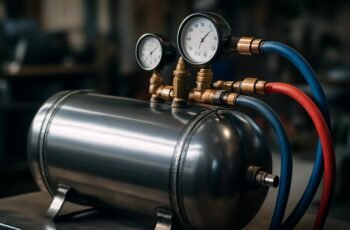
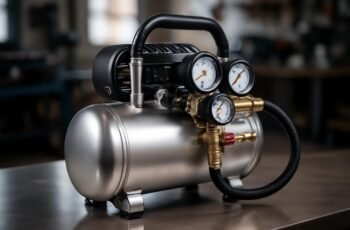
When selecting an air compressor, we understand the importance of a thorough, technical approach to guarantee optimal performance and long-term reliability. By systematically evaluating factors such as compressor types, capacity requirements, power sources, and site-specific constraints, we can identify the best fit for your needs. This process involves detailed analysis of features, maintenance, and budget considerations—elements that are crucial for making an informed decision. To truly optimize your choice, it’s essential to consider each aspect carefully before making a purchase.
Key Takeaways
- Determine your required CFM and PSI to match compressor capacity with tool and project demands.
- Choose the appropriate compressor type (reciprocating, rotary screw, centrifugal) based on application and maintenance considerations.
- Assess tank size, power source, portability needs, and site constraints for optimal performance and mobility.
- Evaluate noise levels, accessories, and features like filters, silencers, and enclosures for environment suitability.
- Consider warranty, brand reputation, reviews, and budget to ensure reliable, cost-effective purchase.
What Are the Key Types of Air Compressors and How Do They Differ?
What are the key types of air compressors, and how do they differ in operation and application? The main categories—reciprocating, rotary screw, and centrifugal—vary significantly in airflow efficiency and maintenance planning. Reciprocating compressors use pistons and deliver high-pressure air intermittently, suitable for small-scale tasks but require rigorous maintenance. Rotary screw compressors operate continuously with meshing rotors, offering higher airflow efficiency and lower maintenance demands, ideal for industrial applications. Centrifugal compressors utilize high-speed impellers for large-volume air, excelling in constant, high-demand environments but demanding complex maintenance. Understanding these distinctions helps optimize performance and maintenance strategies, ensuring the compressor aligns with operational needs while maintaining efficiency and minimizing downtime.
How to Determine Your Required CFM and PSI for Your Projects?
To accurately select an air compressor, we need to assess the specific air demands of your projects, focusing on both volume and pressure. Calculating the required CFM guarantees the compressor can sustain continuous operation under load, while determining PSI levels guarantees sufficient power for your tools. By analyzing these factors precisely, we can identify the optimal compressor specifications for your application.
Assess Project Air Needs
Determining the appropriate CFM and PSI for your project is essential to ensure your air compressor meets operational demands without unnecessary oversizing. To do this effectively, we must first assess tonnage requirements, especially for tools or machinery with specific power needs, ensuring the compressor can sustain continuous operation. Additionally, evaluating portability is crucial; for job sites requiring frequent mobility, a lightweight, portable unit may be preferable, even if it offers lower CFM and PSI. Accurate assessment involves analyzing the peak air consumption of all tools in use, factoring in startup surges, and matching these demands with compressor specifications. This process ensures a balanced approach, aligning compressor capacity with project scope, while considering site constraints and operational efficiency.
Calculate CFM Requirements
Accurately calculating your required CFM and PSI is essential for selecting an air compressor that reliably supports your tools and machinery. To do this, we analyze the calibration requirements of each tool, ensuring the compressor delivers consistent airflow without fluctuations. Precise CFM calculations involve summing the air consumption of all connected devices at maximum load. Additionally, understanding lubrication specifications is critical, as certain tools require specific lubrication levels, influencing compressor design and maintenance schedules. Overestimating CFM can lead to inefficiency, while underestimating risks insufficient performance and potential tool damage. By thoroughly assessing these parameters, we ensure that the compressor’s output aligns with project demands, providing reliable operation while maintaining energy efficiency and compliance with calibration and lubrication standards.
Determine PSI Levels
Once we’ve established the airflow requirements in CFM, the next step is to identify the appropriate psi levels needed for our tools and applications. Accurate determination of psi levels is essential for effective air pressure regulation and optimal tool performance. Most pneumatic tools specify a recommended psi range, typically between 90 and 120 psi, but exceeding this can lead to inefficiency or damage. To ensure compatibility, we analyze the maximum psi required by our tools and consider any pressure drops in the system. Proper air pressure regulation guarantees consistent performance and safety. By matching the compressor’s psi output with the tools’ specifications, we prevent under- or over-pressurization, which can compromise operation and longevity of our equipment.
What Size and Tank Capacity Should You Choose for Your Needs?
How do you select the appropriate size and tank capacity for your air compressor? First, consider your airflow requirements, measured in CFM, to ensure consistent air delivery. Larger tanks provide a buffer for peaks in demand, reducing compressor cycling and maintaining stable air quality. For applications requiring high air quality, especially where oil handling is involved, a larger tank minimizes moisture buildup and helps manage oil separation more effectively. Conversely, smaller tanks are suitable for intermittent use or portable jobs, but they demand a compressor with higher duty cycles to prevent overheating. Balancing tank size with compressor power ensures optimal efficiency, reduces wear, and maintains clean, oil-free air where needed. Proper sizing aligns with operational needs, avoiding underperformance or unnecessary energy consumption.
Which Power Source Is Best: Electric or Gas? Pros and Cons Explained
Choosing between electric and gas power sources impacts flexibility, operational noise, and emissions. Electric compressors typically offer quieter operation and cleaner emissions, making them suitable for indoor use, while gas-powered units provide greater mobility and independence from electrical outlets. Evaluating these factors helps determine the most effective choice for specific application requirements.
Power Source Flexibility
When evaluating power sources for air compressors, it’s essential to contemplate the strengths and limitations of electric versus gas options. The choice impacts not only performance but also portability concerns, especially in remote or varied job sites. Electric compressors excel in stability and lower maintenance, but their reliance on power cords limits mobility. Gas-powered units offer greater flexibility, enabling operation in locations without electrical access, though often at the expense of increased noise and emissions. The table below highlights key aspects:
| Aspect | Electric | Gas |
|---|---|---|
| Portability Concerns | Less portable, cord-dependent | Highly portable, no cords |
| Power Source | Electrical outlet | Fuel-powered engine |
| Maintenance | Lower, fewer parts | Higher, includes fuel system |
| Suitability | Indoor or controlled environments | Remote job sites |
| Cost | Generally lower | Usually more expensive |
Noise and Emissions
Deciding between electric and gas-powered air compressors often hinges on their noise levels and emissions, which directly affect safety, compliance, and environmental impact. Noise metrics, such as decibel ratings, quantify compressor sound levels, with electric units typically producing less noise, making them suitable for noise-sensitive environments. Gas compressors tend to emit higher noise levels due to internal combustion engines, requiring additional sound attenuation measures. Emissions controls are also critical; electric compressors produce zero on-site emissions, aligning with strict environmental regulations, while gas-powered units emit pollutants that can impact air quality. For operations prioritizing environmental compliance and low noise exposure, electric models generally offer advantages. Conversely, gas units may be necessary where electricity access is limited, despite their higher emissions footprint.
What Features and Accessories Enhance Your Air Compressor’s Performance?
Have you considered how specific features and accessories can substantially boost your air compressor’s efficiency and lifespan? Enhancing airflow optimization ensures consistent performance and reduces strain on the motor, prolonging equipment life. Additionally, noise reduction features can markedly improve operational comfort without compromising power. Essential accessories include:
- Air filters and dryers for cleaner, drier air, minimizing corrosion and wear
- Vibration dampers to reduce mechanical stress and noise
- Pressure regulators and gauges for precise control and monitoring
- Inline silencers to actively reduce noise levels during operation
Incorporating these features not only optimizes airflow but also maintains quieter operation, which is critical in sensitive work environments. Selecting accessories with these functionalities ensures your compressor performs reliably over time, maximizing both efficiency and durability.
How to Assess the Noise Levels and Portability of Different Models?
Evaluating noise levels and portability requires a systematic approach to ensure the compressor fits both operational and logistical needs. To assess noise levels, we examine decibel ratings provided by manufacturers, focusing on models suitable for your environment—whether quiet operation is critical or tolerable noise levels are acceptable. Portable models should be evaluated based on weight, handle design, and size, which directly influence ease of transport and setup. Comparing portability models involves analyzing their dimensions and weight-to-power ratios, ensuring they align with your mobility requirements. It’s essential to consider sound attenuation features, such as enclosed motors or soundproofing, especially if the compressor operates in noise-sensitive settings. A thorough analysis of these factors ensures optimal selection aligned with your workspace constraints and mobility demands.
What Maintenance Tasks Are Essential to Keep Your Compressor Running Smoothly?
What are the fundamental maintenance tasks necessary to guarantee your air compressor operates reliably and efficiently? Regular maintenance ensures optimal performance and safety. Key tasks include:
- Replacing or cleaning air filters to prevent particulate buildup that can impair operation and cause damage.
- Draining moisture from tanks to avoid corrosion and maintain air quality.
- Inspecting and tightening belts and fasteners to prevent mechanical failures.
- Monitoring oil levels and changing oil as recommended for lubricated models to reduce wear.
Adhering to maintenance reminders ensures timely action, reducing downtime and repair costs. Safety considerations should always be prioritized, such as disconnecting power before servicing and wearing protective gear. Proper upkeep not only prolongs compressor life but also maintains safe, efficient operation.
How to Evaluate the Reliability and Warranty of Air Compressors?
When assessing an air compressor’s reliability and warranty, we focus on warranty duration and coverage to ensure long-term protection. We also evaluate the manufacturer’s reputation for quality and consistency, along with the availability of service and support. These factors collectively determine the device’s dependability and the manufacturer’s commitment to ongoing assistance.
Warranty Duration and Coverage
Understanding the warranty duration and coverage of an air compressor is essential for evaluating its reliability and long-term value. It provides insight into the manufacturer’s confidence and potential future costs. Key factors include:
- Warranty length: Longer durations often indicate greater confidence in product durability.
- Coverage scope: Determine if it includes parts, labor, or both.
- Exclusions: Review what isn’t covered to avoid surprises.
- Claim process: Assess ease of filing and response times.
Focusing on these areas helps identify the true reliability of a model beyond initial performance. Two-word discussion ideas like “Warranty Scope” and “Coverage Limits” emphasize the importance of understanding what’s protected. This subtopic is critical for making informed, cost-effective choices, ensuring long-term operability.
Manufacturer’s Reliability Reputation
Evaluating a manufacturer’s reliability reputation is essential for ensuring long-term satisfaction with an air compressor. Reliability benchmarks, such as failure rates and performance consistency, serve as objective indicators of quality. Customer trust is built through consistent delivery of durable products backed by solid warranties. To assess reputation, consider these factors:
| Manufacturer | Reliability Benchmarks | Warranty Offerings |
|---|---|---|
| Brand A | 98% uptime, low failure rates | 5-year coverage, comprehensive parts |
| Brand B | Moderate downtime, steady performance | 3-year warranty, limited coverage |
| Brand C | High failure incidents | 2-year warranty, minimal support |
| Brand D | Consistent operation, positive reviews | 4-year warranty, extensive service |
Analyzing these data points helps identify brands that prioritize reliability, fostering long-term customer trust.
Service and Support Availability
How can we effectively assess the reliability and warranty coverage of an air compressor’s service and support options? Evaluating service support involves analyzing response times, availability of technical assistance, and the comprehensiveness of warranty options. Reliable support minimizes downtime and operational disruptions. Key considerations include:
- Coverage scope of warranty options, including parts and labor.
- Response time and availability of on-site or remote support.
- Authorized service centers and trained technicians.
- Customer reviews highlighting responsiveness and support quality.
What Is the Best Budget Range for Your Desired Features and Quality?
Determining the appropriate budget range for your air compressor depends on balancing the desired features with the quality standards you expect. Generally, a modest budget of $200 to $500 offers basic models suitable for light tasks, providing the best value for infrequent use. Mid-range options, $500 to $1,000, deliver enhanced durability, greater capacity, and more consistent performance, ideal for moderate workloads. For professional-grade applications, investing over $1,000 ensures high-quality materials, advanced features, and longer lifespan, though it may exceed casual needs. Establishing your priorities—whether power, longevity, or additional features—helps identify the ideal budget range. This strategic approach guarantees you maximize the best value within your financial constraints, aligning features and quality with your specific operational requirements.
How to Compare Brands and Read Customer Reviews Before Buying?
When selecting an air compressor, comparing brands and reading customer reviews are essential steps to ensure you make an informed decision. Evaluating brand reputation helps identify manufacturers known for durability and reliability, reducing the risk of early failure. Customer reviews offer insights into real-world performance, highlighting issues with customer service or product defects. Focus on reviews that mention:
- Consistency of product performance over time
- Responsiveness and support from customer service
- Transparency in product specifications
- Common complaints or recurring issues
Analyzing this feedback allows you to assess whether a brand’s reputation aligns with your reliability expectations. Combining this qualitative data with technical specifications ensures a thorough comparison, ultimately guiding you toward a choice that balances quality, support, and value.
Frequently Asked Questions
How Energy-Efficient Are Different Air Compressor Models?
We find that energy efficiency comparisons vary considerably among models, with higher power ratings often indicating greater efficiency. We analyze operational data to identify models that optimize power use while maintaining performance, ensuring you select the most energy-efficient option.
What Safety Features Should I Look for in an Air Compressor?
We prioritize safety features like automatic shutoff and leak detection, knowing 30% of compressor failures stem from leaks. Ensuring strict safety protocols minimizes risks, safeguards operators, and maintains system integrity effectively.
Can I Use an Air Compressor for Painting or Cleaning Tasks?
Yes, you can use an air compressor for painting and cleaning tasks; it’s ideal for airbrush painting requiring fine control and dust cleaning, provided it has appropriate pressure regulation, moisture traps, and suitable nozzle attachments for precision and efficiency.
How Long Does an Average Air Compressor Typically Last?
An average lifespan for an air compressor is around 10-15 years, given proper maintenance tips like regular oil changes, filter replacements, and pressure checks. Consistent upkeep guarantees optimal performance and extends the compressor’s functional life.
Are There Eco-Friendly or Low-Emission Air Compressor Options Available?
Yes, eco-friendly options and low-emission models are available, featuring energy-efficient motors and advanced control systems. We analyze their performance and environmental impact to help you choose sustainable, cost-effective air compressors for your specific operational needs.
Conclusion
Ultimately, selecting the right air compressor requires careful analysis of your specific needs and thorough research. As the saying goes, “Measure twice, cut once”—a principle that applies here to guarantee you invest wisely. By understanding key factors like type, capacity, power source, and maintenance, we can optimize performance and longevity. Approaching this decision analytically ensures your investment delivers reliable, efficient results, minimizing downtime and maximizing productivity in every project.