When selecting an air compressor tank, it’s imperative we carefully analyze the specific demands of our tools and operations. Understanding how tank size influences performance, safety, and cost helps us make informed choices that optimize efficiency and lifespan. With various materials, configurations, and safety features available, the decision becomes more complex. To guarantee we’re making the best investment, we must evaluate not just current needs, but also future expansion and maintenance considerations that could impact long-term reliability.
Key Takeaways
- Assess your tools’ air demand and usage frequency to determine appropriate tank capacity for continuous operation.
- Choose tank material based on application: steel for durability, aluminum or composites for portability and corrosion resistance.
- Select the correct pressure rating to ensure safety, compliance, and reliable performance under expected operating conditions.
- Consider tank size and orientation—vertical for space efficiency, horizontal for stability and maintenance access.
- Balance initial costs, maintenance needs, and lifecycle expenses while prioritizing safety features like relief valves.
How Does the Size of the Air Compressor Tank Impact Performance?
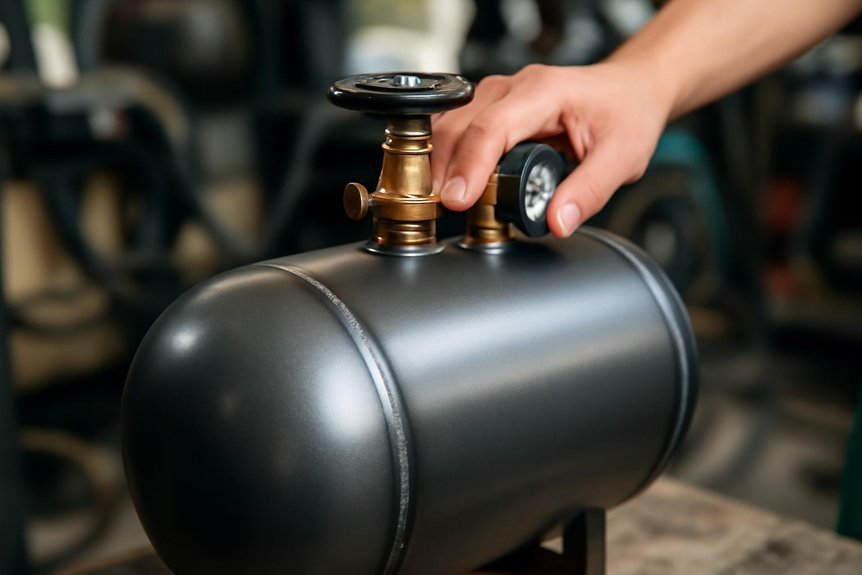
How does the size of an air compressor tank influence its overall performance? Larger tanks provide a greater air reserve, reducing the frequency of compressor cycles and minimizing wear on redundant components. This stability ensures consistent pressure delivery, which is essential for precise operations. Additionally, a bigger tank often contributes to noise reduction because the compressor runs less frequently and at lower speeds, decreasing vibration and sound emissions. Conversely, smaller tanks demand more frequent cycling, potentially increasing wear and noise levels. Consequently, selecting an appropriate tank size directly affects operational efficiency, longevity, and noise control. The ideal size balances capacity with the compressor’s power, ensuring smooth performance while mitigating issues like excessive noise or component fatigue.
What Materials Are Commonly Used for Compressor Tanks and Which Is Best?
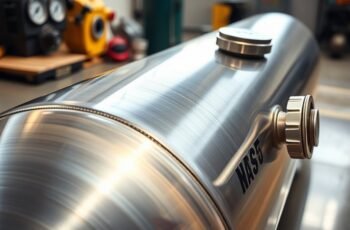
The choice of materials for compressor tanks considerably impacts their durability, safety, and overall performance. Commonly used materials include steel, aluminum, and composites, each offering distinct advantages. Steel tanks are robust, cost-effective, and widely used, but they are heavier and prone to corrosion without proper treatment. Aluminum tanks are lightweight and corrosion-resistant, ideal for portable applications, though typically more expensive. Composite tanks, made from fiberglass or carbon fiber, provide high strength-to-weight ratios and corrosion resistance but at a higher cost. The best option depends on application specifics; for heavy-duty, stationary use, steel is usually preferred. For portability and corrosion resistance, aluminum or composites are superior choices.
| Material | Strengths | Limitations |
|---|---|---|
| Steel | Durable, cost-effective | Heavy, corrosion-prone |
| Aluminum | Lightweight, corrosion-resistant | Higher cost |
| Composites | High strength-to-weight ratio | Most expensive |
How Do You Determine the Right Tank Capacity for Your Needs?
To determine the appropriate tank capacity, we start by evaluating the specific tools and equipment you’ll operate to ensure the compressor can meet their air demands. Next, we analyze your typical usage patterns to estimate the necessary volume for continuous operation without frequent cycling. Finally, we consider potential future needs to select a tank size that accommodates expansion without compromising efficiency.
Assess Your Tool Requirements
Determining the appropriate tank capacity requires a clear understanding of the tools you’ll operate and their air consumption rates. We analyze the specific power demands of each tool, considering peak and continuous usage. This assessment informs whether a larger tank is necessary to maintain consistent pressure or if a smaller tank suffices for intermittent tasks. Additionally, evaluating disposal methods and recycling options for the compressor components can influence capacity choices, as sustainable practices may require different equipment specifications. By quantifying your tools’ airflow needs and integrating environmental considerations, we can select a tank that optimizes performance while minimizing energy waste. This analytical approach ensures your compressor setup aligns with operational demands and sustainable disposal strategies.
Calculate Usage Frequency
Evaluating how often you’ll use your tools provides essential insight into selecting the appropriate tank capacity. By analyzing your usage frequency, you can determine the optimal tank size to meet demand without excessive cycling or downtime. Consider how many hours per day you operate the compressor and the intensity of each session. Additionally, a consistent maintenance schedule influences tank capacity needs, as infrequent use may allow for smaller tanks, while frequent use demands larger ones.
Key considerations include:
- Anticipating peak demand periods to prevent pressure drops.
- Balancing compressor cycling to reduce wear and extend lifespan.
- Aligning tank size with your maintenance schedule to ensure reliable operation.
A thorough understanding of your usage frequency enables precise, efficient selection, minimizing operational hiccups and optimizing performance.
Consider Future Expansion
Considering future expansion is essential when selecting an air compressor tank size because your current needs may evolve over time. Planning for future expansion involves evaluating potential workload increases and identifying upgrade pathways that accommodate higher demand. By selecting a slightly larger tank, you create flexibility for increased usage without immediate equipment replacement. This proactive approach minimizes downtime and reduces long-term costs, as it allows seamless scaling of your compressed air system. Analyzing projected growth and understanding the relationship between tank capacity and compressor output helps determine an optimal size that supports both current and future requirements. Incorporating these considerations ensures your investment remains viable, and your system adapts efficiently to operational changes over time.
What Features Should You Look for in a Durable Air Compressor Tank?
When selecting a durable air compressor tank, we focus on material strength, corrosion resistance, and safety features to ensure long-term reliability. These factors directly impact the tank’s ability to withstand pressure cycles and environmental exposure without failure. Evaluating these characteristics allows us to identify tanks that meet rigorous safety and durability standards.
Material Durability and Strength
How can you guarantee that an air compressor tank will withstand long-term use without failure? The key lies in assessing material durability and strength through rigorous durability testing and careful material sourcing. Strong materials, such as high-grade steel or aluminum, are essential to resist fatigue and structural compromise over time. During manufacturing, durability testing simulates operational stresses, ensuring the tank’s resilience. Material sourcing involves selecting reputable suppliers that meet strict quality standards, reducing the risk of internal flaws.
- Reliable tanks give you peace of mind, knowing they won’t fail unexpectedly.
- Proper material sourcing ensures consistent quality and performance.
- Durability testing validates the tank’s capacity to endure continuous use without compromise.
Corrosion and Rust Resistance
What features should we prioritize to ensure an air compressor tank resists corrosion and rust over its lifespan? Effective rust prevention hinges on selecting tanks with corrosion-resistant coatings or materials, such as galvanized steel or aluminum. These materials inherently offer higher corrosion resistance by forming protective oxide layers or resisting oxidation. Additionally, surface treatments like epoxy or powder coatings act as barriers, preventing moisture contact that leads to rust. Proper design considerations, such as seamless welding and corrosion-resistant fittings, further reduce vulnerabilities. Ensuring the tank’s internal environment remains dry and free of moisture also plays a critical role in rust prevention. Ultimately, prioritizing corrosion resistance through material choice and protective coatings extends the lifespan and maintains the structural integrity of the compressor tank.
Pressure and Safety Features
Are you aware of the critical safety features that guarantee your air compressor tank operates reliably under pressure? Ensuring proper pressure regulation and safety mechanisms is essential for durability and user safety. Look for tanks with robust pressure relief valves—these prevent dangerous over-pressurization. Safety shutdown systems automatically activate if internal pressure exceeds safe limits, protecting both the operator and equipment. Additionally, features like built-in airflow optimization components enhance efficiency while reducing noise, contributing to quieter operation.
- Reliable pressure relief valves for safety assurance
- Automatic safety shutdown systems for peace of mind
- Design elements that promote airflow optimization and noise reduction
How Does Pressure Rating Affect Tank Selection?
Pressure rating is a critical factor when selecting an air compressor tank, as it directly influences both safety and performance. A tank’s pressure rating determines the maximum safe working pressure, preventing over-pressurization and potential failures. Selecting a tank with an inadequate pressure rating can lead to unsafe conditions, even if the tank’s size or material seems appropriate. Conversely, choosing a tank with a higher-than-necessary pressure rating might involve unnecessary costs and tangential concerns, such as increased weight or size. While pressure rating doesn’t directly impact unrelated topics like tank shape or mounting orientation, it ensures the compressor operates within safe limits. Properly matching pressure ratings is essential for reliable operation and compliance with safety standards, making it a foundational consideration in tank selection.
What Are the Advantages of Vertical vs. Horizontal Tanks?
When choosing between vertical and horizontal tanks, understanding their core advantages can substantially influence installation efficiency and operational convenience. Vertical storage offers a compact design, making it ideal for tight spaces and optimizing vertical space utilization. This configuration often simplifies maintenance access and minimizes footprint. Conversely, horizontal tanks typically have a broader horizontal footprint, providing greater stability and easier integration into existing layouts. They also tend to facilitate more straightforward inspection and cleaning processes due to their accessibility.
Vertical tanks save space and simplify maintenance; horizontal tanks offer stability and easier cleaning.
- Maximize vertical space with vertical storage for efficient use of limited areas
- Ensure stability with horizontal tanks in open, flat environments
- Simplify maintenance through easier access and inspection points
How Important Is Portability and Space Consideration in Tank Choice?
How essential are portability and space considerations when selecting an air compressor tank? These factors directly impact operational flexibility and site layout efficiency. Portability considerations become critical in environments requiring frequent relocation or mobile setups, where lightweight, compact tanks facilitate easier transport without sacrificing capacity. Space optimization is equally vital, especially in confined workspaces; selecting tanks with appropriate dimensions prevents clutter and maximizes available overhead or floor space. The balance between tank size and spatial constraints influences overall workflow efficiency, safety, and equipment management. Ignoring these considerations can lead to operational inefficiencies and increased labor costs. Therefore, assessing both portability considerations and space optimization ensures the chosen tank aligns with functional demands and spatial limitations, enhancing overall system performance.
How Do Maintenance and Safety Features Influence Tank Longevity?
Maintenance and safety features play a essential role in extending the lifespan of an air compressor tank by preventing failure-inducing issues. Proper maintenance scheduling ensures timely inspections, reducing risks of corrosion, leaks, and pressure failures. Rust prevention measures, such as protective coatings and moisture control, directly impact tank durability by inhibiting corrosion that weakens structural integrity. Safety features like pressure relief valves and automatic shut-offs prevent over-pressurization, decreasing the likelihood of catastrophic failure. These measures not only preserve the tank’s operational capacity but also protect user safety.
- Regular inspections catch potential issues early, avoiding costly repairs
- Corrosion-resistant coatings safeguard against environmental damage
- Safety devices reduce catastrophic failure risks, ensuring long-term reliability
What Budget Considerations Should You Keep in Mind When Choosing a Tank?
Budget considerations substantially influence the selection of an air compressor tank, as initial costs, ongoing maintenance expenses, and potential repair costs must all be evaluated. When assessing budget, it’s essential to analyze the total cost of ownership, which parallels choosing equipment in unrelated niches like high-end audio systems or precision manufacturing. A higher upfront investment in a durable, high-quality tank often reduces long-term repair and replacement costs, enhancing operational efficiency. Conversely, opting for a cheaper model may lead to increased maintenance and potential failure, undermining productivity. We must also consider compatibility with existing systems and future scalability to avoid unnecessary expenses. Ultimately, aligning the budget with technical specifications ensures a reliable, cost-effective investment, vital for maintaining optimal performance in demanding environments.
Frequently Asked Questions
How Often Should I Perform Maintenance on My Air Compressor Tank?
We recommend performing maintenance on your air compressor tank every 3 to 6 months, depending on usage, to ensure safety and efficiency. Regular inspection provides repair reminders and prevents potential failures, optimizing performance and prolonging tank lifespan.
What Are the Signs That My Tank Needs Replacement or Repair?
Did you know 80% of compressor failures involve tank corrosion or pressure relief valve failure? We see these signs indicating your tank needs repair: rust, leaks, inconsistent pressure, or safety valve malfunctions. Address these promptly for safety.
Can I Upgrade My Existing Tank to Improve Performance?
Yes, we can upgrade our existing tank through options like increasing capacity or adding a refrigerated dryer, considerably impacting performance by reducing cycling and moisture, hence enhancing efficiency and prolonging compressor lifespan in our system.
How Do Environmental Conditions Affect Tank Durability?
Environmental aging significantly impacts tank durability, as exposure to moisture and temperature fluctuations can compromise corrosion resistance. We analyze these factors meticulously, ensuring optimal performance and longevity by selecting materials and coatings that withstand harsh conditions effectively.
Are There Specific Safety Standards or Certifications to Look For?
We recommend looking for safety certifications and compliance standards, such as ASME or OSHA, to ensure your air compressor tank adheres to essential safety protocols, reducing risk of failure and ensuring reliable, compliant operation in demanding environments.
Conclusion
In conclusion, selecting the right air compressor tank involves careful analysis of your tools’ air demands, space constraints, and safety features. Did you know that an undersized tank can increase compressor cycling by up to 50%, reducing efficiency and lifespan? By evaluating capacity, materials, and safety features, we ensure optimal performance and longevity. A strategic choice now can lead to significant cost savings and reliable operation over the compressor’s lifespan.