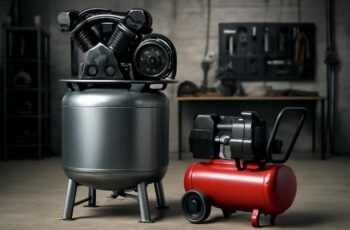
Did you know that the key difference between silent and standard air compressors often lies beneath their surface design? While silent models integrate soundproof enclosures, vibration dampening, and variable speed drives to reduce noise, standard units typically rely on open motors and basic cooling systems. These differences impact not only noise levels but also operational efficiency and maintenance. Understanding these nuances can profoundly influence your choice, especially when considering long-term performance and environment suitability.
Key Takeaways
- Silent compressors operate with soundproof enclosures and vibration dampening, significantly reducing noise compared to standard units.
- They often feature variable speed drives, improving energy efficiency and reducing operational costs.
- Silent models may have higher maintenance needs due to complex components and specialized parts.
- Standard compressors are typically less expensive upfront and easier to maintain but generate more noise.
- Choice depends on noise sensitivity, space constraints, maintenance capacity, and overall operational requirements.
How Do Silent and Standard Air Compressors Differ in Operation?
How do silent and standard air compressors differ in operation? The silent differences primarily lie in noise reduction mechanisms and motor design, impacting their standard operation. Silent compressors utilize soundproof enclosures and vibration dampening technology, which minimize noise generated during compression. This contrasts with standard units, where open motors and basic cooling systems contribute to higher noise levels. The core mechanical process—air intake, compression, and storage—remains similar, but silent models often feature variable speed drives that optimize power usage and reduce operational noise. Consequently, while both types perform equivalent compression functions, the silent compressor’s design prioritizes quieter operation without altering the fundamental compression cycle. This technical distinction makes silent compressors suitable for noise-sensitive environments, whereas standard models maintain straightforward operation with less emphasis on acoustic performance.
What Are the Main Advantages of Silent Air Compressors?
What makes silent air compressors stand out in various applications is their ability to deliver reliable performance with minimal noise disturbance. Their quiet operation is a significant advantage, especially in environments requiring concentration, such as medical or laboratory settings. Additionally, silent compressors tend to have lower maintenance costs due to fewer moving parts and reduced wear and tear on components. This translates to increased uptime and cost efficiency over the long term. The design often incorporates sound-dampening features that mitigate noise without compromising performance, making them suitable for confined or noise-sensitive spaces. Overall, their combination of quiet operation and reduced maintenance requirements offers a compelling solution for users seeking efficiency, durability, and minimal acoustic impact.
Are There Any Drawbacks to Using Silent Air Compressors?
Are silent air compressors truly free of drawbacks? While they excel in reducing noise levels, they aren’t without limitations. Their quieter operation often involves more complex components, which can lead to increased maintenance routines. These compressors may require specialized parts or materials, raising costs and complicating repairs. Additionally, their soundproof enclosures sometimes restrict airflow or heat dissipation, potentially affecting efficiency and longevity. Although the noise reduction is significant, users must weigh these factors against the benefits. Overall, silent air compressors offer notable advantages but demand careful consideration of maintenance routines and potential trade-offs in durability and operational complexity.
Which Factors Should You Consider When Choosing Between the Two?
When choosing between silent and standard air compressors, several critical factors must be carefully evaluated to make an informed decision. First, consider the importance of quiet operation; silent compressors significantly reduce noise levels, which benefits environments requiring minimal disruption. Next, analyze maintenance costs, as silent models often incorporate advanced components that may influence long-term expenses. Additionally, assess the compressor’s efficiency, durability, and suitability for your workload, since higher initial investments in silent units can be offset by lower operational costs. It’s essential to evaluate your space constraints and noise sensitivity, especially in shared or noise-sensitive environments. Overall, balancing these factors—quiet operation, maintenance costs, and functional requirements—ensures the selected compressor aligns with your operational needs and budget.
Is a Silent Air Compressor Right for Your Specific Needs?
Determining whether a silent air compressor suits your specific needs hinges on evaluating your operational environment and noise tolerance. If noise considerations are paramount—such as in healthcare, educational, or residential settings—silent compressors offer significant advantages. They facilitate quiet operation, enabling silent maintenance without disrupting nearby tasks or occupants. Conversely, in environments where noise is less critical, standard compressors may suffice, especially if cost or higher airflow capacity is a priority. Assessing your workflow’s sensitivity to sound and the importance of maintaining a low-noise environment helps determine suitability. Ultimately, the decision depends on balancing noise considerations with operational efficiency and maintenance requirements. Silent compressors excel in minimizing sound emissions, making them ideal for noise-sensitive applications, but may involve higher upfront investment.
Frequently Asked Questions
How Do Noise Levels Impact Workspace Safety?
We find noise levels critically impact workspace safety by influencing noise exposure, which can cause hearing loss and reduce alertness. Silent operation minimizes these risks, promoting a safer environment through decreased noise-induced stress and improved communication.
What Maintenance Differences Exist Between Silent and Standard Compressors?
We find that silent compressors require less routine maintenance, mainly due to fewer moving parts and quieter operation, which reduces wear and tear. While initial costs are higher, long-term maintenance saves money and minimizes operational disruptions.
Are Silent Compressors More Energy-Efficient?
Silent compressors generally demonstrate higher silent efficiency, reducing noise impact and often consuming less energy due to optimized motor design and insulation, making them more environmentally friendly and cost-effective over prolonged use, especially in noise-sensitive environments.
How Long Do Silent Compressors Typically Last?
Silent compressors typically last 8-10 years, thanks to their quiet operation and robust components. When considering cost comparison, their durability and lower maintenance needs often offset initial investments, making them a reliable, long-term choice.
Can Silent Compressors Handle Heavy-Duty Industrial Tasks?
Silent air compressors can handle heavy-duty industrial tasks if designed with high-capacity motors and durable components. However, their suitability depends on specific industrial use requirements, as standard compressors often outperform them in extreme-duty applications.
Conclusion
In weighing silent versus standard air compressors, we see a balancing act akin to tuning a finely crafted instrument—where noise reduction harmonizes with operational efficiency. Silent models, like a whispering breeze, excel in delicate environments but come at a cost of complexity. Ultimately, your decision hinges on evaluating your workspace’s acoustic needs, maintenance capacity, and budget, shaping a precise instrument tailored to your unique demands—an engineering symphony in the making.